Musings about the Ethics Committee November 17, 2025
Posted by Jill (@bonnjill) in ATA, Random musings.add a comment
I recently resigned from the ATA’s Ethics Committee. I have been a member of the Ethics Committee for many years, initially when Marian Greenfield was ATA President and then when Ted Wozniak was elected back during the Orlando conference. I was the Chair of the EC from November 2017 to November 2021. I was summarily replaced when the President appointed Robin Bonthrone as Chair and removed me without any notice or thanks. Robin had not served on the Ethics Committee beforehand and had a steep learning curve, and I stayed on the EC to train and support him. This procedure happened again recently, replacing Robin with Gio Lester, who also has not served on the EC and will now have a steep learning curve as well. While I stayed on the EC to train the newly appointed Chair, as far as I am aware this will not be the case this time.
This is not a good practice. As I explained in my final report to the Board back in October 2021, “I would like to inform future ATA Presidents that this position is not one that should be appointed outside the existing committee. The Chair makes decisions on what cases to accept and dismiss based on years of precedent, case histories, and detailed knowledge of the Code. That institutional knowledge is not there if the newly appointed Chair has not been a member of the committee in the past. I would like to suggest that the Chair be appointed from among the existing committee members next time. A personal phone call thanking me for my service instead of a terse email accepting my pro forma resignation would have also been nice.” Obviously this suggestion was not noted.
The Ethics Committee is a standing committee established by Article VII, Section 2 of the ATA Bylaws and is charged pursuant thereto with dealing “with problems affecting the relationship of translators and interpreters with their peers and others as provided in policies and procedures adopted by the Board”. Under the procedures adopted by the Board, the Ethics Committee is also charged specifically with responding to complaints of violations of the ATA Code of Ethics and Professional Practice (CEPP) or of Article III, Section 6, of the ATA Bylaws. The Code of Ethics has undergone minor changes, the last round being in 2017, but the Ethics Committee decided to do a major rewrite during the pandemic. We collected various Codes and compared them to get ideas. We then met on Zoom every other Friday for over a year and painstakingly debated the overall structure as well as individual words of the CEPP – and then we worked on the Procedures. We removed some old tenets and added several new ones (including a “conduct unbecoming” tenet) for three main reasons: 1) to bring the CEPP more in line with current codes of ethics and practice in the industry, 2) to update the CEPP to address issues related to modern practice and technology and 3) to close loopholes that have become evident when handling ethics complaints. Oh, the discussions we had over the words!
When I was replaced as Chair I suggested the Ethics Committee members be nominated for one of ATA’s awards for all of their hard work, but that never happened. The members of the EC were never formally thanked or acknowledged for our work, and our work on the Procedures was tabled in 2022 and has still not been resubmitted for approval. I believe this is where my disappointment with the ATA began. I have never been one to expect glory, but a little thanks is always appreciated. When Robert Sette and I ran our write-in campaign my objective was never to serve on the Board. I simply wanted people to discuss decoupling, and our campaign achieved that. I have been pulling away from the ATA for several years now and have not attended the conferences for the last three years after attending for twenty years straight. While there are several underlying reasons for this, lack of any show of appreciation for volunteer service certainly makes it hard to muster up the enthusiasm to attend. I have not decided if I will attend the 2026 conference, but I am still working as a translator so if I don’t have a Zoom class I may go just to say hi.
In any event, I would like to formally acknowledge and thank the following people for all of their hard work on our Zoom meetings:
Mike Collins
Jutta Diel-Dominique
Roxana Dinu
Michael Elliff
Kathryn German
Jennifer Guernsey
Natalie Higgins
Ana-Cecilia Rosado
Jill R. Sommer
Milena Calderari-Waldron
I am proud of our work and have a great respect for them. To quote Mike Collins, “it was a great honor and pleasure serving with you all – despite the headaches it is the thing I feel best about when it comes to service to ATA and the wider translation/interpretation community.” I miss our regular meetings, because we all got to know and respect each other very much.
My reason for this post is two-fold: 1) to thank my fellow EC members for their hard work rewriting the code and 2) to hope maybe the next officers see this post and at least think twice about how they replace volunteers. Thanks for your attention.
ATA benefit – Cosnautas subscription and an honest question September 13, 2024
Posted by Jill (@bonnjill) in ATA.add a comment
This sounds like an exciting benefit and I’m happy for the Medical Division members, but why German-Spanish and not German-English? Does anyone know? I know Spanish dominates the Medical Division, but I would assume English would be a given choice (but somehow it isn’t). I would assume it would be pretty easy to generate a German-English option given the technical capabilities, but I would hate to “assume” (and will all know the phrase “when you assume…”). Thanks for any insights.
The ATA Medical Division has partnered with Cosnautas, a top-notch medical terminology resource platform, to offer all of our members a FREE Cosnautas subscription until October 31st.
As a Medical Division member, you will have free access to all the incredible resources Cosnautas offers, including:
● English-Spanish dictionary
● English-French dictionary
● English-Portuguese dictionary
● German-Spanish dictionary
Please note that this benefit is only available for ATA Medical Division until October 31st, 2024.
Buddies and Newbies October 11, 2023
Posted by Jill (@bonnjill) in ATA, Random musings.add a comment
The ATA conference (ATA64) is in a couple weeks, from October 25-28, 2023, in Miami, Florida. I keep getting emails advertising various events, even though I’m not attending this year. Today’s email was all about Networking, and one of the events is Buddies and Newbies. I used to offer a session on tips for first-time attendees every year, which got replaced by Buddies and Newbies. It really is a great opportunity for first-time attendees to pair up with a seasoned conference attendee and get some tips and meet some people so they aren’t overwhelmed walking into the Welcome Event. Newbies and Buddies go to one session and one meal together so that Newbies can ask questions and Buddies can offer personalized advice. Newbies receive extra support as they navigate the sessions and events, while Buddies are rewarded knowing they made someone feel welcome at their first conference. Who knows, you might even make a life-long friend like I did. I attended my newbie’s wedding in Minneapolis two weekends ago. I met Joe 10 years ago at ATA54 in San Antonio, and we became fast friends. He was one of my lifelines during the pandemic, playing online games and attending my virtual cocktail hours. So if you are attending the conference for the first time—or even the 11th time—be sure to attend the Buddies and Newbies event right before the Welcome Event. You never know who you might meet.
BDÜ call to action – why can’t the ATA act like this on our behalf???? August 10, 2023
Posted by Jill (@bonnjill) in ATA, Business practices.6 comments
I don’t know about you, but I am getting sick of the ATA just lying down and taking it when it comes to machine translation and post-editing. They should have been fighting this for years – not embracing or accepting it. I have spent 25 years watching the translation industry change for the worse, and I am sick of it. I am tired of having to fight this on my own at the individual level. We should have never had to! My former best client is now using MTPE on jobs that used to earn me thousands of dollars. They are paying $50-100 instead – and probably not earning much more than that themselves. The base word rates haven’t changed in 25 years and now they are whittling away at them again. Calculate the rates in terms of hourly rates, and you’ll see that it now often pays better to clean houses than to translate. That’s b.s. In a few years I hope the industry enjoys not having any competent translators left who have any self-respect once all this “technology” shows its true colors and the players stop gobbling each other up. I for one am looking at leaving and switching careers to another track altogether.
From the July newsletter of BDÜ (translation below):
Zunehmender Preisdruck durch „kreative“ Abrechnungsmethoden
Mit wachsender Sorge und Missfallen beobachtet der BDÜ neue und „kreative“ Abrechnungsmethoden seitens Agenturkunden, mit denen diese versuchen, alle Vorteile der Nutzung sämtlicher verfügbarer Übersetzungstools (inklusive CAT und NMÜ) für sich zu beanspruchen. Nach der – einseitigen – Veränderung der Wortgewichtungen zu Ungunsten der Übersetzer oder auch Einbeziehung von internen Fuzzy Matches in diese Abrechnung taucht nun eine sogenannte „dynamische Abrechnung“ auf, bei der MTPE-Jobs (Machine Translation Post Editing) zwar im Vorfeld mit einem bestimmten Volumen beauftragt werden, die finale Honorarhöhe jedoch erst nachträglich nach der Anzahl der tatsächlich bearbeiteten Wörter ermittelt wird. Auf diese Weise werden Honorare nicht nur für Übersetzer unkalkulierbar, sondern völlig unauskömmlich, sofern die gleichen Wort-Tarife angesetzt werden wie für herkömmliches MTPE.
Der BDÜ lässt derzeit die Rechtmäßigkeit solcher nachträglichen Absenkungen juristisch überprüfen und bringt die Problematik auch auf europäischer Ebene bei FIT Europe (Regionalzentrum des Weltdachverbands Fédération Internationale des Traducteurs) für eine mögliches gemeinsames Vorgehen ein. Alle, denen ähnliches Gebaren seitens Agenturkunden begegnet, sind aufgerufen, entsprechende Beispiele als Grundlage für weitergehende Aktionen an den BDÜ-Bundesvorstand zu kommunizieren (bundesvorstand@bdue.de).
Translation:
Increasing pressure on prices due to “creative” billing methods
The BDÜ has been observing with growing concern and displeasure the new and “creative” billing methods on the part of agency clients, with which they are trying to claim all of the benefits of using all of the available translation tools (including computer-assisted tools (CAT) and machine translation post-editing (MTPE) for themselves. After the – unilateral – change in word weightings to the disadvantage of the translators or also the inclusion of internal fuzzy matches in this accounting, they are now introducing a so-called “dynamic accounting” in which MTPE jobs are ordered in advance with a certain volume, but they then determine the final fee amount afterwards based on the number of words that were actually edited. In this way, fees become not only incalculable for translators, but also completely unaffordable if the same word rates are applied as for conventional MTPE.
The BDÜ is currently looking into the legality of these retroactive reductions and is also raising the issue at European level with FIT Europe (the European branch of the Fédération Internationale des Traducteurs) for possible joint action. The BDÜ is calling on anyone who encounters similar behavior from their agency clients to communicate any examples of this to the Federal Executive Board of BDÜ as a basis for further action. (bundesvorstand@bdue.de).
Petition June 22, 2020
Posted by Jill (@bonnjill) in ATA.2 comments
If you are a voting member of ATA my colleagues and I respectfully ask you to consider signing and submitting this petition by June 24 (that’s tomorrow) so that a Bylaws amendment to ensure voter choice will be presented for a vote at the 2020 ATA Elections.
I spoke with a former president about this very subject on Thursday, so I was able to gain some insight as to why ATA does what it does. [S/he] said they don’t want to have to put up a “straw man” when they already have a good candidate in mind for the position. That doesn’t sound very democratic to me. In order for an organization to be strong there should be an active exchange of opinions – even and especially opinions that aren’t unanimous. [S/he] didn’t want anyone’s feelings to get hurt and have them decide not to run again. It’s business, folks; it’s not personal. When Bob and I weren’t elected last year I didn’t let it get me down. That isn’t why I’m not running this year. I (and several others) put my nomination in this year, and it wasn’t accepted. I then decided to stay off the board and be a loud, pain-in-the-ass, squeaky wheel instead. If someone chooses to run for office in a contested election there will always be a winner and a loser. Maybe people didn’t know them. Maybe their speech didn’t match what people wanted for a representative. It doesn’t mean that they shouldn’t try again in the future.
ATA’s Bylaws allow competitive elections for President-elect as well as the other officers (Secretary and Treasurer). After Bob and I got over 100 votes each as write-in candidates, we sat in on the board meetings on Saturday and Sunday and witnessed the debate and the Board, at the Nominating Committee’s request, subsequently voting to eliminate the NC’s obligation to put forward multiple qualified members as nominees. There was quite a bit of confusion surrounding this vote, in fact.
Let’s clarify it for them. If you feel the Board should be working for its own members’ best interests, we need a vote to add a Bylaws amendment to ensure voter choice will be presented for a vote at the 2020 ATA Elections. Signing the petition will take two minutes at the most. Once you are finished please send the signed petition to atapetition@gmail.com. This ensures it will at least be put to a vote, as it should be.
Campaign statement for write-in as Director October 14, 2019
Posted by Jill (@bonnjill) in ATA.comments closed
 For those who don’t know me, this should serve as a brief introduction. My name is Jill R. Sommer, and I am running as a write-in candidate for the ATA Board of Directors. I have been a full-time freelance German>English translator since 1995. I hold a dual BA in German and Russian from Bowling Green State University and an MA in German translation from Kent State University. I was on the board of the Northeast Ohio Translators Association from 2001 to 2017, with 15 of those years as Chapter President. I have been active in the German Language Division and Medical Divisions, was a moderator of the Business Practices listserv, and am on the ATA’s Ethics Committee, where I am currently serving as Chair.
As an active member of ATA since 2002 I have a long history of volunteering for the Association. I have always said I would rather be a squeaky wheel outside the Board, but I feel the time has come for me to be a squeaky wheel on the Board.
I feel that the recent ATA board decision to decouple certification from membership is a core issue that goes against the Bylaws, and to implement such a change requires a bylaws amendment vote by the voting members. I think critical issues such as declining membership or decoupling or even thoughts on continuing education should more frequently be put to the members. Individual translator and interpreter members are the heart of the ATA, and I see my role on the Board being to speak for those members.
I will work to promote greater diversity of educational opportunities, such as smaller, more specialized conferences being offered. Through smaller, regional seminars, we can make many valuable connections with colleagues that are more difficult to make at the annual conference. Such smaller events can also be more affordable and can draw in a diverse range of members.
Robert Sette and I have been conducting a write-in campaign for the ATA Board, for the following positions:
For President-elect (2-year term): Robert Sette
For Director (3-year term): Jill R. Sommer

Robert and I respectfully ask for your support and your vote. If elected, we will work with determination on behalf of the membership’s right to have a fair debate on decoupling with the views of both sides presented. This is the only fair option, given that the ultimate decision—on the part of the membership—will truly shape the future of our association.
Guest post by Robert Sette: In reply to Dr. Koby October 6, 2019
Posted by Jill (@bonnjill) in ATA.1 comment so far
[Note from Jill: I turned this into a blog post because Robert wanted to include a graphic in his reply to Dr. Koby’s comment. This just seemed like the easier way.]
This is a reply to Professor Geoff Koby of Kent State University, specifically to his comments on this blog:
Professor Koby,
I accurately stated at the Denver Board meeting on August 3, 2019 that “5 of us [are] driving this petition movement”. At that time, ATA was in possession of 35+ signed member petitions, including those signed Chapter Presidents, current and former committee chairs and certification graders as well as former Board members other than myself. Also two former Certification Committee chairs were among the petitioners.
As you are aware, this petition effort had been rejected while in process because it failed to meet a deadline contained in a policy that had not been published since its approval 3 years earlier. Said policy was not available in the “Policies” section of the ATA website, nor was it able to be found by a reasonable keyword search (only by the name of the policy, which had nothing to do with “bylaws amendments”. Further, the submission form referenced in that policy had never been prepared by ATA, and it took over a week for me to subsequently obtain it. When I did, it was time stamped 20 minutes before being sent by the Chair of the Governance Committee, who when I asked later, said, “I knew you would see that and I meant to change that date before sending it to you.” He also said, “Well we wouldn’t reject your petition because you didn’t have the form.” But our petition was rejected because of a procedural, purely arbitrary, deadline that was never published, and not available on the website. So does the Board enforce its policies or does it not?)
Back to our petition: We requested a waiver of the 120 day deadline, which was denied, and we were instead told by President Corinne McKay that “[the Board had] decided to hold a referendum on the decision to open the certification exam to non-members. This will appear as a referendum question on this year’s ballot, and all voting members will be able to vote on it.” (see email screen cap below).

And so we stood down. But there had been no Board decision to hold a referendum. We were given false information (i.e. lied to) ostensibly to get us to stop our efforts, at a time when a bylaws amendment vote or a referendum still could have taken place quite easily. You were vocal at the following Board meeting with your opinion to forge ahead with decoupling, without regard for the consequences to the ATA.
As you will see soon, many people have disagreed with this decision over the years. Frequent dissent has been brought up on ATATalk. Member-driven bylaws amendments to protect our credential were submitted in 2003, 2006 and 2009 to Headquarters (though none of them were beneficiaries of the reach of social media, so they only obtained around 35 signatures each time. For the record, neither I nor the other drivers of current efforts were involved in those petition efforts). This shows that HQ was aware of opposition, and current leadership should also have been aware of it.
My guess, and it is an educated guess, is that the Board knew they would and do now face a huge uphill battle to have the membership approve a bylaws amendment allowing decoupling. So the board has hidden for years behind the word “policy”, and now “ambiguous” in reference to the bylaws.
Lastly, you say that this matter is on the agenda for the upcoming Board meeting, but there has been no real discussion of a vote so far. This one-sided “information” campaign does not fool us. The debate cannot be one-sided, and I dare to say that the approach employed so far has tainted the process. Any debate and discussion of this decoupling issue must be balanced, fair, and, dare I say, bipartisan. Otherwise, it violates the fiduciary duty of ATA Board members to represent the whole of the membership.
Unless true freelancers who represent a diversity of opinion are elected to the Board at Palm Springs, dissenting opinions will continue to be ignored and quashed.
Robert Sette, CT
Full-time freelance translator
Write-in candidate for ATA President-elect
Co-founder of ATA Members Voice (on Facebook)
@ATAmembers #ATAmembers
Decoupling and the ATA October 1, 2019
Posted by Jill (@bonnjill) in ATA.1 comment so far
 Twenty years ago the ATA hired a consultant, Michael Hamm, former executive director of the National Organization for Competency Assurance and the principal of Michael Hamm & Associates, to “[review] and [evaluate] ATA’s accreditation program and [provide] the association’s leadership and members at large with a number of valuable insights. The purpose of what came to be known as the “Hamm Report” was to point the way toward strengthening the program and improving the benefits of accreditation… Michael Hamm observes that while most credentialing efforts are initially developed to meet the needs of the members, the most effective ones are not tied to any membership criteria for participation, since competence and quality have nothing to do with the payment of dues to an association. The credibility of the credentialing effort is enhanced if it is viewed as a service to the wider public rather than a service to members. The move from a membership-based to a freestanding credential is a significant one in the evolution of any voluntary certification program.” Stejskal, J., “International Certification Study: ATA’s Credential,” ATA Chronicle 32, no. 7 (July 2003), p. 14, available at http://www.atanet.org/chronicle-online/wp-content/uploads/2003-July.pdf.
See also Hamm, M.S., “An Executive Summary: Review of the ATA Certification Program,” available at http://www.atanet.org/bin/view.pl/24113.html.
Twenty years later questions have arisen that probably should have been asked over the last twenty years. In his report on the ATA certification program Mr. Hamm wrote:
“Most certification programs have moved away from association membership requirements because no one has ever demonstrated a strong relationship between paying dues to any organization and professional competence.”
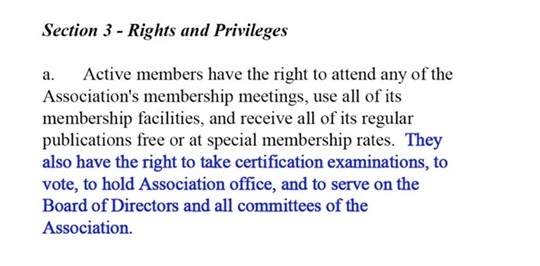
Many changes have been made in the ATA, such as recruiting active/voting members who are not certified (I was one of the first – and paid for the Peer Review) and making member benefits and rights such as the ATA Conference and Certification Program self-sustaining (which led to higher fees all around), leading up to this final act of decoupling. The problem is that the ATA Bylaws specify certification as a “right of membership.” Changing this requires a Bylaws amendment by membership vote. Robert Sette is one of a number of members asking the ATA Board to put it to a vote of the voting members. He responded to the above quote:
“Most”? In 2000? So why can’t we find them today? In an admittedly brief search, I saw a regional association of speech therapists in Australia that offered its certification to non-members. That was the only one I found.
If this is a “trend” as Hamm said elsewhere in his report, why do we not now, 20 years later, see more non-member certification programs in a wide variety of fields?
I contend that this was flat-out an inaccurate, false statement. And it has served as the basis for the ATA to waste volunteer time and member funds for much of the past 20 years.
The ATA Bylaws require an amendment in order to decouple certification (exam & credential) from membership. ATA has steadfastly refused for 20+ years to seek such an amendment, so we are working to demand a voice in this decision for the voting membership of the Association before decoupling occurs.
In fact, one ATA member pointed out that NAJIT implemented a decoupled exam and it was unable to sustain itself and failed, after 33 people became certified in approximately 10 years.
Robert made a couple other points that are worth noting:
Just a thought or two on the ATA certification credential:
a) ATA certification already is the gold standard. The CT credential, along with MITI and DipTrans, are the 3 most prestigious credentials in the translation industry.
b) It is a voluntary credential, not a license. As such, a membership fee associated with maintaining the credential is logical. Why should non-members ostensibly benefit from the expense of promoting the CT mark while not contributing financially to that promotion?
Paula Gordon also did a great job explaining her thoughts on decoupling back in 2017 in a blog post entitled Why I Will Vote Against ATA’s Bylaws Amendments. It was about an amendment to the Bylaws expanding voting rights, but she rightly ties it into decoupling. Be sure to click on the link and check it out.
As for me, Jill R. Sommer: I feel it will harm the association as a whole. I know several members who have already left ATA because they feel it does not fully represent the members’ interests. President-Elect and incoming President Ted Wozniak has told me the Board does not feel they will lose many members as a result of the change, but I am not sure they can estimate the ramifications – especially since people have already left the association because of it. Additionally, many members are feeling ongoing frustration at ATA leadership’s refusal to allow a member vote on the matter. A vote is proper, just, and overdue.
Also, as head of the Ethics Committee this does affect me in that the Ethics Committee would really not have much power to sanction misbehaving non-members. Sure, we can yank their certification, but I already know of one or two members who continue[d] to claim they are certified (until they received our cease and desist letter). As NOTA President, I would sometimes go on Proz and try to police the people claiming NOTA membership when they lived in other countries. And I only had 100 member names to go through. It is hard to patrol an association of 10,000+ members. Yes, members submit complaints, but at the moment we cannot sanction non-members and have to dismiss the complaint. We are a committee of 10 volunteers just trying to pay our rent while help the association out.
In conclusion, forging ahead without a vote, continuing to tell us—educated, well-informed members—that ATA leadership alone knows what is right for the Association and needs to “inform” us, will do nothing but tear the Association apart, causing further decline of membership numbers and even less respect for the actions of the ATA Board.
If you would like to be part of the ongoing discussion on decoupling and calling for a vote, consider joining https://www.facebook.com/groups/atamembersvoice/
Guest post: Write-in candidates for ATA President-Elect and Director September 22, 2019
Posted by Jill (@bonnjill) in ATA.22 comments
Dear ATA colleagues,
As many of you are aware, a group of us have been quite vocal about the issue of decoupling, specifically regarding the ATA Board diluting a membership right that is clearly granted in the Bylaws. Although the Board has agreed to postpone the effective date of decoupling until January 1, 2021, they have not formally agreed to seek membership approval in the form of a Bylaws amendment. We have attempted to dialog with the Board and have been rebuffed through various means, including being told that we had 6 years to bring this issue up, and that we were “too late”.
As a result, I am pleased to ask your support for Jill R. Sommer and I running as write-in candidates for the following positions:
President-elect: Robert Sette
Director (3-year term): Jill R. Sommer
The prime concern we have is to ensure that the voice of members is heard. You may have received messages before prior Board meetings saying “We are listening”. I guarantee you that if we are elected, we will hear your concerns, and our hearing will not be selective.
Our “platform” covers the following:
-
- Membership vote on decoupling: We support holding a Bylaws amendment vote as a prerequisite for opening the ATA certification exam to non-members, as well as an assurance that no member funds will be used to support non-members taking the exam.
- Consideration of member input and dissenting views: The Board has rebuffed member input on significant issues and has squelched dissenting views. Though policies and procedures are important, if they are to be enforced, they need to be communicated in a timely and effective manner.
- Continued inclusion of interpreters: We are a diverse association in terms of the languages we all work with, as well as the segments of the industry in which we work. Full-time interpreters, full-time translators, and all gradations in between deserve a voice in ATA affairs.
- We support more transparent, useful and timely information being provided to the membership. There is no reason that members should wait 3+ months for approval of the meeting minutes to learn factual information on action taken at ATA Board meetings. As a corollary, the policies according to which the Board operates should be easily available to the membership, notwithstanding confidentiality issues.
- Reform of the nominations process: We support the very recent Board action supporting multiple candidates for each elected office of the association. Diversity of views and “new blood” is very important in all director and officer positions, to avoid the leadership being monolithic (re: languages, policy positions, segment of the T&I industry, etc.).
- While this is not really a “plank” of our platform, Jill and I are both full-time freelancers, like a majority of our association.
In conclusion, I respectfully ask for your support for Jill and I for the specified positions. We are both available to answer any questions you may have.
Best regards,
Robert Sette, CT
Scam alert: Wayne Needs You August 27, 2019
Posted by Jill (@bonnjill) in ATA, Scam alert.1 comment so far
SCAM ALERT!!!!!
I just received the following email from the ATA domain (atanet.org). I immediately reached out to Mary David at Headquarters, and she let me know that it is NOT from ATA.
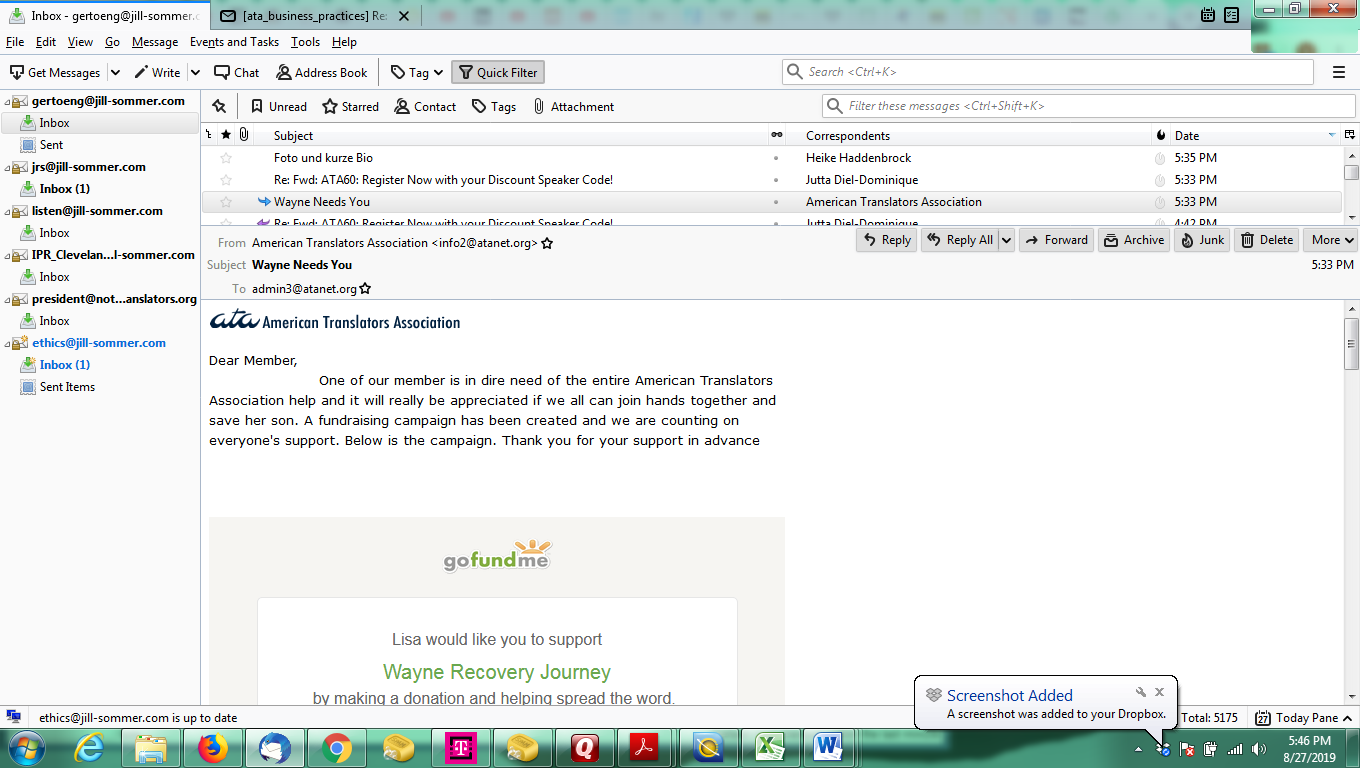
DO NOT DONATE!
Clues that it is a scam:
* ATA has not and will never send out fundraiser requests.
* Most GoFundMe requests take you to the GoFundMe page and not directly to Paypal.
* If you search the GoFundMe site the page does not exist.


 Musings from an overworked translator