Call for ATA Annual Conference Presentation Proposals February 17, 2012
Posted by Jill (@bonnjill) in ATA.add a comment
Better late than never. I had a computer virus that has had me out of commission for the last week. I am finally able to check my mailing list e-mails and am catching up… Once again I am at a loss on an interesting topic to present, so if anyone has a suggestion I am all ears.
The American Translators Association is now accepting presentation proposals for ATA’s 53rd Annual Conference in San Diego, California (October 24-27, 2012).
More than 1,800 translators, interpreters, educators, language services companies, and project managers are expected to attend this year’s Conference. Making a presentation to such a diverse audience is an excellent strategy to gain widespread recognition as a leader and expert in your field.
Speaking at an ATA Annual Conference is also a challenging and rewarding opportunity. A competitive peer-review process,with an emphasis on relevant topics in the translation and interpreting communities, is used to select presentations. The prestige of being accepted–as well as a discount on conference registration fees–is an unbeatable benefit of presenting.
Submissions are invited from all areas of translation and interpreting, including finance, law, medicine, literature, media, science and technology, terminology, independent contracting, business management, and training/pedagogy. Sessions may be language specific or general.
Click https://www.atanet.org/conferencesandseminars/proposal.php to learn more about the proposal process and to access the proposal form.
The deadline for submitting a presentation proposal is March 12, 2012.
Theft at conferences November 10, 2011
Posted by Jill (@bonnjill) in ATA, Business practices, Random musings.3 comments
This post deals with several recent experiences I learned about that occurred at the latest ATA conference, but it can apply to conferences in general. When people are at a conference they tend to act as if they are in a bubble and nothing bad can happen. This is not the case. One should behave at a conference in the same way as one would in a foreign country or even at home – with some caution.
One member of the Business Practices listserv was furious when her computer bag was stolen out of the room where the listserv was holding a happy hour. She had placed it on the floor next to the bartender station. After reporting the theft to hotel security, they found it 15 minutes later “on the 3rd floor, in an empty closed room, with all the zippers opened, conference materials left alone but [the] laptop was gone.” She was then upset with the way the hotel handled the situation because they would not give her the incident report because it was “confidential Marriott property,” claimed they did not have security cameras (although they initially told her they would check the cameras) and did not report the incident to the police. She felt the Marriott was covering the incident up and asked people to contact her if they saw any suspicious activity.
OK, first of all, shame on her for leaving her bag unattended. I always remind the first-time conference attendees to be aware of their valuables and to look back when they leave their seat, room, etc. to make sure they have not left anything behind. I never let my laptop or purse out of my sight – or in fact out of my hands or off my shoulder. I would never in a million years leave it unattended next to a bartender station or anywhere else. The fact is that hotels in general are public locations, and anyone can come in off the street and blend into the crowd. Hotels warn theirs guests to protect valuables from hotel thieves by using the room safe and hiding expensive clothes under casual clothes. Why wouldn’t one think that an open room in a hotel bar would be fair game to thieves? Secondly, the hotel has a right to be skeptical of claims of theft, no matter how indignant the guest is. According to an online article entitled Protecting Valuables From Hotel Thieves, “[i]tems reported stolen from hotel rooms frequently turn up in the guest’s possession. And there is the not-uncommon possibility that the guest’s claim may be fraudulent.” I’m sure this was not the case here, but it helps to put yourself in the hotel’s shoes.
And may I remind my fellow conference attendees once again not to wear their conference name badges outside the hotel?!?! I can’t tell you how many people I saw walking outside or in the adjacent shopping malls wearing their conference name badges. Luckily the neighborhood was safe (unlike the neighborhood in Atlanta in 2002). If you are wearing your conference badge outside the hotel you might as well be carrying a sign saying “Hey, I’m a tourist. Please feel free to rob me.”
Finally, I was very upset to hear that one of our members had all her resumes, business cards and the plastic stand deliberately stolen/removed from the German table in the Job Marketplace. She went to get a copy of her resume for a potential client on Friday late afternoon or early evening, and it was nowhere to be found. How could someone do such a thing to a colleague? No matter how you feel about a person, you don’t do something like this and mess with their ability to work. I find this behavior childish and unprofessional. Whoever did this, shame on you!
I would like to conclude by saying that the ATA staff does a great job organizing these conferences for us, but one should never expect them to police the attendees’ behavior. It is up to us to act professional and be mindful of our surroundings.
ATA Conference Overview October 31, 2011
Posted by Jill (@bonnjill) in ATA, Random musings.12 comments

The attendees came from all over
I am back home after a very successful ATA conference – a little worn out but full of ideas. It was a little dicey for a while, since Boston was hit with a Nor’easter on Saturday night, and many flights were delayed and/or cancelled. Luckily my flight was Sunday evening, so apart from the plane being full my return home was uneventful. Some of my colleagues were not as lucky.
The American Translators Association met this year in Boston for its 52nd annual conference. This year they unveiled a new tagline – The Voice of Interpreters and Translators. Interpreters have been complaining for years that they didn’t have a voice in the ATA, which I don’t think was necessarily true but what do I know since I’m not an interpreter. I hope the addition of this tagline changes that, and this is the last we hear of it.
I found it to be a very fulfilling  conference. Everyone was very pleased with the GLD’s Distinguished Speakers. Craig Morris (a regular reader of this blog and a blogger in his own right (Always Greener – Notes from the other side)) held two sessions on renewable energy, and Jan-Philipp Sendker offered sessions on editing and a bilingual reading and discussion of his work. The photo to the right is of Craig during his entertaining and interesting preconference seminar. I thought the best session was Corinne McKay, Judy Jenner and Chris Durban’s Smart Business Panel. They had a lot of good advice, and the ballroom was packed with attendees to hear that advice (no small feat for the last session on the last day of the conference, which is traditionally less attended since most people have already started heading home). The best advice I heard and one that I hope everyone can take to heart is to stop complaining about low rates/bad clients, etc. and just focus on improving your own bottom line by ignoring the bad and focusing on the good.
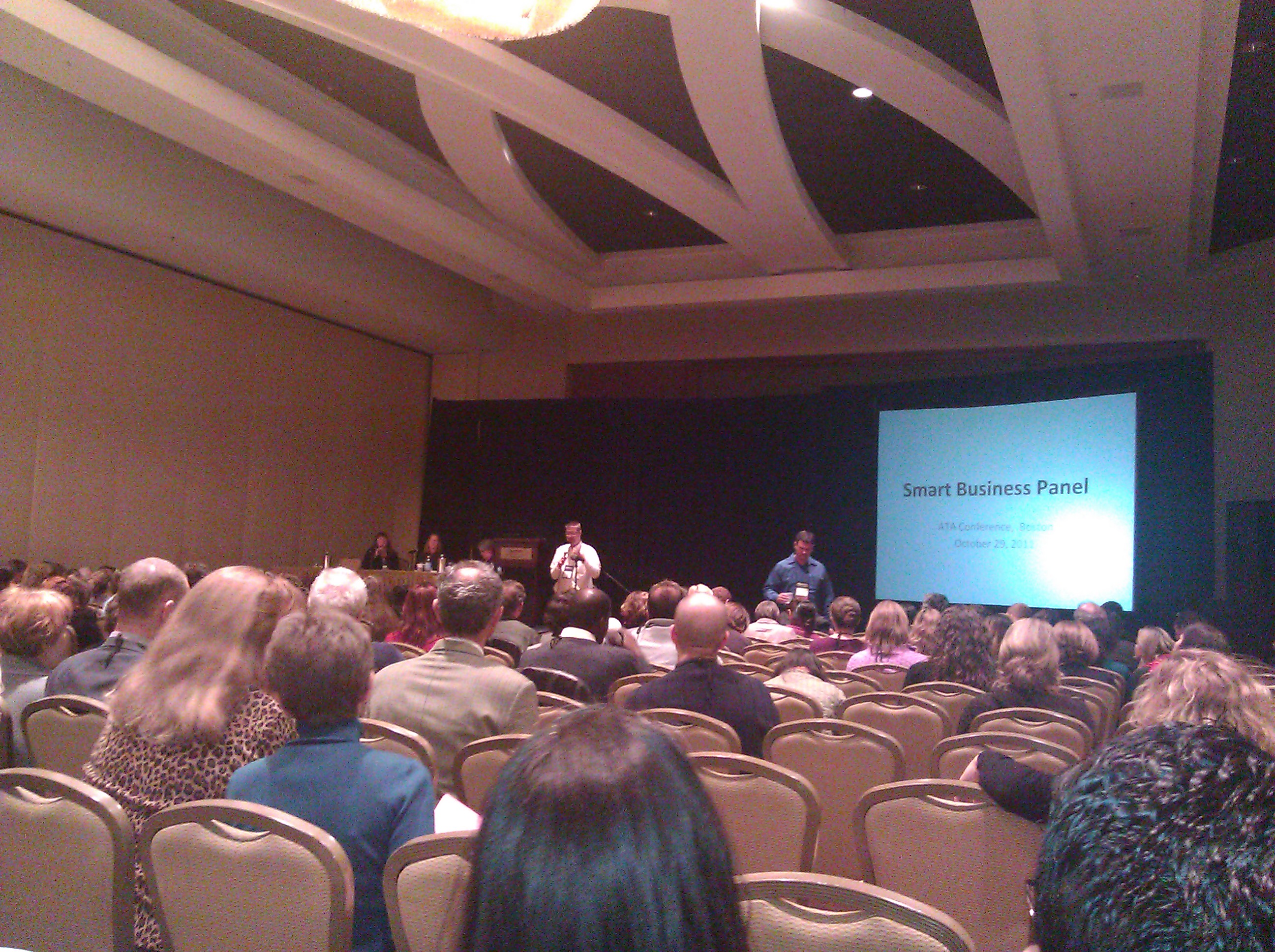
Corinne, Judy, Chris (with Jost Zetzsche keeping things lively as the moderator)
I spent more time than I usually do in the Exhibit Hall and really enjoyed myself – getting a free chair massage every day, visiting clients, checking out the various tools and reconnecting with the FBI. I may or may not decide to work with them again, but my old boss has done a good job of convincing me to think about it.
I attended several Tools Tutorials this year too, and Eve Bodeux and I have made a pact to finally install Fluency (we both bought it last year and haven’t gotten around to using it). Every time I see it being used I am impressed. Let’s see how it fares in real life use…
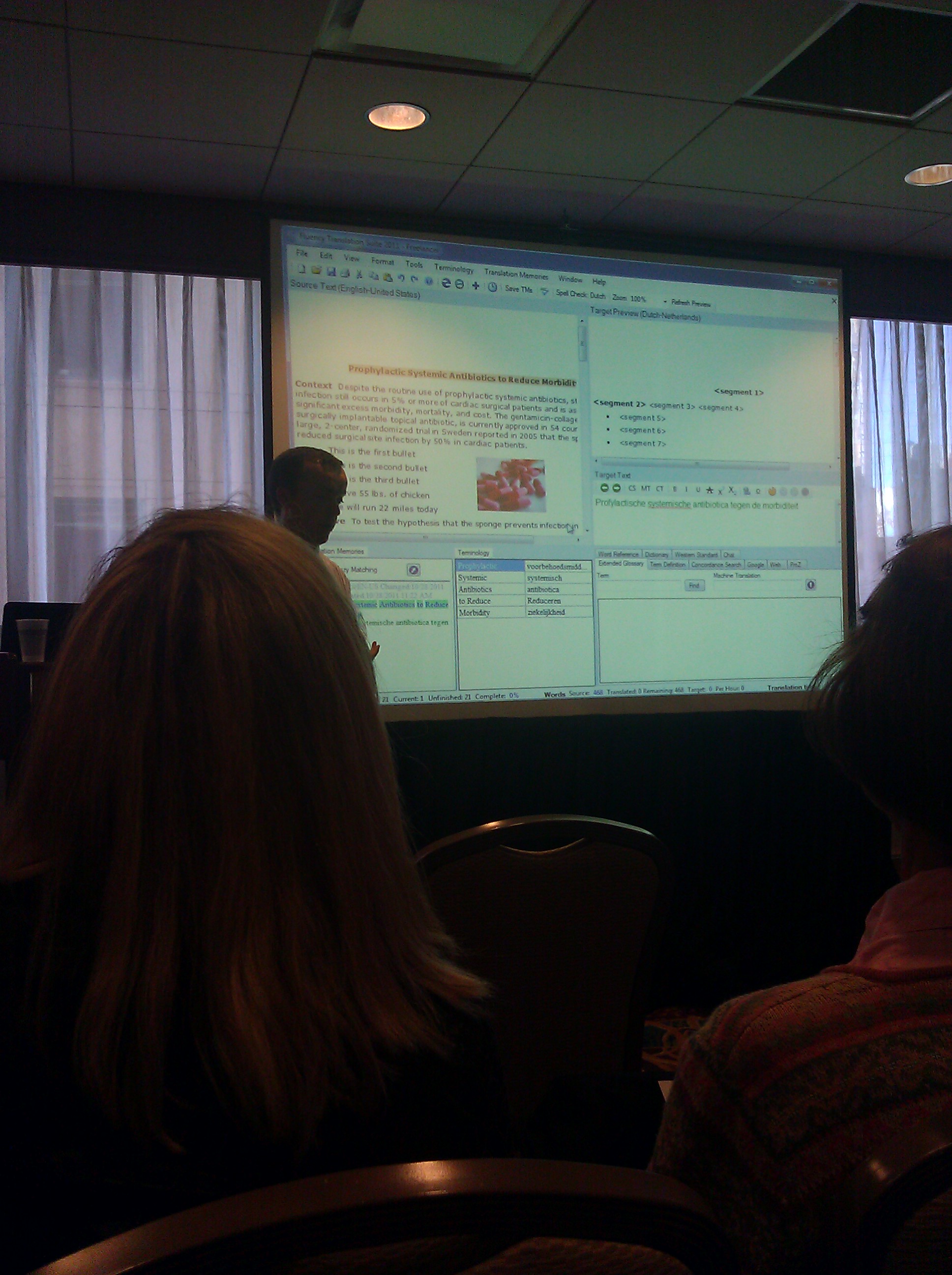
The Fluency Tutorial
I also intend to help the Language Technology Division reach out to its less technically-savvy members by writing some blog posts about how to effectively use some tools and republishing them in the LTD newsletter or website (or even the ATA Chronicle). There are a lot of people who aren’t as technically curious as I am, so I hope to help them even if just a little bit. My first planned post is how to format effectively in Word.
And of course I enjoyed many lovely meals and get-togethers with my friends and colleagues. The Welcome Reception did not have enough seating options, so several of us sat on the floor in a corner of the ballroom to enjoy the lovely turkey, cranberry sauce and stuffing that was served. I also wasn’t too pleased with the Division Reception format (but again, this was because the hotel lacked the facilities). It also seemed too rushed this year. An hour simply isn’t enough time, and the tables did not offer an intimate setting among colleagues. I preferred last year’s format of separate rooms much more. It was easier to talk and hear each other. Also, unfortunately for many of us, the Business Practices Happy Hour was held at the same time as the German Language Division Reception, so I had to choose one. Hey, it happens 🙂 . The GLD was invited to the Goethe Institute, and it was nice to enjoy a glass or two of (free) wine with colleagues. Over the course of the week I was able to enjoy many nice meals – including two lobster dinners and one lobster roll, and for that I am truly thankful.

Questions from my ATA webinar September 16, 2011
Posted by Jill (@bonnjill) in ATA, Business practices.7 comments
I gave a webinar on Tuesday on Tips for Navigating Your First ATA Conference. The recorded broadcast is now available for free online on the ATA webinar page.
I promised to post answers to the questions on my blog. Naomi did a good job answering some of them during the webinar itself. I was going to post the ones I hadn’t answered, but I feel some of these questions might help others as well so here are all the questions.
Q: Any special tips for attendees that will also be doing the certification exam?
A: Do not stay out late the night before. Make sure you do not eat anything you are not accustomed to eating the night before. I am pretty sure there is a session on preparing for the ATA certification exam on Thursday or Friday. Check the final program. [Me: Be sure to take the ATA practice test. I would even go so far as to recommend you not take the exam at the conference, because the conference can be tiring and you should be at your best when you take the exam.]
Q: On the cards/résumé, should I indicate that I’m only an associate ATA member?
A: Most people have no idea what the different ATA membership classes mean. They only understand the difference between ATA members and ATA certified translators. I would suggest you just say ATA member.
Q: How many business cards, resumés should I bring along?
A: She said 100 resumes per language combination.
Q: Does the roommate blog also work for looking for people staying in nearby hotels?
A: I don’t see why not. The roommate referral blog is there to help people find roommates. ATA will not remove your posting if you are looking for a roommate in another hotel.
Q: Is there a desk to check in valuables such as laptops?
A: It would be a hotel thing. ATA does not have anything.
Q: How much are tips on average in Boston (for example, for massages)?
A: I usually slip the massage therapists between $3-5 for each massage, unless they were absolutely wonderful and I feel the need to give them more. The chair massages are usually about 10 minutes long, and I usually tip my regular massage therapist $23 for a 90-minute session and $18 for a 60-minute session. For those of you who don’t live in the U.S., the web has all kinds of advice on tipping. I personally like this one the best.
Q: Regarding pre-seminars, I am not sure about the requirements when I see “intermediate” or “advanced”
A: Intermediate or advanced just means that it is designed for people who have some experience in the subject matter itself or in the field. There is nothing wrong with checking out an intermediate or advanced session and if it is too much simply getting up and quietly leaving. But if it is a pre-conference seminar that you pay money for, I would stay for the whole thing. You never know what you will learn!
Q: What kind of questions should we bring for networking?
A: Anything you want to know. Do you have any advice for someone breaking into the field?, What is your favorite kind of text to translate?, How do you balance life and work?… Anything you feel might be appropriate and would be a good ice-breaker.
Q: Is it necessary to carry my laptop to the Conference?
A: This is a personal choice. I usually bring my laptop with me to the Conference and leave it in my hotel room. Some people carry it around to take notes during sessions. It is up to you whether or not you want to carry it around with you.
Q: When are certificates for attending the conference available?
A: They are included in the bag you pick up at registration.
Q: Would you recommend taking a tote with wheels?
A: Again, this is a personal choice. If you have back problems you may want to consider it, but I personally try not to let my bag get too heavy. I empty it of most things after I register. Vendors do not pass out heavy items, so you won’t necessarily need one. One final thing to consider: a tote with wheels may trip other attendees if the hallways are crowded.
Q: How many roommates can I have?
A: The hotel sets the limit, not ATA. I believe the limit is 4, but you’d have to ask the hotel. I usually room with one other person so we each get our own bed. I wouldn’t want to share a bed with an absolute stranger.
Q: How many business cards do you recommend to take?
A: I recommend you bring 100-200 business cards. It’s better to have too many with you than too few.
Q: What is your advice to members from outside US?
A: I’m not sure I understand this question. Could you be more specific? Many members from outside the U.S. attend the conference.
Q: What’s the “dress code” for the conference?
A: Business casual. I usually wear a blouse and slacks. Some people wear suits, but they are the exception.
Q: Does one need a laptop for the tool training sessions?
A: None of the tool training sessions this year mentioned that they would be hands-on. We gave them that option, but most of them are lecture-style.
Q: Is there a way to get in touch with participants before the conference?
A: I’m not sure if I understand the question. Do you mean participants or speakers? I don’t encourage you to contact speakers before the conference. The speakers are volunteers, and I know I probably wouldn’t like to be peppered with questions before I’ve even given my presentation.
Q: Should I bring resumes with an envelope?
A: No envelope. You leave the resumes on a table so people can pass by and pick them up.
Q: Do you have any suggestions for translators with very little experience on how to network effectively?
A: Get involved in your local chapter and on the national level in your division. I have also written an article explaining how I broke into the business called E-Mail Marketing for Translators. The web also has lots of articles on networking, such as 24 networking tips that actually work.
Q: Should my resume have my photo?
A: No. This is not a custom in the U.S. and many agencies find it jarring. What you look like has absolutely no bearing on how good a translator or interpreter you are.
Q: Is there any special name badge marker to identify interpreters?
A: There has not been in the past. So many linguists both translate and interpret, that the difference has probably not been important. To meet other interpreters, go to the interpreter division events and talks on interpreting.
Q: I work with three languages (Arabic/French/English). Should I put all the combinations on the resume, or do you recommend I make different resumes for each combination?
A: I recommend you make one resume and put all three languages at the top. It is cheaper and also easier to keep track of. But if you prefer to differentiate you are also welcome to make separate resumes.
Q: Which of the 2 Hiltons hotel in San Diego is the next conference?
A: Check the ATA website. Click on conferences, then the 2012 one. [Me: it’s the Hilton San Diego Convention Center.]
Q: Is there wireless internet available throughout the conference location?
A: Mary answered this in the presentation. There will be a wifi hotspot in the lobby and in the Exhibit Hall. People staying in the conference hotel will have wifi in their rooms (and probably throughout the hotel itself – but not in the session rooms).
Q: I am looking at the program for the conference. How come there is only ONE seminar dealing with Arabic?
A: I answered this in the presentation, but I will answer it again to reiterate. There is one session in Arabic probably because only one person submitted a proposal for Arabic. If you want more sessions in Arabic I suggest you encourage the people in your division to submit more proposals. The conference sessions are all given by volunteers who submit proposals. The due date for proposals is March of next year.
Q: If I am now part of a translation certificate program (at NYU, Ara>Eng), should I say that on my resume? My current degrees are not in a translation-related field. (They are in performance.)
A: Absolutely! I would include this in the Summary of Qualifications at the top.
Q: If you are a younger translator/interpreter (20s, 30s), do you have any suggestions on how to highlight our summary of qualifications which probably is shorter? Obviously, someone in the 40s or 60s might have more degrees and experience with more specializations, etc. Also, many newcomers are career changers no matter what age they are. How do we market ourselves being so “green” but knowing we have an absolute linguistic talent?
A: Everyone had to start some time. As I told my students in Kent State University’s M.A. program, even though you are a “newbie” there are still things you can highlight like “Graduating from Boston University’s …. Interpreter Program in 2012” (which shows you are dedicated and serious about becoming a professional) and mentioning that you “lived and worked in Mexico for x amount of time” (which shows you have cultural knowledge and experience through immersion). Plus everyone has background knowledge and hobbies. You should highlight what you feel makes you stand out compared to other people just entering the field. Since you are still in school and are probably focusing on your studies (unless I am wrong and you are translating and interpreting part-time on the side) you may consider not bringing a resume and just attending the conference to soak it up and see how others do things. You can then bring a resume once you’ve graduated. However, since you are from Boston you will probably want to take advantage of the fact that lots of local agencies will probably be in attendance. Another thing you might consider is doing a specialization-based resume and highlighting the fields you translated in as part of your past jobs by listing specific texts or fields. You don’t have to do a summary of qualifications (many people don’t), but I find it to be quite helpful for agencies so they don’t have to dig through the resume. Ultimately, it’s your decision to do what you feel is best for you.
There will be plenty of other newbies attending the conference. Monterrey and Kent State always sends a faction of students, for example. They use the opportunity to meet agencies that may be looking to hire project managers once they graduate. You won’t be the only newbie there 🙂 It sounds like you are definitely doing some very good things to mold and prepare yourself, so keep it up!
Q: Do you know where the Conference will be next year?
A: The sites for the next 5 conferences are on the ATA website, under Conferences. [Me: Next year we will be in San Diego.]
Q: Could you speak a little more about preparing one’s “elevator speech” (or introduction – I don’t quite recall the term you used), what it should include, and how to go about it?
A: The link about elevator speeches is on the handout.
Q: You mentioned several options for networking. Which one have you found most effective?
A: I find being active on my division listserv and attending conferences to be the most effective ways to network. People enjoy working with people they know. Being visible (even if only online) allows them to get to know you. I also highly recommend attending some of ATA’s smaller, more specialized conferences in your field. They are smaller and allow you to get to know people a little better. Also, agencies and project managers usually attend specialized conferences to specifically look for linguists in that field or with specific skill sets.
10 Productivity Tips for the Mobile Translation Professional – Ana Iaria @ TCD May 24, 2011
Posted by Jill (@bonnjill) in ATA, Tech tips, Tools.4 comments
Translators truly are the epitome of mobile professionals. We can live and work from anywhere as long as we have a computer and an Internet connection. Ana frequently works on several continents a year, so her session on productivity tips for the mobile professional was chock full of tips to make working anywhere as easy and productive as possible.
Tip 1: Have a portable computer
There are various models, sizes and prices as netbooks or laptops. It is up to you to choose whichever computer you feel comfortable working on. Netbooks are not as easy to type on as laptops, but they can be quite handy if you are simply traveling and want to stay connected. Ana suggests a MacBookPro as a second computer, because then you can have both Windows and Mac. Be sure to install all the software you need to work on it (TEnTs, Office products, electronic dictionaries, etc.) – “don’t keep it as a bare-bones computer.”
Tip 2: Keeping time and time zones
Keeping track of the time zone you are in and the time zones of your clients is of paramount importance. Ana’s first suggestion was a time zone converter that does not rely on an Internet connection. Her favorite bookmark is World Clock, which also offers a iPhone app. Windows 7 also allows you to add an additional clock to your system. If you work with a Mac, she highly recommends using the VelaClock widget.
Tip 3: Gadgetry for your computer
* Flux is a screen dimmer that works with sunset/sunrise and changes the computer monitor to reduce glare on your eyes.
* If you work with Firefox there are all kinds of add-ons to make your life easier (drop-down dictionaries, add-ons like FoxClock, Xmarks, MultiRowBookmarks, etc.).
* Ana recommends buying what she calls a “bag of tricks”. It is an organizer called Grid-It that allows you to carry your external mouse, converters, cables, pen drives, etc.
Tip 4: Mobile communications
A smartphone is a must for a mobile professional. It allows you to check e-mail, use apps that make your life easier while traveling, and keep in touch with clients. If possible, get a SIM card for the country you are in so you can make and receive calls. A Skype number is also a very good solution. Someone during the presentation suggested using MagicJack to make inexpensive international calls in the United States and Canada.
Tip 5: Online storage and backup
Sync software is important to ensure your computer always has the files you need. Mac has a tool called Time Machine that allows you to sync your computers. Dropbox is another tool that allows you to easily move between computers or store files online for easy access. Adrive or Yousendit were other suggestions to store and share large files.
Tip 6: Working with WiFi
WiFi has revolutionized how we stay connected. Ana recommended several WiFi locators such as Fon (with which you buy a dongle and share WiFi with people all over the world who have offered to share their WiFi) or Total Hotspots. Another WiFi finder is Jiwire. Skype offers the Boingo network. Ana recommends scouting the WiFi spots before you leave for your destination and printing them out if necessary so you are prepared. Another option is to get a Starbucks card, which allows you to use WiFi at any Starbucks. If you are travelling in your country considering tethering your laptop to your mobile phone (be sure to check your contract first).
One word of warning though – be aware of open networks. If you are on an unsecured network don’t log into your bank’s website, for example. Also be sure you are running malware detection programs and anti-virus software on your computer at all times. You are as safe as you want to be.
Tip 7: If you are traveling for leisure
* Don’t overwork yourself
* Take some time off to visit places. Don’t hole yourself up in the hotel. Go out and see the sights and visit friends/family. (I am particularly guilty of this. I was translating a cookbook when visiting a friend in Munich. I worked during the day while he worked. I think I only took one day to be a tourist. Sure, I had already been to Munich several times, but that one afternoon off sitting in a café at the palace was very refreshing.)
* But always be available to your clients. Even if you are on vacation a short e-mail thanking them for the inquiry but explaining you are currently unavailable – and perhaps recommending a colleague – goes a long way to keep your customer happy.
Tip 8: If traveling for business/conferences
* Make the most of the conference
* If meeting clients, point out that you are working on the go, you can score a point or two.
* Don’t forget to network – and work
* Enjoy the social side of it as well
Tip 9: Don’t forget the productivity tools you use at home
* Have the same software on all computers – TEnTs, dictionaries, Office, any Open Source programs, etc.
* Olifant helps you create and maintain translation memories (TM) files (conversion, editing, etc.). Olifant is a .NET application that allows you to load or import translation memories in different formats (such as TMX or tab-delimited); edit the translation units, their attributes and any other associated data; and save or export your data in various formats.
* Apsis Xbench is an integrated reference tool aimed to provide a clear and structured view of the terminology of any translation project.
* Electronic dictionaries
* You can keep your reference files on your virtual drive folder
* Password manager or export
Tip 10: Check your list before going mobile
Ask yourself if you have your
* Computer
* Cell phone
* Storage
* WiFi finder
* Bag of tricks
10 Technology Tips You Can Start Using Today – Michael Wahlster @ TCD May 12, 2011
Posted by Jill (@bonnjill) in ATA, Tech tips, Tools.3 comments
Although I enjoyed all of the presentations I attended at the TCD conference in DC, Michael Wahlster’s presentation on technology tips was my favorite. As Corinne has already mentioned, he used a new presentation technique called zooming presentation through Prezi. He basically had one file and zoomed in and out to the various points he was making. It was quite impressive. Anyway, despite being a huge tech geek even I walked away with quite a few things I want to look into.
* VoIP (Voice over Internet Protocol)
He talked a lot about Skype. I already use Skype for video conference or working with colleagues to ask quick questions about particularly troublesome sentences in the Chat feature, but Skype offers so much more. Some Skype-enabled phones work like a cordless phone through a router. It also allows you to forward your calls to an overseas number or gives you worldwide dial-in phone numbers (so you can live in Kansas and have a phone number in Japan) and block phone spam. SkypeIn allows you to select your area code (almost anything, but if you want the cachet of the 212 Manhattan area code you’re out of luck). With Skype2Go you can call from your regular cell phone anywhere in the world, many countries for only 2.3 cents a minute.
Since the presentation, it was reported that Microsoft is going to purchase Skype for 8.5 billion dollars. This raises the question if Skype is going to survive in the long run as the largest telephony company in the world with all the advantages it has now. There is a tendency among big tech companies to buy niche companies, take their best technologies and let the rest die. But Skype, a Luxemburg-based company, has been there before when it was purchased by eBay. It was involved in a lawsuit with eBay and the auction house threatened to pull the plug on Skype. Skype survived. Perhaps very cautious optimism is called for.
Google Voice is also a good option, although it doesn’t offer as many benefits as Skype. One plus is that it allows you to flag a phone number as spam (great if you want to ignore calls from an ex or a particularly bothersome client who won’t take no for an answer). Once the number is flagged you no longer have to see when the person calls.
* DNS (domain name service)
If you have had problems connecting to the Internet it may be your ISP’s domain name service, so Michael suggested we look into OpenDNS. It is faster and more reliable than most ISP’s. It makes your network more secure and reliable. Using OpenDNS means you enter their IP address is in your router or your network setup – not the one assigned to you by your ISP. It offers Web content filtering, so it is good for parents who want to filter their children’s access to content. It’s not an Internet service – it’s a IP translation service.
* Encryption
Encryption allows you to protect your own data assets, protect e-mail attachments and most importantly protect client confidentiality. With encryption you can make all or part of your hard drive invisible. Michael stressed that laptops must be encrypted, because they can walk away so easily. “Storing data in the cloud without encryption is like storing your suitcase in a locker in the airport without turning the key.” Encryption ensures that your data is secure. He recommends Truecrypt, which offers on-the-fly encryption and “plausible deniability” (for the advanced paranoid, if you want to protect data even in cases where you may be forced to reveal your password).
* Passwords
Michael suggests we use a password manager to keep track of all the various passwords we create for various websites. Passwords should always be at least 12 characters (using capital and lowercase letters, symbols instead of letters, special characters, etc.). You should create a strong passphrase for the password manager that only you know. Michael’s example was the common Latin phrase Gallia est omnis divisa in partes tres, which he shortened to Ge0d!p3 (using the number zero for the o and the ! for the i). Keepass is the tool he recommends. Keepass is a “free, open source, light-weight and easy-to-use password manager.” It stores all your passwords together and all you have to do is remember your one passphrase. He also urged us not to write down our passwords and not use personal information like birthdays, spouse or pet names, etc.
* Sharing + Collaboration
Most of us collaborate with each other and storing the files on the cloud can make life a lot simpler. Dropbox is the tool Michael (and I) recommend. Dropbox is a folder system that stores your data online (in “the cloud”). I use Dropbox to move files and folders between my desktop PC and my laptops. Michael suggested storing files such as your music and photos so you can use it at any computer. I export my TMs to Dropbox as a back-up beyond my data back-up system (more on that later). You can also use Dropbox to share files with colleagues and ensure everyone is using the latest version. If someone is using the file in the Dropbox folder the file is locked. The first 2 GB is free; anything over and above that you pay for. The nice thing about Dropbox is you can drag and drop files to the Dropbox folder. I also have Dropbox installed on my smartphone.
* Note Taking
You can use note taking software tools to save text, links, URLs, images, sounds, etc. No more Post-it notes littering your monitor screen or desk. Michael recommended Evernote (60 MB per month limit for the free version), but MS OneNote comes standard on most computers nowadays. The thing that intrigues me about Evernote is you can also sync it with your smartphone.
* Text Editors
Text editors go beyond the capacity of Notepad. They allow you to open plain text files and the formatting and tags are usually highlighted in another color (useful when you are handcoding or translating HTML files). Michael uses Notepad++. I like using UltraEdit.
* Uninterrupted Power Supply (not just battery back-up)
This is probably one of the most important tech tips you should know about. It is extremely important to have an uninterrupted power supply in case the power goes out, because a UPS allows you to back up the files you are working on and close the computer down in the event of a power outage. Battery back-ups take a split-second to switch over, which is usually not long enough for a computer. This avoids loss of the files you are working on. Michael suggested you buy as large a UPS as possible. I just bought replacement batteries for my UPSes the week before the conference. They are important!
* Data Backup
It is important to back up your data both to an external hard drive and to “the cloud” (aka the Internet). Backing up your data off-site is important in case there is a robbery (they will most likely steal your hard drive as well), fire, flood or other natural disaster. The two most trusted back-up systems are Carbonite and Mozy. You should remember to back up your files for your clients and don’t forget critical files like your TMs or other work products. I wrote a detailed post here about the importance of data backup back in January.
* Infections
Every translator should have an anti-virus program and malware/spyware removal programs running on their computer. I use a combination of AdAware and Spybot Search & Destroy. If your computer is running slowly the first thing you should do is run some malware/spyware removal programs on it. I also really like CCleaner to make my computer run faster and more efficiently. Michael talked about ComboFix, but urged us to be very careful when using it because it finds amazing things but erases everything suspicious (his quote was RTFM!).
ATA-TCD conference wrap-up May 3, 2011
Posted by Jill (@bonnjill) in ATA, Business practices.3 comments
Seventy of the industry’s top freelancers and translation agencies attended the ATA’s Translation Company Division Business of Translation conference in Washington D.C. this past weekend. The focus of the conference was on business practices. The TCD opened up its conference to freelance translators for the first time and featured two session tracks, one for freelancers and one for agencies. Many people complain that the ATA allows agencies to be members, but I think it makes perfect sense. Although there are some behemoth translation agencies out there, many agencies are one- or two-people operations. In fact, many freelancers sometimes subcontract work when they have too much or have a client who needs a language that they don’t work in, essentially making them function as agencies themselves. The line is so fluid that I don’t feel we can or should draw a line.
I also wholeheartedly believe that the smaller ATA regional conferences offer more bang for your buck. I met two of my most valuable clients at the ATA Working for the Federal Government conference in DC back in 2004, and one of them still accounts for 25% of my income and is my favorite client (the other one is no longer in business). The smaller conferences allow you to network more and really get to know each other. Don’t get me wrong – I still love the Annual Conference, but the size of it can be intimidating and doesn’t ideally lend itself to really meeting potential clients. You exchange business cards and a potential client picks up your resume from the 100s of resumes on the Job Exchange table, but at the smaller conferences you can sit down with a potential client and truly devote time to getting to know them and what they need.
The TCD conference is without a doubt the best conference I have ever attended. Every single presentation I attended had outstanding and eye-opening content and really made me think about my business practices. Chris Durban was the keynote speaker and literally (!!) threw down the gauntlet (in this case a gardening glove) and urged us to stand behind our work and sign it. She was funny and kept our attention from start to finish with her description of a Mystery Shopping exercise where she hired 5 agencies to translate a small French text into English. The resulting work examples she shared made me confident of the quality I offer to my clients. And we were just getting started…
If you take away just one new idea you can view a conference as successful. I had many this weekend and will be sharing them over the next few days. One “aha moment” for me was a comment Ana Iaria made during Chris’ session on “10 Habits of Translators Who Prosper as Freelancers” in which she suggested freelancers take an hour lunch break to run errands and/or grab a bite to eat as if you were working in a proper office. It seems simple, but I think it will really change things for the better for me. When I get too overwhelmed I frequently let errands slide or forget to eat. I intend to implement this tip right away and see what a difference it will make.
We are the ATA – the ATA is us November 23, 2010
Posted by Jill (@bonnjill) in ATA.9 comments
A comment posted to my blog post on certification while I slept last night has spawned this current post. The commenter stated she was going to let her membership in ATA lapse because it did not offer Italian>English certification. I have taken the ATA to task here on this blog over the last few years, and often achieved some change (I like to think the reason we had free Internet this year at the conference is partly due to a blog post I wrote after the last conference. I know it’s probably due to years of comments about paying for Internet, but please leave me my delusion 😉 ). However, I would never in a million years make the bad business decision to let my membership in ATA lapse.
It concerns me to hear people complain about the ATA without trying to do anything to effect change. No organization is perfect. Organizations by nature are bloated and bureaucratic. We the members make up the organization. ATA is more than “Headquarters” and “The Board.” Our Board is made up of volunteers who are willing to serve three-year terms to run the organization – not corporate lackeys who are there to “bring us down” or serve their own interests. In fact, I believe there are only one or two agency owners on the Board at the moment. We are the ATA – the ATA is us!!!
There is so much more to ATA membership than simply certification. I feel my membership in ATA brings me countless benefits, including attendance at the annual conference and smaller specialized conferences (where I have met some excellent clients), a discounted subscription to Payment Practices and the Translator’s Tool Kit, the monthly ATA Chronicle, the Business Practices Archive and, most importantly to me, the GLD, LTD, Medical Division, and Business Practices listservs, which allow me to discuss terminology, technology, and business practices with other ATA members. The BP listserv has both freelancers and agency owners on it, which allows us to see both sides of issues. This is extremely enlightening and eye-opening, let me tell you.
If you are considering letting your membership lapse for whatever reason, ask yourself what you can do to make things better. Let’s use the example of the commenter. Just because they don’t offer Italian to English certification, have you thought about possibly being on a committee to make sure that eventually happens? The ATA probably doesn’t offer that language track because it doesn’t have enough volunteers to chair the committee and serve as graders. Tess Whitty could probably tell you how to do that. ATA can only be vital if it has members that are willing to do work in order to get things it wants to see done done. ATA is more than Headquarters and the Board. We are the ATA – every single member. It is up to us to ensure it benefits us.
This is why Errors & Omissions insurance is a crock… November 22, 2010
Posted by Jill (@bonnjill) in ATA, Business practices.4 comments
Philip Auerbach, President of Auerbach Translations, sent the following letter to the ATA’s Business Practices list. I have to say I am absolutely appalled at Lloyds’ behavior, but frankly I’m not surprised. I have been telling fellow translators that E&O insurance is a huge waste of money and could potentially put a target on your back. Now we have an incident in which it is also not worth the premiums the insured party pays. I have Mr. Auerbach’s permission to repost his letter in his entirety. I have written Nick Hartmann (the current ATA President) and Dorothee Racette (the President-Elect), who have assured me they will be looking into this. Unfortunately, with this being a holiday weekend the Executive Director of ATA is on vacation this week. They have assured me he will address this as soon as he returns. I truly hope that ATA defends its members in this case, as it is an ATA-sponsored insurance policy that Lloyds is not honoring. Both Nick and Dorothee are freelancers, so I am confident that this issue will not be ignored.
I just want to point out that this is exactly why I feel LSPs and individual translators should all be part of the same organization. We all have by and large the same problems. I know a lot of LSPs feel that ATA does not address their needs, and many freelance translators feel LSPs should not be members of the ATA. Hey folks, we’re all in this together. Let’s work together to address this.
Dear fellow ATA members:
I want to bring to your attention an issue that has arisen with Lloyds, the ATA’s Errors & Omissions insurance carrier, as it affects any LSP or translator … and similar issues that are probably in all other E&O insurance policies that anyone carries.
An issue arose with a long-time member of the ATA, an LSP with over 15 years’ experience, which I directly learned about. For the first time ever, this LSP had a major dispute with a client that resulted in an insurance claim through Lloyds. The identity of the LSP (which we will call ABC) and its client are not important. What is important is how the insurance company reacted…. and how this will impact you.
An agency or a translator strives for a reputation of producing excellent quality with professionalism. Out of integrity, when an agency or a translator makes a mistake, one of three remedies is commonly proposed:
a) a discount on that project
b)a refund of any amounts already paid
c) a compensatory project of a similar or greater amount.
In this case, ABC did make some mistakes –- apparently, its first-ever serious breach of procedures — and immediately arranged a compensatory project with its client for around $12,000. Out of integrity, this was apparently more than the value of the mistakes themselves. However, after further investigation, the client then told ABC that it wanted compensation of around $30,000 for additional expenses incurred and long after project deliveries. At that point, ABC invoked its insurance through Lloyds.
Unlike homeowner’s insurance where one deals directly with the agent, ATA insurance must go through Lloyds’ lawyers in New York. The lawyers chose to ignore ABC’s terms and conditions, ostensibly because these would be diminished in view of the admission of “errors.” These ignored terms included that:
a) all challenges to projects must be submitted within ten days of delivery; and
b) all disputes were to be resolved through arbitration if the matter became serious.
In addition, ABC apparently stipulated both verbally and in writing to its client that methods the client insisted upon were likely to cause the very issues which necessitated its additional expenses for which the client wanted reimbursement.
Again, Lloyds deemed all those terms and issues as irrelevant.
More importantly to all ATA members, Lloyds’ insurance has a clause (VIII b) which says, “The insured shall not, except at their [sic] own cost, make any payment, admit any liability, settle any claims, assume any obligation or incur any expense without the written consent of the Underwriters [Lloyds].”
In other words, if you as a responsible LSP or translator agreed to a monetary or in-kind settlement with your client — such as ABC’s $12,000. compensatory project — per the standard business practices of a), b) and c) above, Lloyds will not recognize that payment…. and you will have to pay it again if insurance is invoked. And that, effectively, constitutes double compensation.
Ostensibly this clause is to protect insurers against collusion with your client or to avoid your setting a monetary “floor” from which the insurance company must operate. Those concerns are reasonable.
The ATA attorney, Jefferson Glassie, backed Lloyds in this matter and stated, “It is a common, standard, and accepted practice and term of insurance policies. Any arrangements for claim or damage reimbursement involving [ABC] are totally between the insurer and [ABC]. ATA cannot be responsible in any way for insurance claims or awards involving members insured under the Policy and is not responsible for [ABC’s] conduct.”
So, we as LSPs and translators are left with a situation where the sole E&O insurance policy that ATA offers to us violates our professional ethics and common business practices… and where the ATA executives and lawyers whose salaries are paid though our dues back the insurance company, and not their members.
When ABC passed me Mr. Glassie’s justification, I was appalled. To me, whether this is “standard insurance practice” is totally irrelevant:
It was standard practice for years in the US to deny the vote to women and Blacks.
It was / has been standard practice for years in the US to discriminate against Catholics, Jews, Blacks, women, Latinos, Asians, Gays, interracial couples and many others.
And it was standard insurance practice until this year to deny pre-existing medical conditions and certain coverage to children.
“Standard practice” does not mean a policy is right or is justified.
It is we members who pay the ATA executives and the ATA lawyer to defend our interests. These can include, for example, insisting on the insertion in the ATA’s E&O policy of an exclusion for mitigating circumstances. And if Lloyds won’t accept that, it behooves our ATA executives to find us another company’s policy that will… or perhaps to join with other associations to pressure a change collectively.
At present, you as an LSP or translator are expected to report ALL disputes to your insurance company, regardless of whether they escalate to a serious level. And if you act in good faith with your client and reach a monetary agreement first, you alone will have to pay that amount if an E&O policy is invoked; Lloyds or any other “standard practices” insurer will not cover that amount.
I cannot think of a single, experienced translator or LSP that at some time has not inadvertently passed on a mistake to a client.
Beware. The next party caught in this breach of common sense could be you.
Sincerely,
Philip AuerbachPhilip Auerbach, President
Auerbach International Inc./Translations Express
There’s more than one way to skin a cat… November 17, 2010
Posted by Jill (@bonnjill) in ATA, Random musings.25 comments
Every year at the ATA conference I get upset about how everyone talks about how ATA certification is the be all and end all of translation. It’s not. The exam is extremely difficult to pass. The folks at ATA quote a pass rate of 20%, which hasn’t changed even though ATA has now implemented a review of your credentials in order to be allowed to take the test. I would think the pass rate would go up if only qualified translators were allowed to take the exam and not just the bilingual hobbyists most translators are always complaining about. Also, some people just don’t test well.
The test itself is also flawed. I know, I know… “the graders and folks on the Certification Committee are working hard to improve the test…” blah blah blah, but the fact remains that it is still a very difficult exam to pass. I myself have failed it several times, failing by the skin of my teeth every time. One reviewer marked me off for translating “Schein” as “bill” (as in dollar bill) instead of the preferred “banknote.” Some of the “errors” were indeed true errors, but my translation style does not stick extremely closely to the source, which is what the graders prefer. I tend to translate freely when necessary. Not to mention the fact that I also use the Internet a lot to double-check terms and find synonyms. I also utilize a native German proofreader who ensures that I have not misunderstood the source text (it’s been a LONG time since that has happened, but better safe than sorry…). A handwritten test simply isn’t a good test of my skills (and my atrocious handwriting, which was flawless until computers came along, probably doesn’t help). There is also the fact that it isn’t available in all language pairs.
The fact that I have failed the test several times does not make me a bad translator. I happen to know that I am in very good company. I could name names, but I won’t (but those of you who have written me to tell me that you have joined my little club know who you are). In fact, I think the fact that I passed the FBI language battery of tests and the fact that I am frequently overworked attest to the fact that my clients do not think I am a bad translator. I have also heard from many PMs and agency owners that ATA-certified translators make just as many mistakes as non-certified translators and sometimes the quality simply isn’t there. I’m not on that end of the spectrum, so I can’t say that for a fact though. I’m merely repeating hearsay.
However, certified members are voting members in ATA. Were you aware that only 15-20% of ATA members are certified? Interesting, isn’t it? That means that 80% of ATA is NOT CERTIFIED. This also means that almost 80% of the members do not have the right to vote.
But there’s another way to ensure that you have a say in what goes on in the ATA. The ATA Board voted to simplify the process to obtain voting membership through Membership Review (also known as Peer Review) in 1999. As the ATA website states, “The new criteria… are in keeping with the ATA Bylaws that state voting members be ‘professionally engaged in translating, interpreting, or closely related work.'” I think more people who are professionally engaged in the industry should be making sure that they have a say in ATA business and who is on the ATA Board.
Membership Review involves submitting credentials and other information to the Membership Review Committee and paying a nominal fee of $50. Translators and interpreters can either submit a copy of your translation degree and one letter of recommendation from a client or evidence of three years of experience as a translator (three letters of recommendation and copies of your tax returns). See the ATA website for more details. It is a very painless process. Candidates who successfully go through the membership review process are considered Active Members but are not certified.
So what are you waiting for? Make sure your voice is heard! ATA shouldn’t be governed by just the certified members – it should be governed by ALL the members!


 Musings from an overworked translator