Posted by Jill (@bonnjill) in Random musings, Translation Sites.
If you have read my “A little bit about my background” tab, you are probably aware that I graduated with a master’s degree in translation from Kent State University and am an adjunct instructor in the graduate program (I have primarily taught the first-year computer courses as well as a first semester German translation course and an undergraduate course in German translation). I am very proud of my affiliation with Kent State University.
Kent State University is one of only four or five universities in the United States that offers master’s degrees in translation. There are numerous translation certificates and programs out there, but only a couple master’s degrees programs. Getting my master’s in German translation was the best decision I have ever made. It literally changed my life. I would have never lived overseas had it not been for Kent. That said, I have always wished I had studied business or another specialized field at the same time. Well, now you can!
From the Kent State web site:
In its May 28 meeting, the Kent State University Board of Trustees established a dual-degree program that combines master’s-level study in language translation and business administration, effective fall 2009. The program is the first of its kind at a public or private university in the United States. Students who complete the new program will earn a Master of Arts degree in translation through the department of Modern and Classical Language Studies (under the leadership of the university’s Institute for Applied Linguistics) and a Master of Business Administration.
The program was established to give Kent State students a unique, competitive edge in today’s global economy and to help provide Ohio with business professionals who can work effectively across countries and cultures. The new program builds on Kent State’s internationally recognized leadership in language-translation education, which includes the nation’s only comprehensive sequence of bachelor’s, master’s and doctoral degree programs in translation and translation studies. The dual-degree program was approved by the appropriate faculty councils, the university’s Educational Policies Council and the Faculty Senate, and by the president and the senior vice president for academic affairs and provost.
Posted by Jill (@bonnjill) in Random musings, Translation Sites.
I have somehow become the go-to person for the daughter of one of my NOTA members who is doing an internship in Germany. She has asked me questions that have stumped her for the past couple days now. I don’t mind an occasional question, but lists of questions and e-mails every day are a no-no. Anyway, she wrote me today asking about the term “Wirtschaftspate.” I didn’t really have time to get into it, so I told her to ask her co-workers. She instead asked her professor at OSU, who told her:
For future references [sic], get in the habit of parsing words, i.e., isolating the stem of the words and the various components that make up an entity. Wirtschaftspate = Der Pate = godfather, hence, the godfather of economy. It’s actually quite common to hear the word ‘Pate‘ in German when referring to someone really important or someone whose opinion and approval means much. Hence, translating it as ‘the godfather of economy’ makes full sense and it’s something that’s featured in other languages as well.
I couldn’t disagree more!
After doing a quick Google search for “godfather of the economy” I responded to her that this was not at all a common phrase. In fact, it only got one hit – in reference to someone becoming the godfather of the economy minister’s child. Why do people insist on simply breaking down words in German and then come up with an inelegant solution that sounds wooden and at worst translated?
Parsing words is not a good idea at all and is the sign of a inexperienced translator. I used to parse words before I went to Kent State University and lived in Germany for a while. It is better to find an equivalent meaning than to parse words. Read the sentence and decide how the word fits in the sentence. In this case, he is getting an award for his dedication in offering his experience and know-how to an economic campaign. The movie “The Godfather” (Der Pate) has nothing to do with it.
Posted by Jill (@bonnjill) in Random musings, Tools, Translation Sites.
Whew, that was a bit nerve-wracking… Leo, a much-loved, online German-English/German-French/German-Spanish/German-Chinese dictionary disappeared for a while yesterday. When I tried to call it up yesterday it took forever to load and then displayed “page not found.” Luckily I still also use my electronic dictionaries from Acolada UniLex (which includes my beloved Pons/Collins Unabridged general dictionary, Brinkmann/Blaha Wörterbuch der Datenkommunikation, Ernst Wörterbuch der industriellen Technik, and Kucera Wörterbuch der Chemie) and Langenscheidt (which truly unites the Handwörterbuch, Fachwörterbuch Mikroelektronik, Fachwörterbuch Telekommunikation, and Peter Schmitts Fachwörterbuch Technik und angewandte Wissenschaften as well as the Duden Rechtschreibung in one interface-which is *really convenient*), so it wasn’t that big of a deal. However, I did get nervous when someone wrote to PT late last night asking where it went and someone responded that it had transformed into Leo-Pro, which had transformed into Slicktionary, which had then been swallowed up by dict.cc. What a frightening thought. I would hope if something like that would happen they would let us know ahead of time.
Leo may not always be the most accurate solution (and some of its terms can be downright wrong), but it often has suggestions that go beyond the scope of my dictionaries and hit the nail on the head. It is especially helpful with obscure business terms and slang words, which I encounter a lot in my marketing surveys (not to mention bad grammar, typos, garbled special characters, etc., but I digress…) A good translator generally doesn’t and shouldn’t depend on dictionaries to perform their job, but they can come in handy when you are stuck trying to come up with the perfect word. And you really have to have a good command of a language to recognize when a suggested term is in no way suitable.
Luckily it was back up again when I woke up this morning. There were a lot of people sweating bullets yesterday… Welcome back, Leo!
Posted by Jill (@bonnjill) in Business practices, Tools, Translation Sites.
I’m amazed to learn that one of my translation agency clients, which specializes in financial translations (note: I do not translate the heavy financial stuff. They have me translate magazine articles and the like), relies on the Trados analysis feature to perform its word counts, because Trados does not count stand-alone numbers. Numbers often have to be localized (commas changed to decimal points and vice versa), so if you have a document with a lot of numeric information with decimals or tables of pure numbers, Trados short-changes you. I feel that if I have to look at the number and/or physically alter it, then I should of course be compensated for that work.
Trados is a translation environment (CAT) tool and not a word count tool. Marita Marcano and I wrote an article about word count tools in the ATA Chronicle (“What’s in a Word?, p. 32 of the August 2006 issue) and presented a session at last year’s ATA conference on word count tools with Clove Lynch, who was representing the Localization Industry Standards Association (LISA). LISA is working on coming up with a word counting standard, so hopefully this will change things soon. However, as it stands now, each tool has its own counting algorithm it uses to perform its count. There is no standardization between tools. We found PractiCount and Total Assistant to be the most accurate tools in our comparison. Word was a disaster (for reasons I will go into tomorrow for those of you who are not aware of the problem).
It seems to be a well-known fact among my colleagues that Trados does not count numbers. I don’t understand why some agencies insist on using Trados to do their word counts. They are not only shorting the translators, who are typing in the numbers, but are shorting themselves because they bill their clients based on these incorrect word counts.
Update: Client education does indeed work. I just received my client’s response: “I will definitely forward your feedback on the Trados Tool. It is the only tool we have to make a wordcount!!” I referred them to my article as well.
Posted by Jill (@bonnjill) in Random musings, Translation Sites.
I wanted to share this gem from my Snopes.com RSS feed on my iGoogle page (http://www.snopes.com/language/misxlate/slippers.asp). As translators we hear lots of myths and tales, such as Martin Luther supposedly throwing his inkwell at the devil while translating the Bible into German in his study at the Wartburg Castle (kind of a fun trip for translators, BTW – the tour guide mentioned he was constipated and that is why he might have imagined seeing the devil, but I digress…); however, I have to say that I had never heard about this myth before. Enjoy!
Claim: Cinderella’s slippers were made of fur in the original versions of the fairy tale, but they became glass slippers in later versions as the result of a mistranslation.
Status: False.
Origins: Although Cinderella’s glass slippers make their first appearance in Charles Perrault’s version of this well-known fairy tale, they were not the result of a mistranslation.
The standard explanation for Cinderella’s famous footwear is that it is the result of a mistranslation, someone having mistaken pantoufle de vair, fur slipper, for pantoufle de verre, glass slipper, when making an English version of Charles Perrault’s Histoires ou contes du temps passé avec des moralités (1697). (The title of Perrault’s collection — in English, Stories or Tales of Olden Times with Morals — also is known as Tales of My Mother Goose, after a line that appears on the frontispiece of the original, Contes de ma mère l’oye.)
The principal difficulty with the standard explanation is that pantoufle de verre appears in Perrault’s original text, so this is definitely not a question of mistranslation. Nor does it seem to be a case of mishearing, with Perrault writing verre for vair when transcribing an oral account, since vair, a medieval word, was no longer used in his time. (Vair, variegated fur, from the Latin varius, varied, also is a root of miniver, originally menu vair, small vair, which referred initially to the fur — perhaps squirrel — used as trim on medieval robes and later was applied to the prized ermine, or winter weasel fur, on the ceremonial robes of peers.)
Finally, the glass slipper is peculiar to Perrault’s telling of the story, which is one of the world’s best-known and most widely distributed folktales. In most versions, Cinderella is helped by her dead mother, who reappears as a domestic animal, typically a cow or goat, rather than her fairy godmother; often, she makes three visits to a ball, festival, or church; and her true identity is revealed by a ring that will not fit anyone’s finger but hers. The story probably is of Oriental origin. In the oldest known version, from China in the ninth century, the heroine loses a slipper, as it happens, but it is of gold. The glass slipper, then, along with the use of the witching hour of midnight as the moment at which the heroine’s finery will disappear, seems to be one of Perrault’s own contributions to the Cinderella story.
Posted by Jill (@bonnjill) in Business practices, Random musings, Translation Sites.
If you are just getting started (or are striving to be better), here are my top 10 tips to be efficient and successful.
1. Be organized. Develop a system that works for you. Use some kind of job tracking system. Make lists of tasks you need to do that day, week, month. Keep all open jobs in a folder and move the files somewhere else once you have delivered the job. Set up an archiving system to archive your past work using a system that allows you to quickly and easily locate a file if the client asks for it. I zip up the source file, Trados backup file, target file, and any reference materials and/or any purchase orders from the client and name it with the client name and some descriptive words about the file (title, keywords, etc.). I then save the zip file in a folder called “Archive” in My Documents that has subfolders for each month, which are then moved inside folders for each year at the end of the year. Also, keep a handle on your e-mail in box using folders and e-mail filters. Read your e-mail program’s Help to find out more.
2. Manage your time wisely. Check your e-mail and plan your day accordingly as soon as you turn the computer on. Work when you need to work. Set your e-mail program to check e-mail every half hour – not as soon as it comes in. Avoid being sucked into watching television when you should be working. One of my colleagues always recounts to new translators how she would watch soap operas for several hours a day when she first started translating. If you do take a break, set a deadline and then go back to work when that time is up.
3. Take regular breaks. Try to get up and walk away from your desk every hour for at least five minutes. Make a cup of tea or coffee or drink a glass of water. Take a lunch break. Sitting at a desk in one position can be very taxing on your shoulders and strains the eyes. Getting up and walking away allows your eyes to focus on something else for a while. Your health and your sanity will thank you.
4. Be easy to work with. Be the translator that project managers contact for assignments. If you cannot accept a job, try to recommend another translator who can. Always be pleasant and try to be as accommodating as possible. I always include a few sentences of personal greeting to my project managers or the accountant who receives my invoice. Build up a personal rapport with your clients.
5. Strive to be the best. Respond promptly to e-mails – even if it is just to say “Thank you for your inquiry; however, I’m afraid I am booked through next Thursday.” Turn in your translations on time or even early. If you are running behind, notify your clients in advance – not an hour before the deadline. Do everything you can to track down that last elusive term or abbreviation. Ask your colleagues on a listserv, call an expert, or research it on Google. One time I was translating bank statements and records and called someone at the bank in Germany to find out exactly what the abbreviations meant instead of just guessing.
6. Don’t be a generalist – specialize. By that I mean don’t accept every job that comes across your desk just because you might need the work. If you don’t know how to translate patents or have no idea what the steel pressing text is about, turn it down! You’ll be doing yourself and your client a favor. If you accept a job that is over your head you will only be stressing yourself out and may ruin your relationship with your client by turning in a sub-par translation despite all your hard work.
7. Put in the extra effort to format your documents properly. Clients really appreciate it when you format the documents to correspond to the source text. That said, they may have different margin settings or may not have your font, so your perfectly formatted document could look terrible if you don’t format in a manner that transcends margins and fonts. Learn as much as you can about formatting. Learn how to set tabs instead of hitting the tab key eight times and/or the space bar. Try to use common fonts such as Arial or Times New Roman instead of obscure fonts such as Shruti or Ravie. Learn how to use the Hanging Indent tab on the ruler instead of using the space bar to line up your text.
8. Run spell-check. This should be obvious, but you’d be surprised how many translators do not run spell-check before delivering their translations. Make sure your translation is perfect – or at least has no obvious typos. Someone once told me to proof your translation backwards so you really notice the words.
9. Try to take tech-free days. When I am really busy my apartment looks like a tornado went through it by the end of the week :-). It’s important to schedule days or afternoons off so you can run errands, do laundry, vacuum, wash dishes, and just plain relax. My biggest pet peeve is that agencies don’t seem to respect weekends. It is up to us to defend our right to have a day or two off. Everyone needs days off in order to recharge. In our case, we also need to loosen up our shoulders and give our brains a break. Translation can be stressful and requires a lot of concentration and thought.
10. Keep marketing yourself whenever you can. Even though I have plenty of work and several clients who regularly contact me at least several times a week, you never know if that client will develop liquidity problems, your favorite project manager may leave and no one else there will know you, or their client base may change and they will suddenly no longer be getting work in your field of specialization. Become active in local groups (either translation-related or in your fields of specialization) and post regularly on listservs where your fellow translators are active. Join the ATA and attend their smaller, specialized conferences (you’re more likely to make lucrative contacts). Keep your resume up to date, post your profile/resume on translator portals such as Aquarius, TranslatorsCafe, or ProZ (however, I don’t pay to use them.), and carry business cards with you wherever you go. You never know where your next job will come from.
Does anyone else have a fabulous tip they would like to share? I’d love to hear it!
Posted by Jill (@bonnjill) in Business practices, Translation Sites.
I just received one of those e-mails we all love from an agency I haven’t worked for in at least a year and a half. Part of me wanted to refer them to Corinne McKay’s post on the care and feeding of translators, but in the end I decided it just wasn’t worth it and simply deleted both e-mails from my in box without answering them.
Since most of you probably received this as well (judging from the anonymous, generic greeting) I don’t have qualms about posting the text of the e-mail here. If this violates some kind of code please let me know. After all, I am new to the blogosphere. I have, of course, left out all identifying information.
Hello,
I am contacting you because you are listed as one of our valued translators.
We need to identify those translators who use Trados and rate breakdowns.
Please respond if you do or do not use Trados.
If you do currently use Trados, please fill out the table below:
| Trados version: |
|
| Rate breakdown |
|
rate percentage (for example: 33%) |
Rate (USD)
|
| Repetitions |
|
|
|
| 100% matches |
|
|
|
| 95-99% matches |
|
|
|
| 85-94% matches |
|
|
|
| 75-84% matches |
|
|
|
| 50-74% matches |
|
|
|
| No Match |
|
|
|
Please contact me if you have any questions.
Yeah, right. I’ll be getting right on that…
First of all, I don’t know what happened to the Trados suggested rate of 30/60/100, because a lot of agencies that have recently contacted me are asking for all kinds of crazy graduated rates (see above). Anything less than a 85% match pretty much needs your full attention – not to mention those close matches that maybe have a number or word that is different. I know several translators who do not pay close enough attention to close matches as it is, which drives me crazy when I proofread their work.
Secondly, why should I essentially VOLUNTARILY offer an agency a discount – for a piece of software that I purchased out of my own pocket? Every job has its own particulars and should be negotiated accordingly. If the agency provides a good TM and I have a good relationship with them, I am usually happy to negotiate a Trados discount with them. However, that should not be considered a given just because I own a translation environment tool.
Posted by Jill (@bonnjill) in Business practices, Translation Sites.
Au contraire! I, like you, thought I didn’t need a job tracking system. When you are first starting out it is easy to keep track of the jobs because you may only have one or two. You may not think you need a job tracking system right now, but once things get busy and you completely forget about a job you agreed to take when you were stressed out with another job and/or forgot to write it down somewhere, you will definitely implement one! I’ve been there and I know of what I speak. I have forgotten two jobs in the thirteen years I have been doing this, and both times I was absolutely mortified. Luckily I had good relationships with the clients and was able to save our relationships. The first time I offered a substantial discount and busted my rear end to get the file done as soon as possible. The second time they decided to do it in-house, and the situation involved a lot of groveling and apologizing on my part… I’m still working with both clients – and the last job I forgot was back in November 2006.
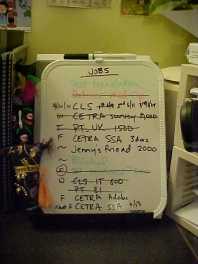
There are numerous systems translators use to track their jobs. As you can see, I use the old-fashioned, yet oh so handy, dry erase board. It’s a tried and true method to track jobs and note deadlines and estimated word counts, and it gives you the added satisfaction of crossing a job off once you have finished the job and sent the invoice (the same day you deliver the job – or at most the next day. Don’t put it off or you’ll forget!!!).
As I mentioned before, one of my German-English colleagues uses Post-It notes on her monitor to track her jobs. Here are some other options you may not have thought of…
 An Excel spreadsheet is an excellent tool to track your jobs and keep a running tally of how many words you have translated in a year. The graphic to the right may be difficult to read, but basically it contains the job number, end client, file name, pages, type of work (editing or translation), _x$h, word count, actual client, due, delivered, rush?, $/word, invoice date, $invoiced, notes, and TM. You can adapt this to fit your needs. You may want to include a column for date paid, late? (or days late), etc. I particularly love that it tracks the words you have translated for that year. You can also use all kinds of formulas to automatically add it up for you if you like that kind of thing. The sky’s the limit!
Another tool that is especially designed for translators is Translation Office 3000. This project management, accounting, marketing, word count, dictionary, etc. tool quickens, simplifies and optimizes a translator’s day-to-day work. You can keep track of your jobs, track your outstanding invoices, note your quotes and easily convert them into a job, handle your client contact information, and count your files based on lines, words, characters, etc. – all with the help of this tool. I particularly like the ability to track contact information and the visual schedule so you can see when a job is overdue. I don’t like the fact that you have to first create a project and then enter a job, but others may find it very helpful. You can download a free 30-day version here.
Some other options that were suggested to me when I forgot the job were:
3) a web calendar with automatic reminders (e.g., Freemail Kalender at
http://web.de)
I use a web calendar as well (more on that another day when I talk about iGoogle), but I haven’t gone the extra step and entered due dates in it. My job board is perfectly sufficient for my needs – provided I am diligent about writing a job down as soon as I accept it. It’s become habit now, which is quite comforting.
Posted by Jill (@bonnjill) in Business practices, Translation Sites.
There’s an interesting discussion on the PT listserv at the moment about “end of day” (EOD) delivery deadlines. The translator who started the discussion took it to mean the end of her day (midnight), while her client meant 5 or 6 p.m. (close of business) This is a really interesting discussion, because “end of day” is so nebulous. Some translators agreed with her, saying that for them “end of day” means the customer wants it in their e-mail in box when they get to work the next morning so that they can immediately start working on it (although in this case the client would have most likely stipulated SOB – start of business – or “first thing tomorrow morning”). The majority of the members, however, felt that “end of day” meant the end of normal business hours.
Those of us (like me) who prefer to start work late in the morning and do our best work in the late afternoon or evening hours should never assume that the end of our day is the end of everyone else’s day. One member pointed out that we should not assume that our clients take note of our work habits. Nor should they.
This discussion also makes it clear that we should never assume things and should always clarify our terms at the beginning of the job – not the end. We are service providers, and it is our job to ensure that we meet our client’s stipulated deadline.
So in the future if your client tells you “2000 words EOD” be sure to ask exactly what time they consider to be end of day. You may be surprised at the response.
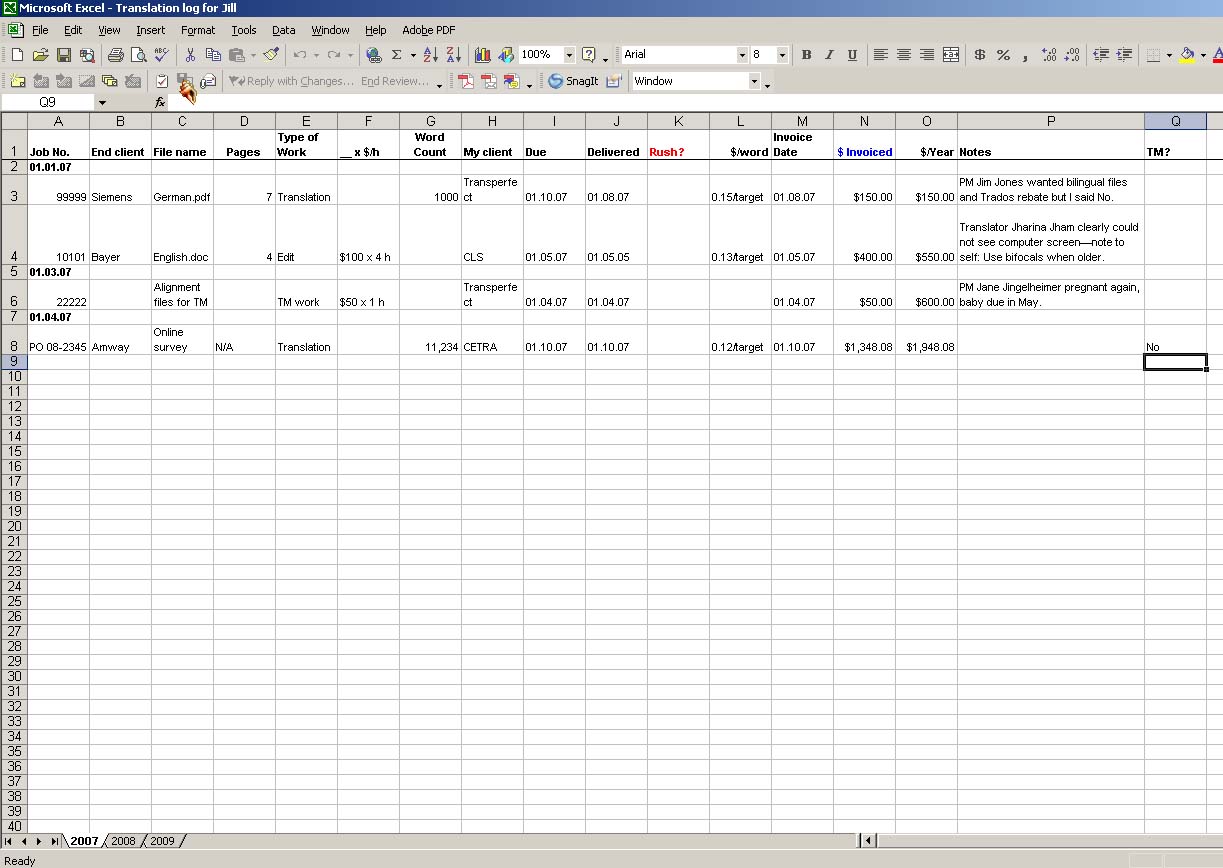 An Excel spreadsheet is an excellent tool to track your jobs and keep a running tally of how many words you have translated in a year. The graphic to the right may be difficult to read, but basically it contains the job number, end client, file name, pages, type of work (editing or translation), _x$h, word count, actual client, due, delivered, rush?, $/word, invoice date, $invoiced, notes, and TM. You can adapt this to fit your needs. You may want to include a column for date paid, late? (or days late), etc. I particularly love that it tracks the words you have translated for that year. You can also use all kinds of formulas to automatically add it up for you if you like that kind of thing. The sky’s the limit!

 Musings from an overworked translator