When do you cry “Uncle”? June 4, 2008
Posted by Jill (@bonnjill) in Business practices, Random musings, Translation Sites.2 comments
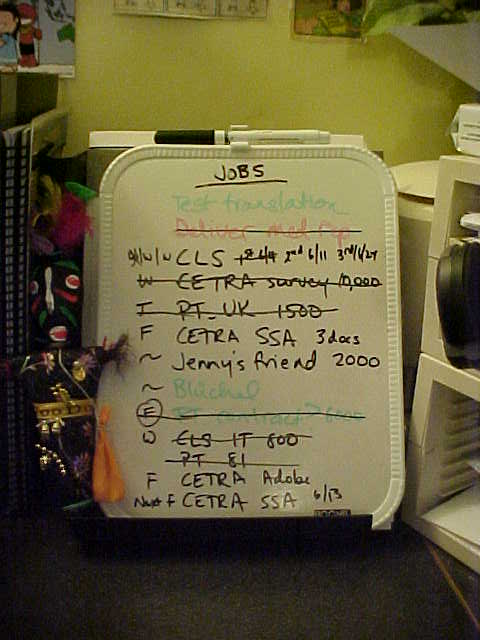 I just finished two large jobs and a couple small ones, delivering a total of 20,000 words today. The muscles in my shoulders are stiff, and my arms are a little numb. I have been busy before, but the past few days have been absolutely insane. Everyone I know is completely overwhelmed with translations. When does it end, and when do you cry “Uncle”?
One friend/colleague starts turning down work when she has six Post-It notes stuck to her monitor, indicating six different jobs. In my case, my job board, as you can see, is filled from top to bottom with jobs and crossed-out jobs. I guess you just learn how much you can handle and practice saying no to clients when you are too overwhelmed. But that’s easier said than done.
I’d be curious to hear how everyone else manages to handle a deluge of work. Do you feel guilty saying no to your clients? Do you say no to new clients, yet squeeze in work from long-term clients? I realize my work load this past week was beyond insane. I have some small jobs on my desk now, which are manageable, but I’m taking some time off tomorrow for some “me time” – a pedicure and if they can squeeze me in at the last minute a deep-tissue massage. I also plan on finally writing about the importance of a job tracking system and will talk about how some of my friends track their jobs as well.
In the meantime, I’m off to get some supper and get ready for water aerobics – and, most importantly, turning off my computer. More on this subject tomorrow!
An example of why study/living abroad is so important for a translator June 3, 2008
Posted by Jill (@bonnjill) in Random musings, Translation Sites.2 comments
Among other things, I’m translating a marketing survey at the moment. After being asked the same question several different ways, the respondent is understandably frustrated. His (I’m going out on a limb and assuming he’s male based on the language used) response is Das habe ich eben schon beantwortet. Ihr Pappnasen, checkt ihrs noch? Luckily I’m having an ongoing chat on Skype with a fellow translator about our day, our dogs, whether I can proofread a small text, etc. You’d think Pappnasen would be my problem, which is why she is surprised that I am asking her about checkt ihrs noch?. She’s from Baden-Württemburg and hadn’t heard the term Pappnasen very often. I explained to her that my friends in Bonn used to call each other Pappnasen all the time. It must be a Cologne/Bonn thing because of Karneval. Anyway, if I had been depending solely on a dictionary to translate this phrase I would have been stumped. Langenscheidt offers false nose for Pappnasen. Leo‘s a little better, because it offers fool and idiot in addition to cardboard nose and false nose. This is yet another example of why living abroad is so important to the cultural understanding needed to understand and therefore translate a text well. In the end, I decided to go with When are you finally going to get it, you morons! Thanks, Eva!
Bulk discounts – yea or nay? May 30, 2008
Posted by Jill (@bonnjill) in Business practices, Marketing ideas, Translation Sites.5 comments
There’s an interesting discussion on the ATA German Language Division listserv at the moment about bulk discounts (a.k.a. volume discounts). The general consensus is not to offer them. I wanted to summarize the main points why translators should not consider offering bulk discounts.
-
It is not beneficial to work more at a lower rate – in fact, it’s worse, because you would have to decline assignments from your regular clients who pay your standard rates.
- These regular clients will then go elsewhere when you are not available, and you would lose a good client.
- Most professionals – and even most non-skilled workers – who work over 8 hours a day get paid time and a half overtime – and double time on weekends. Freelance translators unfortunately do not have this luxury. And offering volume discounts ensures that the opposite is true – you are paid LESS for working MORE.
- Many jobs that require volume discounts also have extremely tight deadlines, which would make it a rush job for which you should be paid more – not less.
-
You don’t know if the client will really come through with the kind of volume he is promising (one savvy member suggested drafting up a contract to “contractually commit to a legally enforceable minimum (annual) volume” and if the client doesn’t hold up its end of the bargain you can consider the contract null and void).
- If such a contract were signed, you might be legally considered an employee.
- Why spend time working for a client who doesn’t respect you enough to pay a competitive rate?
- Prices keep rising (gas, food, housing, etc.) and agencies keep trying to depress prices. Volume discounts are just another way to lower the price. Globalization may be rampant, but the fact remains that U.S.-based translators cannot afford to work at extremely low rates and still make a living. If you continue to offer quality translations the clients who choose to outsource will eventually come back. If they don’t, there is still plenty of work to go around. With globalization the need for translation is increasing exponentially and there aren’t enough skilled translators to handle the load as it is.
- Agencies that ask for volume discounts are most likely trying to get a bargain and negotiate the best price. Most agencies will be willing to pay your rate once you tell them you do not offer volume discounts.
- The supply and demand in the industry means you can safely turn down volume discounts and still have plenty of work from other clients. I get contacted by one to two new clients a week who found my profile on the Internet or ATA database or heard about me from colleagues or clients.
If anyone else wants to add something to the list I would love to hear it.
BTW, if you work in German you should definitely join the ATA and subscribe to the GLD listserv. The GLD list has 297 members despite the division itself having over five times as many members (currently close to 1200 members). Those members don’t know what they are missing. I find the listserv to be one of the most valuable tools out there. It is a virtual water cooler for home-based workers (and even some in-house translators). We help each other with terminology and discuss business practices and anything else you can possibly think of (even German stores and food). Most of the things I will bring up here I have learned from the GLD list or PT, which is a Germany-based listserv for translators with 1331 members as of 3/30/08 (the lingua franca is of course German).


 Musings from an overworked translator