Happy St. Martin’s Day! November 10, 2008
Posted by Jill (@bonnjill) in Fun stuff, German culture.3 comments
Saint Martin’s Day is without a doubt my favorite evening in Germany. St. Martin’s Day (or Martinstag, Martinmas, Martlemass, Mardipäev, etc.) is November 11, the feast day of Martin of Tours. Although in the Rhineland it is often celebrated on another day so that it doesn’t conflict with Weiberfastnacht, which is the kick-off for the Karnevalszeit (Mardi Gras) and takes place at 11:11 am on November 11 (11/11) when the women storm City Hall. The parade this year in Bonn is being held on November 10th. Even if you don’t understand German, you might want to click on the link and check out the photos (Bild-Galerie). Watching the kids walk through the dark night with their homemade lanterns simply warms my heart.
Martin of Tours was a Roman soldier who was baptized as an adult and became a monk. It is understood that he was a kind man who led a quiet and simple life. The most famous legend of his life is that he once cut his cloak in half to share with a beggar during a snowstorm, to save the beggar from dying of the cold. That night he dreamed that Jesus was wearing the half-cloak Martin had given away. Martin heard Jesus say to the angels: “Here is Martin, the Roman soldier who is not baptized; he has clothed me.” According to legend, Martin was reluctant to become bishop, which is why he hid in a stable filled with geese. The noise made by the geese betrayed his location to the people who were looking for him.
The day is celebrated in the evening of November 11 in many areas of Northern and Eastern Europe. Named for Saint Martin, the Fourth Century Bishop of Tours, this holiday originated in France, then spread to Germany, Scandinavia, and Eastern Europe. It celebrates the end of the agrarian year and the beginning of the harvesting. It also marks the end of the period of all souls, that begins on November 1st, which is why Saint Martin’s Day activities resemble those from Halloween.
Children parade down the street with paper lanterns and candles and sing songs praising St. Martin’s generosity. A man dressed as St. Martin rides on a horse in front of the procession and there are generally geese being pulled along in a cart. The parade is culminated in Bonn by a large bonfire on the Marktplatz. The kids then go door to door and earn sweets or treats by singing songs, dancing, or citing poems.
The lanterns the participants carry have become a distinctive part of the tradition. Every age group has its own lantern design, which becomes more elaborate with the age of the builder. Older youth often opt to take a flashlight and attach craft paper with cutout designs augmented with transparent colored cellophane paper making them appear like stained glass torches. I still have the lantern my boss’s daughter made for me in my room. Unfortunately the batteries corroded and the light on the plastic arm no longer works.
If you live in Philadelphia (Sarah…) you might want to check out the German Society’s St. Martin’s Day Parade.
An amazing Holocaust love story October 13, 2008
Posted by Jill (@bonnjill) in German culture, Random musings.add a comment
This has got to be one of the most romantic love stories I have ever heard. It is about a couple who met on two sides of a Nazi death camp fence. She would throw apples or bread to the “cute boy.” They met years later on a blind date in the U.S. According to the article, there are plans to make a movie based on this story. I am not at all surprised. Stories from World War II never cease to amaze me, but I got chills and tears came to my eyes when I read about this one.
Is Germany really that child-unfriendly? October 6, 2008
Posted by Jill (@bonnjill) in German culture, Random musings, Translation Sites.add a comment
One of my favorite German/English blogs, False Friends, has a post today about a “baby shooting” that made me chuckle. He likes to point out English misuse in German society. His dry comment “Zugegeben, Deutschland ist nicht besonders child-friendly, aber das geht echt etwas zu weit.” (Admittedly, Germany isn’t exactly child-friendly, but this really goes a little too far) had me laughing this morning. I’m just glad I wasn’t drinking my coffee yet. It would have ended up on my computer monitor. It wouldn’t have been the first time…
TGIF: Berlitz ad – Improve your language September 26, 2008
Posted by Jill (@bonnjill) in Fun stuff, German culture.2 comments
It’s hard to top the I Love Lucy clip, but I’m going to try. This commercial is an oldie but a goodie.
For those of you who don’t speak German, the senior officer is explaining the Coast Guard equipment to the newbie. What he is saying isn’t really that important, but it’s basically “This is my sector. This is the Coast Guard’s most important piece of equipment. This device. This device.” Then something unintelligible like life-saving/survival radar or something about survival – it’s hard to tell and neither choice makes much sense grammatically. The senior officer leaves him alone at his new post and hilarity ensues in English. Enjoy!
For those of you who are interested in the German:
“Das hier ist mein Sektor. Das hier ist das wichtigste Gerät des Küstenwächters. Das Gerät und das Gerät. Überlebensradar.” [but it could be Überlebensretter – it’s difficult to hear]
Oktoberfest! September 19, 2008
Posted by Jill (@bonnjill) in German culture, Random musings.1 comment so far
Thank goodness it’s Friday, and I’m taking a road trip to Cincinnati for the Zinzinnati Oktoberfest, which is proclaimed to be the world’s second largest celebration of Prince Ludwig’s wedding by the Guinness Book of Records. Having attended the Oktoberfest in Munich in 1997, I look forward to comparing the two. Hopefully there will be fewer drunk Italians in Cincinnati – although I have a feeling there will be just as many drunk Americans there. 🙂
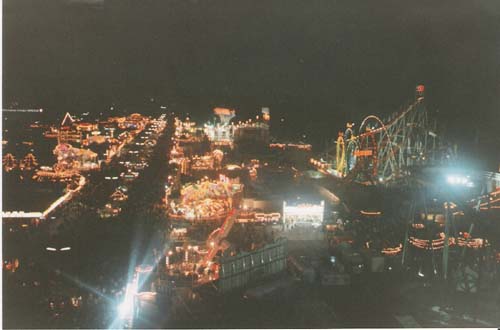 The history of Oktoberfest dates back to the year 1820 when Bavarian Crown Prince Ludwig I decided to marry Saxony Princess Therese and organized a great holiday on the 12th of October. He invited all the residents of the city to join the celebration. The holiday was repeated at the same date the following year, and very soon it became a tradition.
The most common question I usually get asked is why Oktoberfest is celebrated in September. The date of the festival was changed near the end of the 19th century so it can be celebrated while it is still warm out. The Munich Oktoberfest takes place during the sixteen days up to and including the first Sunday in October. It is one of the most famous events in the city and the world’s largest fair, with some six million people attending every year, and is an important part of Bavarian culture. Bavarians and lots of foreign guests drink about 6 million liters of beer, consume approx. 1 million chickens, approx. 400 thousand wurst and sausages and other local cuisine, such as Käsespätzle (spaetzel mixed with melted cheese and onions), roast ox tail, and Kartoffelpuffer (potato pancakes). Thirty percent o f all the beer produced by Bavarian breweries is consumed during this festival.
The Oktoberfest is a lot more than just eating and drinking. You may be surprised to hear that there are lots of amusement park rides and souvenir vendors as well. There are currently fourteen main tents at the Oktoberfest. The tents themselves are non-permanent structures that are constructed for and only used during the festival. The beer (or wine or champagne) served in each is brought to an accompanying table by women in Dirndl (traditional Bavarian dress). These women can carry up to 12 heavy Maßkrüge (a Maßkrug (aka Maß) is a 1-liter beer mug, plural: Maßkrüge) at once. It’s amazing. Seating can be hard to come by, because many people reserve space in tents up to a year in advance. More than 6 million people come to the Oktoberfest, and there are only about 100,000 available seats. If you want a seat, come a little later in the day or try your luck in one of the tents without a line, like the Spaten or Hippodrom tents.
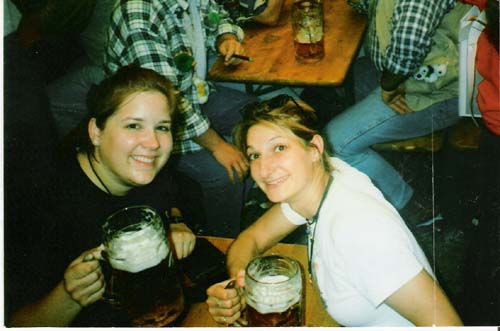 You should fight the urge to take one of the Maßkrug home with you. The Maßkrüge are made from heavy glass – really heavy glass so they are not a good souvenir for backpackers! – and typically have a decorative brewery logo on the side, making them very popular souvenirs among visitors. Although it is strictly forbidden to steal the mugs, they can be purchased in the tents at a “reasonable” price. Buyers are strongly advised to keep the receipts because police are known to search them for stolen mugs even away from the fest area. When police catch someone stealing a mug, the thieves may be fined up to €50. There is also a general Oktoberfest souvenir mug that features that year’s Oktoberfest poster. This one is made of clay instead of glass and is available with a tin lid.
For those of you heading to the Oktoberfest in Munich, here is a fun little Wiesn dictionary for you. I’ll miss the tapping in Cincinnati, but in just a few hours many people will be hearing O’zapft is! (it’s tapped!) in Munich.
9/22/08: For photos of our weekend at the Zinzinnati Oktoberfest, click here! Unfortunately, the sausage in Cincinnati is sadly lacking. They consider Weisswurst to be a Brat and sell something called Mett, which is nothing like the Mettwurst I am familiar with in Germany. German Mett is raw minced pork and is usually served on bread rolls (Mettbrötchen) or sliced bread, frequently with a garnish of raw onion rings or diced. Not my cup of tea, but my sister loved it. Cincinnati’s Mett is more like a kielbasa. The pastries like Bienenstich, chocolate mousse cake or Schmidt’s Jumbo Cream Puffs were to die for though! And of course the beer was awesome! One gem is the Hofbräuhaus in Newport, just across the river. I felt like I was at my favorite beer garden in Germany (Schaumburger Hof). There were even real Germans there 🙂 It’s an absolute must for German culture fans! I’ll definitely be back!
Dear Germany: Eine Amerikanerin in Deutschland September 5, 2008
Posted by Jill (@bonnjill) in Fun stuff, German culture, Random musings.10 comments
I am reading the most fantastic book, which I received as a birthday gift from one of my best friends in Germany. Dear Germany: Eine Amerikanerin in Deutschland by Carol Kloeppel could have been written by me! If you are an American who has lived in Germany (or Austria or Switzerland for that matter) for any length of time or are thinking about moving to Germany, you need to order this book right now. She talks about the little things that made me scratch my head and some things that I simply didn’t register but wholeheartedly accepted because that was just the way it was. For example, the German beds and Bettwäsche [bedding] or the practice of riding your bike everywhere even in business attire. I can’t wait to read what she has to say about the small refrigerators.
The chapter this morning entitled Fahrvernügen und Führerscheinhölle [Driving Pleasure and Driver’s License Hell] made me almost fall out of bed because I was laughing so hard and then cry because I could totally relate. It brought back all those memories of getting a ticket for driving the wrong way on a one-way street and having an ungültige Fahrerlaubnis [invalid driver’s license]. I had to jump through a ton of hoops and spend a lot of money to get my German driver’s license, but it was all worth it. I consider passing the written portion of the test – in German no less – with no errors (five are allowed) on the first try to be one of my greatest accomplishments.
Carol Kloeppel is just a few years older than me (born in Minnesota in 1963). She has a degree in communication science and worked as a journalist and producer for various television broadcasters in the U.S. She met German television journalist Peter Kloeppel in New York in 1990 and moved to Germany to be with him. They lived in Cologne and later moved to Bonn. I keep wondering if I saw her on the streets of Bonn or if she was a member of my American Women’s Club of Cologne or the International Women’s Connection in Bonn. The book is really well-written and entertaining, and her translator, Claudia Geng, should be commended for a job well-done!
I can’t wait to read more, and I’m ordering a copy for my friend Jane right now.
TGIF: Another Eddie Izzard video August 22, 2008
Posted by Jill (@bonnjill) in Fun stuff, German culture, Random musings.add a comment
Hi folks,
It’s Friday, and I am taking the afternoon off yet again to go to the dentist and then go on a Happy Hour cruise of the Cuyahoga River and Lake Erie on the Goodtime III with one of my Meetup.com groups. I could get used to working four days a week… After slogging my way through a really tough text yesterday about philo-Semitism I am really looking forward to some R&R.
Anyway, here is another Eddie Izzard video discussing President John F. Kennedy’s utterance “Ich bin ein Berliner,” which every Intermediate German student laughs about. This is in fact an urban legend, but Izzard is always worth a laugh.
Now onto the educational portion of this post… Here’s President Kennedy’s original speech for those of you who aren’t familiar with it.
According to Wikipedia:
Kennedy came up with the phrase at the last moment, as well as the idea to say it in German. Kennedy asked his interpreter, Robert H. Lochner, to translate “I am a Berliner” as they walked up the stairs of the Rathaus (City Hall). With Lochner’s help, Kennedy practiced the phrase in the office of then-Mayor Willy Brandt and in his own hand made a cue card with the phonetic spelling. [Note: The cue card can be viewed at Haus der Geschichte in Bonn.]
According to an urban legend, Kennedy allegedly made an embarrassing grammatical error by saying “Ich bin ein Berliner,” referring to himself not as a citizen of Berlin, but as a common pastry:
Kennedy should have said “Ich bin Berliner” to mean “I am a person from Berlin.” By adding the indefinite article ein, his statement implied he was a non-human Berliner, thus “I am a jelly doughnut”.
The legend seems to stem from a play on words with Berliner, the name of a doughnut variant filled with jam or plum sauce that is thought to have originated in Berlin.
In fact, Kennedy’s statement is both grammatically correct and perfectly idiomatic, and cannot be misunderstood in context. The urban legend is not widely known within Germany, where Kennedy’s speech is considered a landmark in the country’s postwar history. The indefinite article ein can be and often is omitted when speaking of an individual’s profession or residence but is necessary when speaking in a figurative sense as Kennedy did. Since the president was not literally from Berlin but only declaring his solidarity with its citizens, “Ich bin Berliner” would not have been correct.
The origins of the legend are obscure. The Len Deighton spy novel Berlin Game, published in 1983, contains the following passage, spoken by narrator Bernard Samson:
‘Ich bin ein Berliner,’ I said. It was a joke. A Berliner is a doughnut. The day after President Kennedy made his famous proclamation, Berlin cartoonists had a field day with talking doughnuts.
The New York Times review of Deighton’s novel added the detail that Kennedy’s audience found his remark funny:
In fact, the opposite is true: The citizens of Berlin do refer to themselves as Berliner; what they do not refer to as Berliner are jelly doughnuts. While these are known as “Berliner” in other areas of Germany, they are simply called Pfannkuchen (pancakes) in and around Berlin. Thus the merely theoretical ambiguity went unnoticed by Kennedy’s audience, as it did in Germany at large. In sum, “Ich bin ein Berliner” was the appropriate way to express in German what Kennedy meant to say.
During the speech Kennedy used the phrase twice, ending his speech on it. However, Kennedy did pronounce the sentence with his Boston accent, reading from his note “ish bin ein Bearleener,” which he had written out in English phonetics.
It’s a shame that a great speech is now the subject of ridicule based on half-truths and an urban legend.
Germany in the news – and not in a good way August 12, 2008
Posted by Jill (@bonnjill) in German culture, Random musings.add a comment
Four people were killed in a German ice cream parlor in Russelheim today. That is just sad. It seems as if Germany is catching up with America in senseless killing and random shootings. If you ask me, German ice cream parlors stand for all that is good in the world. There is nothing quite like a German Eisbecher (ice cream sundae), a wonderful concoction of ice cream, fruit, chocolate, and (if you are lucky) alcohol. The German ice cream parlors have taken creative ice cream concoctions to a new level. This is exemplified by a simple Spaghettieis, which looks like a plate of spaghetti in which vanilla ice cream is pressed through a modified spaetzle maker to make it look like spaghetti, placed over whipped cream and topped with strawberry sauce (to simulate tomato sauce) and either coconut flakes, grated almonds, or white chocolate shavings to represent parmesan cheese. Or the After Eight Becher with vanilla and peppermint ice cream topped with whipped cream, mint liquor, and After Eight mints. Nothing beats the fancy ice cream sundaes that combine fruit, alcohol and ice cream. To see how wonderful these creations can be, click here. Yum. Anyway, the shootings southwest of Frankfurt have shocked the country. CNN intimates that it may be related to a shooting blamed on an organized crime syndicate based in the southern Italian region of Calabria. This may not be such a stretch since most ice cream parlors in Germany are seasonal and run by Italians.
And then there is the Rockefeller wannabe calling himself “Clark Rockefeller” who kidnapped his daughter, is a “person of interest” in the disappearance of a California couple, and may be a missing German man who left Germany as a teenager and broke off contact with his family 20 years ago. Authorities are fairly confident that “Rockefeller” may in fact be Christian Gerhartsreiter, who was an exchange student in Connecticut in 1980 under the name Christian Gerhart Reiter when he was 17. I have been following this case closely, because he reminds me of someone in Germany I used to know. Absolutely crazy.
I guess Americans don’t have a lock on weird and disturbing crimes…
Hollywood gets lost in translation – Groan! August 1, 2008
Posted by Jill (@bonnjill) in German culture, Random musings, Translation Sites.3 comments
USA Today has an interesting article about how Hollywood is taking “a more active role in translating its [movie] titles to make sure ‘global launches’ go well.” Hollywood gets lost in translation examines the practice of titling movies for foreign audiences and cites several interesting examples. The author explains “Titles are often tweaked to sound better in the local language, or to provide a hint of the plot to audiences who might be skeptical of what is, to them, a foreign film.” It claims that “translations used to be left to foreign film distributors, with dubious results.” It is an interesting article that will hopefully educate USA Today’s ADHD-afflicted readership that there are other countries and cultures beyond our borders (dare to dream!).
I used to love trying to guess the American title of a movie or TV show when I lived in Germany and always enjoy researching the alternate titles on The Internet Movie Database when I come upon a movie or TV show title in a translation. For instance, the “Die Hard” movies are called Stirb langsam (Die Slowly) in German. “Die Hard 2” is Stirb Langsam 2 – Die Harder, “Die Hard: With a Vengeance” became Stirb Langsam – Jetzt erst recht (Die Slowly – Now more than ever), and “Live Free or Die Hard” has the imaginative title Stirb Langsam 4.0. And, yes, I needed to know this for a computer game.
It’s about time Hollywood started recognizing that they aren’t just making movies for American audiences. Now if only we could get them to stop including gratuitous shots of the American flag or other unnecessary shows of patriotism. Don’t get me wrong; I am as patriotic as the next person. However, after six years in Germany that kind of stuff really makes me shudder because instead of experiencing a swelling of pride or whatever the filmmakers expect us to react with I immediately wonder how non-Americans will react. Most Germans I know generally roll their eyes or make a comment. I had the same reaction at the Cleveland Indians’ game this past Sunday. Instead of belting out “Take Me Out to the Ballgame” during the Seventh Inning Stretch they started us off singing “God Bless America” (the ACLU would have had a field day…) and I sheepishly looked over at the Japanese guy sitting two seats over from me to see how he was reacting to it. OK, how did I get off-topic again…
I’m honored… July 31, 2008
Posted by Jill (@bonnjill) in German culture, Random musings, Translation Sites.add a comment
About Translation reported that my humble blog has been named one of the “Top 100 Language Blogs” by LexioPhiles. Considering the fact that I’ve only been doing this since May 30th, I’m frankly floored and honored to be included among such blogs as yndigo (34), About Translation (42), Translation Blog (52), Blogging Translator (53), and Thoughts On Translation (100). I came in at number 69, which makes me chuckle since I was born in the Summer of ’69. I enjoy reading these blogs very much and have discovered a couple new ones on the list to follow as well.
One of my latest finds (which isn’t on the list) is Nothing for Ungood, which Margaret Marks’ Transblawg (which should have also been considered – I’ve been reading Transblawg for years now) talked about yesterday. I wasted a good half hour of my day yesterday reading Nothing for Ungood’s hilarious insights on Germany and the German culture.


 Musings from an overworked translator