#ata53: Managing, Importing, and Exporting Bilingual Glossaries with UniLex November 8, 2012
Posted by Jill (@bonnjill) in ATA, Tech tips, Tools.4 comments
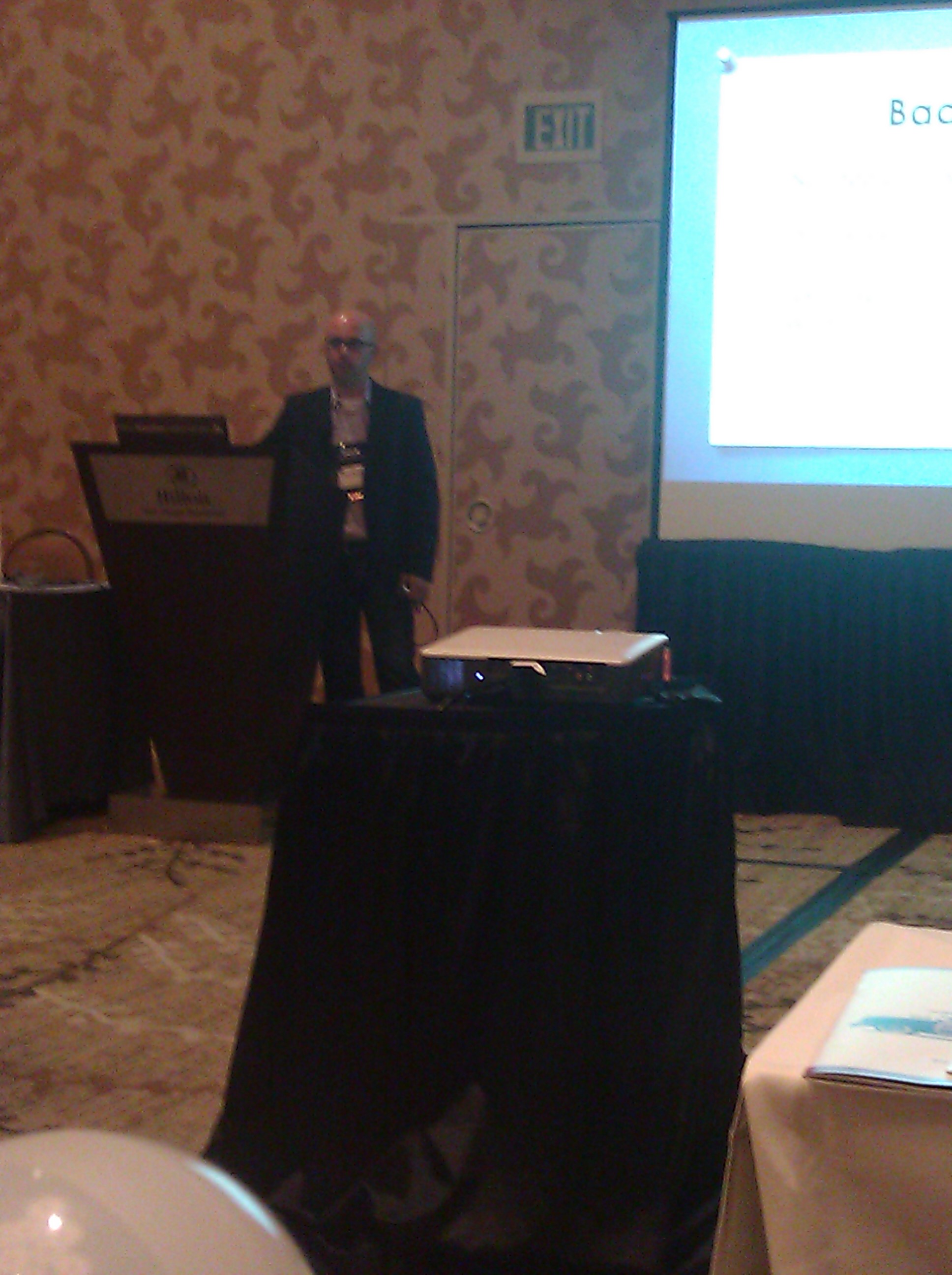 I checked into the Hilton Bayside in San Diego on the Tuesday before the annual ATA conference to attend the above-named preconference seminar by Fabio Said (@fidusinterpres) on Wednesday morning. I like attending preconference seminars, because they allow you to really delve into the material in three hour increments. The conference sessions are usually around one hour and don’t allow that much detail. The preconference seminars went up in price this year, so I only attended one. That said, I was glad I chose Fabio’s presentation, because I can see how it will really benefit me in everyday practice.
To quote the abstract, “This hands-on seminar [showed us] how to use UniLex, a professional (and free) terminology management tool, to keep all your existing and future bilingual glossaries in a single application.” I was probably one of the only people in the room who had actually worked with the tool; however, I had never known that it could be use to manage my own glossaries. Having trained under terminologist extraordinaire Sue Ellen Wright at Kent State, after graduation I worked as a terminologist for six months at a translation agency in Germany and then off and on for them as needed for another six months. I am quite familiar with the process of creating glossaries for clients and for your own use.
Acolada’s UniLex is a German tool that allows you to look up terms and translations in a number of dictionaries within seconds. I have been using the professional version for years when I purchased German-English dictionaries such as the Collins/PONS German-English dictionary, Wahrig Wörterbuch der deutschen Sprache, Brinkmann/Blaha: Data Systems and Communications Dictionary, Ernst: Dictionary of Engineering and Technology, Dietl/Lorenz: Dictionary of Legal, Commercial and Political Terms, Kucera: Dictionary of Chemistry, der Große Eichborn, and several specialized Langenscheidt dictionaries, which are all available on UniLex Pro. It is a stand-alone tool, which does not allow you to copy a term in Word and look it up in the interface, but this makes it an ideal tool to manage your own glossaries as well. Both tools are free, but Fabio stressed several times that we should download and use the regular version, because the regular version allows you to edit the data.
Fabio discussed what the tool can and cannot do. Like I said, it does not integrate with Word or CAT tools. However, if you are a word geek you can really customize it to meet your needs, with spaces for part of speech, context and other details. You can import existing glossaries, add new entries to existing glossaries, and export the data into nice-looking RTF Word files. Not bad for a free tool…
I wrote about using electronic dictionaries back in 2008 and am using the screenshot of the UniLex interface from that post. Since I haven’t had a chance to install it on my new Windows 7 system it may or may not look a little different than in the screenshot below, which was taken from an XP system.
He then walked us through how to create a dictionary in UniLex and import a bilingual glossary (as an Excel file). One thing to remember is that “Key” is the source term and “Equivalents” is/are the target term(s). He also shared a sample Excel table to use for the process, which was organized in 8 columns. The Excel table should then be copied into Notepad or another text editor to ensure no hidden formatting is copied with the data into UniLex. The text file should then be saved using ANSI encoding to ensure any special characters are maintained; however, some systems may do better with UTF-8 encoding. You should test your system before importing large glossaries and editing existing dictionaries. The last step is to close UniLex and reopen it to view the contents of your dictionary.
I have downloaded the tool, but haven’t gotten around to playing with it on my own yet. I’ve been pretty busy dealing with the insurance company, running errands, and following up with the people I met at the conference. Oh yes, and translating. Can’t forget the day (and night) job. I do, however, look forward to playing with it once my life calms down (maybe after the holidays?). In summary, I am very happy I attended Fabio’s preconference seminar and look forward to becoming an amateur terminologist again. I’m curious to see if my old dictionaries and the glossaries I create from my Excel glossaries will be able to happily and smoothly co-exist.
Dealing with adversity November 3, 2012
Posted by Jill (@bonnjill) in Tech tips.Tags: loss of electricity, loss of Internet, power outage, wifi
4 comments
We may not all have to deal with adversity such as those in New York and New Jersey are dealing with at the moment – or the folks in New Orleans and the Gulf coast back in 2005. However, at some point we all deal with the power going out or our Internet going down. It goes without saying that you should at minimum have an emergency radio that is solar powered and has a hand crank to keep you informed about the storm. However, there are quite a few other steps you can take to be as prepared as possible.
If your Internet goes down due to a technical glitch or problem with your Internet service provider, consider trekking to the local coffee shop or McDonald’s to use their WiFi. The Internet always seems to go down when you have a major deadline. This happened to me once when I had a major looming deadline, so I drove to the Panera around the corner and delivered my files from the comfort of my car. I was in my pajamas, so going in wasn’t an option. I am comforted to know that the McDonald’s three miles away from my home that is open 24 hours. Who knows when that may come in handy. If power is out all around you, consider driving to a friend’s home who might have power. I relocated to my parents’ house during the Northeast Blackout of 2003. Driving was tricky and slow with no street lights, but I managed to make it there safely.
If it’s likely that you’ll lose power during a major storm, you should always charge all of your devices ahead of time. Most importantly, when power does go out, unplug your devices to prevent them from being damaged when power is restored with a jolt. Also, if you’ve got a generator, it’s best not to run electronics like phones, laptops, and tablets off of it.
Once power is gone, it stays gone. A good backup battery is great to have on hand to allow you to safely power down your computer. I have used this feature several times now during minor power outages. The Energizer Powerpacks website offers a ton of options such as battery backups, external batteries, and a solar charger. I also own a Energizer Energi To Go battery charger for my phone that I used during the Susan G. Komen Breast Cancer 3-Day walk. I keep it in the drawer next to my desk in a Ziplock bag with fresh batteries. I bring it with me on trips just in case I need it. In fact, it was with me in San Diego. I am also seriously considering buying a solar charger I saw in the Skymall magazine on my flight to San Diego. It will conceivably allow you to recharge electronics such as cell phones or tablets by harnessing the power of the sun.
You can extend your phone’s battery life by disabling certain features, like WiFi and Bluetooth. It takes a lot of power to constantly search for a WiFi or Bluetooth signal. Also, dim the screen brightness and avoid playing audio at a high volume. If your phone is set to check email automatically at regular intervals, turn that off too. All of those processes drain battery life.
You should all already have a backup system for your computer. If you don’t, you need to start thinking about it now. Rather than rehash the subject again, I will simply refer you to my blog post from January 2011 called Backing up your stuff to the cloud. It’s nice to have a backup in your house, but inadequate if that’s all you’ve got. Remote backups with a service like Crashplan, Dolly Drive or Carbonite can be invaluable. I use Carbonite, and it has saved my skin twice now. Your most important criteria for choosing a service is to make sure that it is secure and reliable.
You should also store copies of important documents such as your family and your passport(s), birth certificate(s), car title(s), medical records, insurance inventories, bank records, etc. in the cloud somehow. This helps when you need to evacuate in a hurry as well as in the ensuing aftermath of recovery. The original documents should be stored in a big Ziplock plastic bag and the bag should be stored in a water-resistant and/or fire-resistant safe or emergency kit. I use Suze Orman’s Protection Portfolio. If something ever happens to me my sister knows that everything she needs is in this kit. A little preparation goes a long way to save you some headaches and protect your business.
Problem with Microsoft Update and SDL Trados April 23, 2012
Posted by Jill (@bonnjill) in Tech tips.3 comments
Just a word of warning to those of you who use Trados and install the Microsoft Updates on a delay… there is a problem with Security Update for Microsoft 2007 Suites (KB2598041). If you install each update individually you should skip this one.
If you have already installed the update, you should set your computer back to a earlier Restore Point and install each update individually.
In the future consider waiting a day or two to install the downloaded updates. You can change the setting for Windows Update
- Click Start, type Windows update in the search box, and then click Windows Update in the Programs list.
- In the left pane, click Change settings.
- Select Download updates but let me choose whether to install them.
- Click OK.
Those of us who work with MemoQ, Fluency or Wordfast don’t need to worry about this 🙂 – although it’s still a good idea to delay installing updates to see what problems might crop up.
FTP for translators April 20, 2012
Posted by Jill (@bonnjill) in Tech tips.6 comments
There was a brief discussion about FTP on one of my listservs yesterday. The translator had received instructions from her client telling her to log onto their FTP server to access some files. She was confused about the concept of Explorer and Internet Explorer (which are two completely different animals) and needed some guidance from her listmates. I thought it might be a good idea to quickly explain what FTP is to readers who may not be aware of FTP or are new to the industry.
FTP stands for File Transfer Protocol. FTP is a standard network protocol used to transfer files from one host to another host over a TCP-based network, such as the Internet. In many cases, it is often used to upload web pages and other documents from a home (or work) computer to a public web-hosting server. However, in our industry clients use them when their files are too large to send over e-mail, since some e-mail servers have restrictions. The translator is given the address and a username and the password to log onto the server and download the files.
An FTP server is not a website. You can access an FTP server through a web browser, which is what the client instructed the translator to do, but this created the confusion. She was told to use Internet Explorer, because some browsers such as Chrome or Firefox do not recognize the ftp:// command. For instance, you need to install a plug-in (FireFTP) in order to access FTP through Firefox. Your best bet is to use an FTP client, such as FileZilla or BulletProofFTP (I currently use SmartFTP and have used CuteFTP, and WS_FTP in the past). Cyberduck is a free, open-source FTP client for Mac OS X. Another option (for those who are comfortable with DOS prompts) is to call up the DOS prompt and enter the FTP command. Most FTP clients have a “paste URL” that automatically routes you to the link the client gives you. All you have to do is enter the username and password (and possibly the port if it isn’t the standard 21).
One thing to keep in mind is that FTP was not designed to be a secure protocol—especially by today’s standards—and has many security weaknesses. FTP is not able to encrypt its traffic; all transmissions are in clear text, and usernames, passwords, commands and data can be easily read by anyone able to perform packet capture on the network. The chance of someone intercepting your transmission is miniscule, but you should only access FTP sites that you know are reliable. That said, I doubt that this is a problem that our clients have. It is more an issue if you are blindly surfing the web for illegal content, which you should never do.
Happy translating!
Adventures with MemoQ September 22, 2011
Posted by Jill (@bonnjill) in Tech tips, Tools.17 comments
Greetings from Germany. I’m staying with friends north of Bonn in Bornheim at the moment. They are translators as well and have a network, which meant that this morning when I started translating a medical report for a client here in Bonn (who just happened to come out of the woodwork the day I arrived) my friend yelled down that she wasn’t able to use her Trados because I was using my Trados 2007. Their network was not happy that I was using Trados, even though they have a two-license set-up. I guess three licenses were too much for it.
No better time like the present to try to learn how to use my new MemoQ program. I was happy I had already installed it on my laptop, but I had never worked with it. I have to say it took me about a half an hour to figure everything out (without reading a manual). I learned how to confirm the fields pretty easily. I also managed to import my TM (which I had stored on Dropbox as a tmx) and work with my medical TM, allowing me to translate 1700 words today. I just exported the file to send to someone to proofread it. I have to say that the final product really looks good.
The client had sent me a terrible OCRed Word file, so I asked for a PDF of the hard copy and ran it through my OCR program and formatted it by hand (two of the five pages were fairly filled with complicated tables). MemoQ had absolutely no problems with my formatting and special characters. I think MemoQ has a new fan…
Forewarned is forearmed August 23, 2011
Posted by Jill (@bonnjill) in Tech tips.3 comments
Now that I am working with Office 2010 I need to be aware of any potential problems. Did you know that there is a potential compatibility problem between Word 2007 and Word 2010? According to Microsoft, there is a defect in Word 2007 with regard to DOCX files exchanged between users of Word 2010 and Word 2007. Apparently some Word 2007 users have experienced problems in which spaces were “disappearing” when viewing or printing documents sent to them from users of Word 2010. There is apparently a defect in the file / open code of Word 2007 that causes the problem. This could be a problem if you are working in Word 2010 and deliver a DOCX file to your client who uses Word 2007. If your client reports this problem, the first thing you should ask them is if they have the latest patches for Word 2007 and/or Office 2007 Service Pack 2 installed. Of course, the best solution is to ask the client what version he/she uses and save the file in that format. After all, forewarned is forearmed…
MemoQ group buy through ProZ.com August 19, 2011
Posted by Jill (@bonnjill) in Tech tips, Tools.1 comment so far
Happy Friday, everyone! I’ve delivered my translation, which is due at 2 PM, early and am about to head out to hit a local church tag sale and start my weekend. But I wanted to let you know about this opportunity to purchase memoQ 5.0 Pro through a translator group buying program on ProZ! During this group buy promotion, a group of 100 ProZ.com users will have the opportunity to purchase memoQ translator pro and receive a discount of 40% off the list price. Since I’ve been thinking about switching to MemoQ for a while and just started working with a new client who works with MemoQ (among other tools) I’ve just added my name to the list. There are only 39 units left (after my purchase), so act now. The software usually sells for $770/EUR 620, but they are offering it for $462/EUR 372 at the moment. Interested? Check out http://t.co/c0SVvv1. Have a great weekend!
E-mail etiquette 101 June 13, 2011
Posted by Jill (@bonnjill) in Business practices, Tech tips.19 comments
I received an e-mail from a translation agency today informing me that they have made some recent changes to their Vendor Portal. They sent the e-mail to all the vendors in their database. Do you know how I know this? I then proceeded to get e-mails from their vendors from all over the world because they hit Reply All simply to say “thank you” to the person who sent the e-mail. I’m about ready to set up an e-mail filter to filter the replies to that subject line straight to the Trash. I don’t have the time or energy to delete hundreds of e-mails today (and since this is one of the Common Sense Advisory’s “top 20 translation agencies” there must be thousands of vendors…).
Sounds like some professionals need some schooling in e-mail etiquette. Here are my top 15 e-mail etiquette tips. If I missed one please feel free to share in the comments.
1. Use a subject line. I hate receiving e-mails with no subject line at all. I can’t believe people still do this.
2. Understand the difference between To:, CC: and BCC: and please use CC: and BCC: sparingly. And while I have your attention, don’t use Return Receipts on every single email. I decline them as a rule.
3. Do not hit Reply All unless you truly want to reply to every single person listed in the e-mail header. If one of the e-mail addresses is a generic one, do everyone a favor and delete it before you hit send.
4. Be polite at all times and be mindful of your tone. E-mail is a medium that too easily creates misunderstandings. Use sarcasm sparingly. If something gets “lost in translation,” you risk offending the other party. The more matter-of-fact you can be, the better.
5. Keep your e-mails brief and to the point. We all know people who write diatribes to listservs. I don’t know how they get any work done!
6. Reply in a timely manner. Even if it is a simple “thanks for your inquiry, but I am afraid I am booked up through the rest of the month.”
7. Don’t use e-mail to criticize others (or complain about a third party). Criticism is best conveyed in person or over the phone so that you can immediately mitigate any misunderstandings. Plus, you never know what might happen with your e-mail after you hit send and it arrives in the other person’s e-mail address. Worst case scenario: your e-mail will be forwarded to the third party in question. Ouch!
8. Don’t reply to an e-mail in anger. Write the e-mail and walk away from it for an hour or two (or a day or two) until you’ve had a chance to cool down. Better yet… vent your feelings by writing the e-mail and then hit Delete instead of Send.
9. Don’t forward chain letters. Nine times out of ten, the information is an urban legend. Just don’t do it! If in doubt, check it out at Snopes.com, a website devoted to tracking down and debunking urban legends and rumors.
10. Don’t write in ALL CAPS. This is the digital equivalent of shouting. No one likes to be shouted at.
11. Include your full name and contact information in your e-mail signature, but keep it to 4-5 lines. Also, if you are participating in a listserv please use your given first name so people know who they are dealing with. I have seen people sign their e-mails to listservs with an initial or, even worse, a pseudonym.
12. Don’t send or forward emails containing libelous, defamatory, offensive, racist or obscene remarks. It seems self-evident, but surprisingly it happens.
13. Remember e-mails aren’t private. E-mails sent to a listserv go to everyone on the list. E-mail can be intercepted and read by just about anyone if they choose to do so. Think of e-mail as being the equivalent of sending a postcard through the mail.
14. Use your spellchecker. Nothing reflects on a language professional worse than an e-mail riddled with grammar errors and typos.
15. Reread your e-mail before sending it. Better yet, read it out loud. Make sure you are communicating clearly and that no words have been accidentally dropped in your zeal to write down your thoughts.
For more e-mail etiquette tips, check out 101 Email Etiquette Tips. Your clients and colleagues will thank you!
10 Productivity Tips for the Mobile Translation Professional – Ana Iaria @ TCD May 24, 2011
Posted by Jill (@bonnjill) in ATA, Tech tips, Tools.4 comments
Translators truly are the epitome of mobile professionals. We can live and work from anywhere as long as we have a computer and an Internet connection. Ana frequently works on several continents a year, so her session on productivity tips for the mobile professional was chock full of tips to make working anywhere as easy and productive as possible.
Tip 1: Have a portable computer
There are various models, sizes and prices as netbooks or laptops. It is up to you to choose whichever computer you feel comfortable working on. Netbooks are not as easy to type on as laptops, but they can be quite handy if you are simply traveling and want to stay connected. Ana suggests a MacBookPro as a second computer, because then you can have both Windows and Mac. Be sure to install all the software you need to work on it (TEnTs, Office products, electronic dictionaries, etc.) – “don’t keep it as a bare-bones computer.”
Tip 2: Keeping time and time zones
Keeping track of the time zone you are in and the time zones of your clients is of paramount importance. Ana’s first suggestion was a time zone converter that does not rely on an Internet connection. Her favorite bookmark is World Clock, which also offers a iPhone app. Windows 7 also allows you to add an additional clock to your system. If you work with a Mac, she highly recommends using the VelaClock widget.
Tip 3: Gadgetry for your computer
* Flux is a screen dimmer that works with sunset/sunrise and changes the computer monitor to reduce glare on your eyes.
* If you work with Firefox there are all kinds of add-ons to make your life easier (drop-down dictionaries, add-ons like FoxClock, Xmarks, MultiRowBookmarks, etc.).
* Ana recommends buying what she calls a “bag of tricks”. It is an organizer called Grid-It that allows you to carry your external mouse, converters, cables, pen drives, etc.
Tip 4: Mobile communications
A smartphone is a must for a mobile professional. It allows you to check e-mail, use apps that make your life easier while traveling, and keep in touch with clients. If possible, get a SIM card for the country you are in so you can make and receive calls. A Skype number is also a very good solution. Someone during the presentation suggested using MagicJack to make inexpensive international calls in the United States and Canada.
Tip 5: Online storage and backup
Sync software is important to ensure your computer always has the files you need. Mac has a tool called Time Machine that allows you to sync your computers. Dropbox is another tool that allows you to easily move between computers or store files online for easy access. Adrive or Yousendit were other suggestions to store and share large files.
Tip 6: Working with WiFi
WiFi has revolutionized how we stay connected. Ana recommended several WiFi locators such as Fon (with which you buy a dongle and share WiFi with people all over the world who have offered to share their WiFi) or Total Hotspots. Another WiFi finder is Jiwire. Skype offers the Boingo network. Ana recommends scouting the WiFi spots before you leave for your destination and printing them out if necessary so you are prepared. Another option is to get a Starbucks card, which allows you to use WiFi at any Starbucks. If you are travelling in your country considering tethering your laptop to your mobile phone (be sure to check your contract first).
One word of warning though – be aware of open networks. If you are on an unsecured network don’t log into your bank’s website, for example. Also be sure you are running malware detection programs and anti-virus software on your computer at all times. You are as safe as you want to be.
Tip 7: If you are traveling for leisure
* Don’t overwork yourself
* Take some time off to visit places. Don’t hole yourself up in the hotel. Go out and see the sights and visit friends/family. (I am particularly guilty of this. I was translating a cookbook when visiting a friend in Munich. I worked during the day while he worked. I think I only took one day to be a tourist. Sure, I had already been to Munich several times, but that one afternoon off sitting in a café at the palace was very refreshing.)
* But always be available to your clients. Even if you are on vacation a short e-mail thanking them for the inquiry but explaining you are currently unavailable – and perhaps recommending a colleague – goes a long way to keep your customer happy.
Tip 8: If traveling for business/conferences
* Make the most of the conference
* If meeting clients, point out that you are working on the go, you can score a point or two.
* Don’t forget to network – and work
* Enjoy the social side of it as well
Tip 9: Don’t forget the productivity tools you use at home
* Have the same software on all computers – TEnTs, dictionaries, Office, any Open Source programs, etc.
* Olifant helps you create and maintain translation memories (TM) files (conversion, editing, etc.). Olifant is a .NET application that allows you to load or import translation memories in different formats (such as TMX or tab-delimited); edit the translation units, their attributes and any other associated data; and save or export your data in various formats.
* Apsis Xbench is an integrated reference tool aimed to provide a clear and structured view of the terminology of any translation project.
* Electronic dictionaries
* You can keep your reference files on your virtual drive folder
* Password manager or export
Tip 10: Check your list before going mobile
Ask yourself if you have your
* Computer
* Cell phone
* Storage
* WiFi finder
* Bag of tricks
10 Technology Tips You Can Start Using Today – Michael Wahlster @ TCD May 12, 2011
Posted by Jill (@bonnjill) in ATA, Tech tips, Tools.3 comments
Although I enjoyed all of the presentations I attended at the TCD conference in DC, Michael Wahlster’s presentation on technology tips was my favorite. As Corinne has already mentioned, he used a new presentation technique called zooming presentation through Prezi. He basically had one file and zoomed in and out to the various points he was making. It was quite impressive. Anyway, despite being a huge tech geek even I walked away with quite a few things I want to look into.
* VoIP (Voice over Internet Protocol)
He talked a lot about Skype. I already use Skype for video conference or working with colleagues to ask quick questions about particularly troublesome sentences in the Chat feature, but Skype offers so much more. Some Skype-enabled phones work like a cordless phone through a router. It also allows you to forward your calls to an overseas number or gives you worldwide dial-in phone numbers (so you can live in Kansas and have a phone number in Japan) and block phone spam. SkypeIn allows you to select your area code (almost anything, but if you want the cachet of the 212 Manhattan area code you’re out of luck). With Skype2Go you can call from your regular cell phone anywhere in the world, many countries for only 2.3 cents a minute.
Since the presentation, it was reported that Microsoft is going to purchase Skype for 8.5 billion dollars. This raises the question if Skype is going to survive in the long run as the largest telephony company in the world with all the advantages it has now. There is a tendency among big tech companies to buy niche companies, take their best technologies and let the rest die. But Skype, a Luxemburg-based company, has been there before when it was purchased by eBay. It was involved in a lawsuit with eBay and the auction house threatened to pull the plug on Skype. Skype survived. Perhaps very cautious optimism is called for.
Google Voice is also a good option, although it doesn’t offer as many benefits as Skype. One plus is that it allows you to flag a phone number as spam (great if you want to ignore calls from an ex or a particularly bothersome client who won’t take no for an answer). Once the number is flagged you no longer have to see when the person calls.
* DNS (domain name service)
If you have had problems connecting to the Internet it may be your ISP’s domain name service, so Michael suggested we look into OpenDNS. It is faster and more reliable than most ISP’s. It makes your network more secure and reliable. Using OpenDNS means you enter their IP address is in your router or your network setup – not the one assigned to you by your ISP. It offers Web content filtering, so it is good for parents who want to filter their children’s access to content. It’s not an Internet service – it’s a IP translation service.
* Encryption
Encryption allows you to protect your own data assets, protect e-mail attachments and most importantly protect client confidentiality. With encryption you can make all or part of your hard drive invisible. Michael stressed that laptops must be encrypted, because they can walk away so easily. “Storing data in the cloud without encryption is like storing your suitcase in a locker in the airport without turning the key.” Encryption ensures that your data is secure. He recommends Truecrypt, which offers on-the-fly encryption and “plausible deniability” (for the advanced paranoid, if you want to protect data even in cases where you may be forced to reveal your password).
* Passwords
Michael suggests we use a password manager to keep track of all the various passwords we create for various websites. Passwords should always be at least 12 characters (using capital and lowercase letters, symbols instead of letters, special characters, etc.). You should create a strong passphrase for the password manager that only you know. Michael’s example was the common Latin phrase Gallia est omnis divisa in partes tres, which he shortened to Ge0d!p3 (using the number zero for the o and the ! for the i). Keepass is the tool he recommends. Keepass is a “free, open source, light-weight and easy-to-use password manager.” It stores all your passwords together and all you have to do is remember your one passphrase. He also urged us not to write down our passwords and not use personal information like birthdays, spouse or pet names, etc.
* Sharing + Collaboration
Most of us collaborate with each other and storing the files on the cloud can make life a lot simpler. Dropbox is the tool Michael (and I) recommend. Dropbox is a folder system that stores your data online (in “the cloud”). I use Dropbox to move files and folders between my desktop PC and my laptops. Michael suggested storing files such as your music and photos so you can use it at any computer. I export my TMs to Dropbox as a back-up beyond my data back-up system (more on that later). You can also use Dropbox to share files with colleagues and ensure everyone is using the latest version. If someone is using the file in the Dropbox folder the file is locked. The first 2 GB is free; anything over and above that you pay for. The nice thing about Dropbox is you can drag and drop files to the Dropbox folder. I also have Dropbox installed on my smartphone.
* Note Taking
You can use note taking software tools to save text, links, URLs, images, sounds, etc. No more Post-it notes littering your monitor screen or desk. Michael recommended Evernote (60 MB per month limit for the free version), but MS OneNote comes standard on most computers nowadays. The thing that intrigues me about Evernote is you can also sync it with your smartphone.
* Text Editors
Text editors go beyond the capacity of Notepad. They allow you to open plain text files and the formatting and tags are usually highlighted in another color (useful when you are handcoding or translating HTML files). Michael uses Notepad++. I like using UltraEdit.
* Uninterrupted Power Supply (not just battery back-up)
This is probably one of the most important tech tips you should know about. It is extremely important to have an uninterrupted power supply in case the power goes out, because a UPS allows you to back up the files you are working on and close the computer down in the event of a power outage. Battery back-ups take a split-second to switch over, which is usually not long enough for a computer. This avoids loss of the files you are working on. Michael suggested you buy as large a UPS as possible. I just bought replacement batteries for my UPSes the week before the conference. They are important!
* Data Backup
It is important to back up your data both to an external hard drive and to “the cloud” (aka the Internet). Backing up your data off-site is important in case there is a robbery (they will most likely steal your hard drive as well), fire, flood or other natural disaster. The two most trusted back-up systems are Carbonite and Mozy. You should remember to back up your files for your clients and don’t forget critical files like your TMs or other work products. I wrote a detailed post here about the importance of data backup back in January.
* Infections
Every translator should have an anti-virus program and malware/spyware removal programs running on their computer. I use a combination of AdAware and Spybot Search & Destroy. If your computer is running slowly the first thing you should do is run some malware/spyware removal programs on it. I also really like CCleaner to make my computer run faster and more efficiently. Michael talked about ComboFix, but urged us to be very careful when using it because it finds amazing things but erases everything suspicious (his quote was RTFM!).


 Musings from an overworked translator