Favorite tools: ABBYY FineReader September 24, 2008
Posted by Jill (@bonnjill) in Business practices, Tools, Translation Sites.5 comments
It seems like 80% of my source texts are now in PDF format, so my all-time favorite tool is without a doubt ABBYY FineReader. To quote the ABBYY web site:
ABBYY FineReader® is an intelligent and easy-to-use OCR (Optical Character Recognition) and PDF conversion software that is the optimal alternative to manual data entry and typing. It is an ideal choice for professionals that want to save time and effort while producing excellent results. It provides powerful functionality for converting images received from a scanner, a digital camera or by fax, as well as PDF files, into editable and searchable formats. The program accurately retains formatting and layout of documents and supports a wide range of recognition languages and output file formats.
ABBYY FineReader is very intuitive to use and sometimes even replicates graphics and logos. Users can process documents in 184 languages, including Chinese, Japanese, Thai, Hebrew, Armenian, Cyrillic, Greek, and Latin. ABBYY FineReader also reads pre- and post-reform German orthography, Old German script, scripting languages, and simple chemical formulas. The text recognition software includes dictionaries with spell-checking capabilities for 38 languages allowing verification of recognized text directly in the FineReader Editor. Also, apparently FineReader 9.0 Professional Edition now automatically recognizes the document’s language, which saves you the step of manually selecting the appropriate document recognition language, as well as spreadsheets and tables.
 PDF Transformer is scaled-down version of ABBYY FineReader. It is also “a comprehensive PDF conversion and creation tool” that “accurately transforms PDF files into editable formats and creates searchable PDF documents from Microsoft Office applications.” PDF Transformer only costs $99.99 and does basically the same thing (PDF conversion and PDF creation).
One thing I really like about FineReader is that it does not create as many text boxes as, say, OmniPage. FineReader can convert PDFs as well as graphics (such as TIFs or the eFax attachments I receive) into Word files that can be processed with a translation memory tool. Its Check Spelling feature allows me to ensure that the words were recognized properly, and I can correct them before saving the file. I have also been known to do a “down and dirty” OCR without spellchecking just to get a quick and fairly accurate word count estimate with PractiCount (or AnyCount, Total Assistant or whichever counting tool you prefer). You can also play with the save options to find your ideal settings.
I sometimes have to clean up the file by hand, because it has problems with handwritten text and tables (and checkboxes, some bullet lists, etc.). I simply open a clean Word file and copy and paste the text into the new file using the Edit->Paste Special command, which removes all the formatting. I then format the text manually. This also ensures that the margins are consistent and not haphazard, which sometimes happens as well during the conversion. I also find that the program sometimes creates columns when a table would be much more convenient. Again, I simply create the table and then copy and paste the text into it.
Some translators I know feel that OCR and formatting should be the job of the agency or project manager and/or they should be paid extra for converting a file into Word. I disagree, but I am willing to accept alternate opinions in the comments below. 🙂 Some smaller agencies aren’t as savvy and don’t know how to use OCR programs. Converting the file also allows me to quickly translate it using my translation memory tool (although one client specifically does not want me to use Trados with its files for confidentiality reasons, which I respect). I also feel I have more control over the actual document I am going to work with if I actually do the conversion myself. I have seen too many files that were sloppily OCRed and not spellchecked, which then makes the text confusing and this could easily lead to a mistranslation. If I do get a file that has been run through an OCR program I always insist on getting the original as well so that I can compare the two files.
One very important tip I have is that if you are going to order it, try ordering it from a country other than the United States. I bought my copy off eBay.de. The prices displayed to people accessing the Abbyy website from the States differ drastically from the prices shown to people accessing the website from Europe. ABBYY FineReader 9.0 Professional is displayed to European visitors as costing EUR 139/GBP 89 for the download version, while a price of $399.99 is displayed to someone who lives in the States. I bought my version (FineReader 8.0) for €90 ($116) and received the original CD and a manual in the mail, but you can also order a digital version of the software.
Download the 30-day trials of ABBYY FineReader and PDF Transformer to see which one you prefer and shop around for the best price. You’ll find the tools quickly pay for themselves.
SDL Trados training – total crock or benefit? September 23, 2008
Posted by Jill (@bonnjill) in Tools, Translation Sites.10 comments
If you are an ATA member you probably got an e-mail from SDL Trados today pushing its SDL Trados training at the ATA Conference in Orlando. Having conducted several independent (i.e., non-Trados-funded) training sessions for NOTA and ATA members and having taught the grad students at Kent State how to use WinAlign and Trados Workbench for several years, I certainly have a strong opinion on this. I am curious to hear what others think about these courses as well as “the SDL Trados Certification Program.”
I personally think it’s a total crock. You buy the software for an exorbitant price and then have to shell out $195 for the “Getting Started course” and $295 for the “Intermediate course.” Or you can book all 3 courses for the low, low price of $395! If you ask me, they should be training us how to use the software for free – or creating software that is intuitive and doesn’t require additional training in order to be proficient. I only know one person who is “SDL certified” – and she attended NOTA’s first training session before signing up for the first wave of SDL certification. She feels she benefited from it, so I didn’t have the heart to tell her what I truly thought about it. Until now…
GITS Blog: Seven things I love about being a freelance translator September 19, 2008
Posted by Jill (@bonnjill) in Business practices, Random musings, Translation Sites.3 comments
Hey folks, if you haven’t read Ryan’s post on The GITS Blog, Seven things I love about being a freelance translator, you should click to it right now. We get caught up in the cycle of complaining about clients and talking about how tough freelancing can be, but it’s important to also focus on the positive side of freelancing. There are a lot of benefits to freelancing, and I agree wholeheartedly with all seven of Ryan’s points. Now if you’ll excuse me, I’m going to go take advantage of point number three (“I can work from anywhere”) and go work at a local restaurant with several folks from my Coworking/Work at Home Meetup group. OK, it isn’t quite the point he was trying to make, but I do love the fact that I can truly work from anywhere. Plus, I can work for clients from all over the world out of a suburb of Cleveland, Ohio and enjoy a good standard of living (and buy a nice house for $150,000, which is impossible on the East and West coasts).
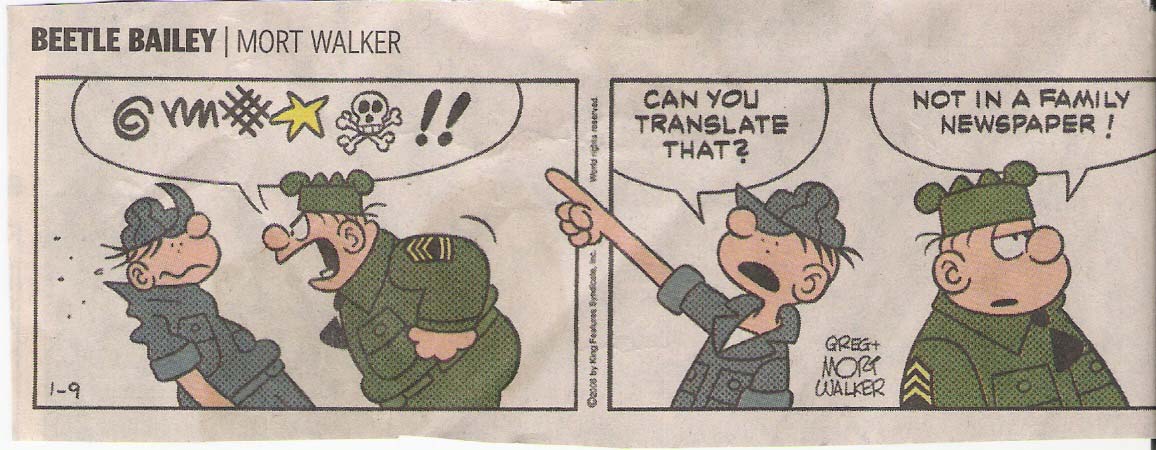
Beetle Bailey: can you translate that? September 17, 2008
Posted by Jill (@bonnjill) in Fun stuff, Translation Sites.add a comment
Since the Speed Bump comic strip was so well-received, I thought I’d share this Beetle Bailey comic strip with you all. For those of you who aren’t familiar with Beetle Bailey, Beetle made his comic-strip debut as a college cutup in 1950 in a mere 50 newspapers. He accidentally enlisted in the Army during the Korean War and has been in the Army ever since. Most of the humor revolves around the mostly inept characters stationed at Camp Swampy. Private Bailey is a pretty lazy soldier who usually naps and avoids work, and thus is often the subject of verbal and physical abuse from his Sergeant.
Translate some scoop for E! Online September 13, 2008
Posted by Jill (@bonnjill) in Fun stuff, Random musings, Translation Sites.add a comment
It’s the weekend, so I am going to post something really fun yet still translation-related. Those of you who know me personally know that I am a big fan of TV. I enjoy numerous shows – just not reality TV – when and if I find the time to watch them. I usually download them and catch up on weekends or whenever I get a chance (like once the season is over). I just caught up on Heroes Season Two and plan to finally start Ugly Betty Season One tomorrow. It’s supposed to rain all weekend. Perfect “vegging out” weather.
Anyway, the point of this post is… Kristin at E! Online interviewed four actors from the TV show Heroes and had them answer in Japanese, Spanish, Korean and French, respectively. Apparently a fan asked the cast to describe the new season in one word at this year’s ComicCon. When it came time for Masi Oka’s (the adorable Hiro) turn, Milo Ventimiglia whispered something in his ear, and Masi answered the question in Japanese. Several weeks later at the Heroes season three premiere party (last night), the E! Online interviewer asked him to tell them in Japanese what was so great about season three, and he then proceeded to give the entire interview in Japanese. The interviewer was inspired and then asked three other bilingual actors to answer in their languages, and now the readers at E! Online have been challenged to translate the answers to find out the “scoop” on Season Three.
Someone was able to translate the Spanish and French (somewhat), but if you want to enlighten them or smooth it out it might be kind of fun. How cool is it that the show is so multicultural? They manage to effortlessly integrate the Japanese dialog with English subtitles without the American audience rebelling (probably a first since the average American doesn’t like subtitles – yes, I’m being sarcastic). OK, the Korean actor plays a Japanese guy, but still it’s a start to America embracing globalization… Every little step counts.
Freelance rule no. 1: Never rely on one or two clients September 11, 2008
Posted by Jill (@bonnjill) in Business practices, Random musings, Translation Sites.1 comment so far
I mentioned in my post two days ago that I had gossiped/chatted with several colleagues that day. Well, one of them was telling me that one of my former clients had lost his government contract and dissolved his agency a while back. This morning I was chatting with another colleague who reminded me how lucky I had been by not accepting his offer of full-time employment with his agency. I had completely forgotten all about it, because I always get one or two offers of full-time employment at every ATA conference. My colleague’s comment was “I can see why you stress having many clients over just one….but then that’s life for most folks employed by one employer….”
I learned this lesson indirectly when I was working in Germany. The agency I worked for relied too much on Microsoft and got into some financial difficulties when Microsoft started paying later and later. Instead of shopping around for new clients the owner ended up selling the agency to a bigger agency, which in turn sold it to an even bigger agency. By then the agency I had worked for was unrecognizable. Luckily I had left before the owner sold the agency. By the second sale, many of my colleagues who still worked there were forced to either move almost 100 km away or find employment elsewhere.
Work with the agency from the first paragraph dried up a year or so ago, and now I know why. Having enough other clients, it really didn’t bother me, and I hadn’t given it another thought. I knew it wasn’t the quality of my work, because he had obviously been impressed enough to want to hire me. Working in-house simply isn’t for me. I love the freedom and excitement of freelancing too much. It isn’t for everyone, but it can be very rewarding if you are well-suited for it.
A good general rule of thumb is to have about 7 A and B clients (for a good explanation of what an A and B client is, see Some thoughts on setting goals at Thoughts on Translation). That way if one of your A or B clients starts paying late or gets bought by another, less-than-reputable agency it isn’t that much of a blow to your pocketbook. I also get regularly contacted by new agencies who found my listing on the ATA website or on ProZ.com. I consider them C and D clients and am always willing to give them a try if I have the time and the project is interesting or in one of my chosen fields. Because they could end up to be A or B clients who pay even better than existing clients.
The only constant in life is change. Freelancing is by and large always about constant change. Every day we get new and different texts to translate. Our client base should also be fluid and constantly changing and improving.
Electronic dictionaries vs. bound dictionaries September 10, 2008
Posted by Jill (@bonnjill) in Business practices, Tools, Translation Sites.3 comments
No sooner do you announce that you are slow, and the work comes pouring in… I am translating a couple surveys today and using both my electronic dictionary interfaces (Langenscheidt and UniLex) and Leo.org to look up words I’m unsure of or can’t immediately come up with. Working with electronic dictionaries and web-based glossaries and dictionaries sure have made our lives easier. Most of my 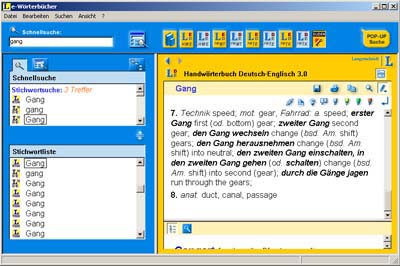 colleagues agree that they rarely reach for bound dictionaries anymore. It is so much quicker and easier to highlight a word and use a keyboard shortcut to paste it into an electronic dictionary interface.
Back when I still thought the ATA accreditation (now called ‘certification’) exam was worth taking I bought lots of bound dictionaries to bring with me to the exam. Now I rarely reach for a dictionary if I have it in electronic form or can easily look up a term on Google.
It is also so easy to work anywhere, because I can pop the translation on my laptop and use all my electronic dictionaries without having to schlepp my heavy dictionaries with me. That is one of the main reasons I stopped working for the FBI – having to drag all my dictionaries in with me (well, that and not being given access to the Internet). Now it isn’t a problem to head to a coffee shop or restaurant with WiFi or travel to Germany or my sister’s to babysit and not be at a disadvantage. I remember dragging dictionaries with me to several ATA conferences because I had some translations to finish before I could enjoy myself.
I love my Langenscheidt and UniLex interfaces. I have four dictionaries each installed on them and, after updating the UniLex and changing a setting under Options, am able to search all the dictionaries in the interface at once. My Langenscheidt dictionaries include the Handwörterbuch, Fachwörterbuch der Mikroelektronik, Fachwörterbuch Telekommunikation, and Peter Schmitt’s Fachwörterbuch der Technik und angewandte Wissenschaften (one of the best technical dictionaries out there). The UniLex interface allows me to quickly access to the Collins/Pons Unabridged German to English Dictionary, Ernst Wörterbuch der industriellen Technik (a good technical dictionary, which I also have in bound form), Brinkmann/Blaha Daten- und Kommunikationtechnik (Data Systems and Communication Technology) Dictionary, and Kucera Dictionary of Chemistry. I ordered the latest electronic version of the Großer Eichborn from UniLex yesterday. I am seriously considering buying the electronic version Dietl/Lorenz Dictionary of Legal, Commercial and Political Terms as well to make my life easier because it takes so long to pull the dictionary off the shelf next to me and find the word I need. Time is money and the more words you can translate an hour the more you earn!
If a term isn’t in any of the dictionaries in the one interface it is usually in the other. I also like to check both and compare all the suggestions in order to choose the most suitable one. I won’t entirely stop buying bound dictionaries, because a) some are still only available in hard copy and b) I am a dictionary addict and they look so great on the shelf. But if given the choice I will always choose the CD-ROM.
Would you willingly point out repetitions? August 28, 2008
Posted by Jill (@bonnjill) in Business practices, Translation Sites.4 comments
One of my project managers got upset with me last week when a 2,000-word job I translated for him ended up having 900 words of 100% repetitions. Apparently it was the client’s error, and the PM didn’t catch it either. Since it was such a small job I assumed it was a deliberate choice on the client’s part (not every sentence was repeated, so it could have been for something completely different) and didn’t bother to say anything. But you know what they say about assumptions – “If you assume, you make an ASS out of U and ME.”
It is worth mentioning that this is one of my clients that has never insisted on Trados discounts. I wrote the PM several e-mails explaining why I did what I did and offered to charge 30% on the 900 words, since I had a feeling the client had really screwed up and would be refusing to pay for those 900 words. It was a misunderstanding all around.
I never heard back from him and when I sent my invoice to the company owner and apologized and explained the discounted price, he had no idea what I was talking about. Oops! So it must not have been as bad as I assumed it was, but a little more communication from the PM would have soothed my nerves. Apparently the PM is on vacation. Here I have been worrying about losing the PM’s trust and business because I hadn’t heard from him. Luckily this is one of my oldest and dearest clients with whom I have an excellent relationship, so there’s no harm done. But what if it had been a random client with whom I only work on occasion…
I thought it was definitely worth mentioning here for that very reason. I was curious as to how you all would have handled the situation. If you notice repetitions, would you voluntarily mention it (and voluntarily earn less)? That seems kind of counterintuitive to me, but apparently this PM was disappointed that I didn’t. I’m curious to hear what you all think.
What annoys you? August 25, 2008
Posted by Jill (@bonnjill) in Business practices, Random musings, Translation Sites.8 comments
Today’s Cleveland Plain Dealer features an article entitled “What annoys you? PDQ asks readers to share what gets under their skin.” The article interviewed people in different occupations asking “In the course of your job, what’s the one thing people do that annoys you the most?” in the “not-so-subtle hope is that the people doing these terrible things will read these answers, and, well, um, stop already.” It was a fun little read, and I thought it would be fun to ask you all what annoys you the most. I’ll start…
The thing that annoys me the most is when project managers at large-scale agencies send a job query e-mail to an unspecified number of BCC: recipients asking if you are available to translate X number of words by X date (usually an impossible word count with an equally impossible deadline) – without mentioning the subject matter involved – and then the job has already been assigned once you respond (even if you respond within 10 minutes of receiving the e-mail). This is the main reason why I prefer to work with smaller agencies.
OK, your turn. Whether you are a project manager, freelance translator, in-house translator, or someone not in the translation industry who just stumbled upon this blog during a random Google search, what is the one thing that annoys you the most about your job?
Hollywood gets lost in translation – Groan! August 1, 2008
Posted by Jill (@bonnjill) in German culture, Random musings, Translation Sites.3 comments
USA Today has an interesting article about how Hollywood is taking “a more active role in translating its [movie] titles to make sure ‘global launches’ go well.” Hollywood gets lost in translation examines the practice of titling movies for foreign audiences and cites several interesting examples. The author explains “Titles are often tweaked to sound better in the local language, or to provide a hint of the plot to audiences who might be skeptical of what is, to them, a foreign film.” It claims that “translations used to be left to foreign film distributors, with dubious results.” It is an interesting article that will hopefully educate USA Today’s ADHD-afflicted readership that there are other countries and cultures beyond our borders (dare to dream!).
I used to love trying to guess the American title of a movie or TV show when I lived in Germany and always enjoy researching the alternate titles on The Internet Movie Database when I come upon a movie or TV show title in a translation. For instance, the “Die Hard” movies are called Stirb langsam (Die Slowly) in German. “Die Hard 2” is Stirb Langsam 2 – Die Harder, “Die Hard: With a Vengeance” became Stirb Langsam – Jetzt erst recht (Die Slowly – Now more than ever), and “Live Free or Die Hard” has the imaginative title Stirb Langsam 4.0. And, yes, I needed to know this for a computer game.
It’s about time Hollywood started recognizing that they aren’t just making movies for American audiences. Now if only we could get them to stop including gratuitous shots of the American flag or other unnecessary shows of patriotism. Don’t get me wrong; I am as patriotic as the next person. However, after six years in Germany that kind of stuff really makes me shudder because instead of experiencing a swelling of pride or whatever the filmmakers expect us to react with I immediately wonder how non-Americans will react. Most Germans I know generally roll their eyes or make a comment. I had the same reaction at the Cleveland Indians’ game this past Sunday. Instead of belting out “Take Me Out to the Ballgame” during the Seventh Inning Stretch they started us off singing “God Bless America” (the ACLU would have had a field day…) and I sheepishly looked over at the Japanese guy sitting two seats over from me to see how he was reacting to it. OK, how did I get off-topic again…


 Musings from an overworked translator