End of day? June 5, 2008
Posted by Jill (@bonnjill) in Business practices, Translation Sites.5 comments
There’s an interesting discussion on the PT listserv at the moment about “end of day” (EOD) delivery deadlines. The translator who started the discussion took it to mean the end of her day (midnight), while her client meant 5 or 6 p.m. (close of business) This is a really interesting discussion, because “end of day” is so nebulous. Some translators agreed with her, saying that for them “end of day” means the customer wants it in their e-mail in box when they get to work the next morning so that they can immediately start working on it (although in this case the client would have most likely stipulated SOB – start of business – or “first thing tomorrow morning”). The majority of the members, however, felt that “end of day” meant the end of normal business hours.
Those of us (like me) who prefer to start work late in the morning and do our best work in the late afternoon or evening hours should never assume that the end of our day is the end of everyone else’s day. One member pointed out that we should not assume that our clients take note of our work habits. Nor should they.
This discussion also makes it clear that we should never assume things and should always clarify our terms at the beginning of the job – not the end. We are service providers, and it is our job to ensure that we meet our client’s stipulated deadline.
So in the future if your client tells you “2000 words EOD” be sure to ask exactly what time they consider to be end of day. You may be surprised at the response.
When do you cry “Uncle”? June 4, 2008
Posted by Jill (@bonnjill) in Business practices, Random musings, Translation Sites.2 comments
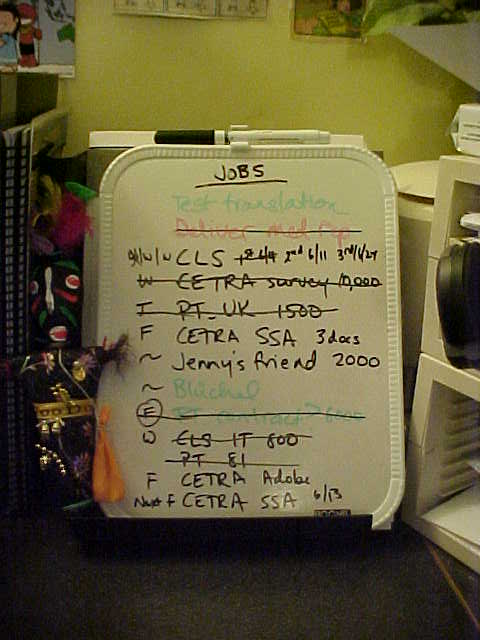 I just finished two large jobs and a couple small ones, delivering a total of 20,000 words today. The muscles in my shoulders are stiff, and my arms are a little numb. I have been busy before, but the past few days have been absolutely insane. Everyone I know is completely overwhelmed with translations. When does it end, and when do you cry “Uncle”?
One friend/colleague starts turning down work when she has six Post-It notes stuck to her monitor, indicating six different jobs. In my case, my job board, as you can see, is filled from top to bottom with jobs and crossed-out jobs. I guess you just learn how much you can handle and practice saying no to clients when you are too overwhelmed. But that’s easier said than done.
I’d be curious to hear how everyone else manages to handle a deluge of work. Do you feel guilty saying no to your clients? Do you say no to new clients, yet squeeze in work from long-term clients? I realize my work load this past week was beyond insane. I have some small jobs on my desk now, which are manageable, but I’m taking some time off tomorrow for some “me time” – a pedicure and if they can squeeze me in at the last minute a deep-tissue massage. I also plan on finally writing about the importance of a job tracking system and will talk about how some of my friends track their jobs as well.
In the meantime, I’m off to get some supper and get ready for water aerobics – and, most importantly, turning off my computer. More on this subject tomorrow!
An example of why study/living abroad is so important for a translator June 3, 2008
Posted by Jill (@bonnjill) in Random musings, Translation Sites.2 comments
Among other things, I’m translating a marketing survey at the moment. After being asked the same question several different ways, the respondent is understandably frustrated. His (I’m going out on a limb and assuming he’s male based on the language used) response is Das habe ich eben schon beantwortet. Ihr Pappnasen, checkt ihrs noch? Luckily I’m having an ongoing chat on Skype with a fellow translator about our day, our dogs, whether I can proofread a small text, etc. You’d think Pappnasen would be my problem, which is why she is surprised that I am asking her about checkt ihrs noch?. She’s from Baden-Württemburg and hadn’t heard the term Pappnasen very often. I explained to her that my friends in Bonn used to call each other Pappnasen all the time. It must be a Cologne/Bonn thing because of Karneval. Anyway, if I had been depending solely on a dictionary to translate this phrase I would have been stumped. Langenscheidt offers false nose for Pappnasen. Leo‘s a little better, because it offers fool and idiot in addition to cardboard nose and false nose. This is yet another example of why living abroad is so important to the cultural understanding needed to understand and therefore translate a text well. In the end, I decided to go with When are you finally going to get it, you morons! Thanks, Eva!
Fanta: The Reich Stuff? June 2, 2008
Posted by Jill (@bonnjill) in Random musings.add a comment
I should be translating, but just stumbled on this interesting bit of trivia on my Snopes.com gadget on my iGoogle page. I had never heard the urban legend that Fanta was invented by the Nazis. It isn’t true, but the story of how it was invented is very interesting. Apparently Fanta was invented during World War II when it became difficult to get the ingredients to make the syrup. A German-born Coca-Cola employee, Max Keith, came up with the idea to make a new soda with whatever they could find to keep the factories operating and protect Coca-Cola people by keeping them employed during the war.
The importance of ergonomics – and a good desk chair June 2, 2008
Posted by Jill (@bonnjill) in Random musings.1 comment so far
One of the things I stress to the students at Kent State’s Institute for Applied Linguistics is the importance of ergonomics – and most importantly a good desk chair. You will most likely be sitting at your computer for 6 to 10 hours a day (sometimes more), so it is very important to set up an ergonomically correct workstation. One of my former students bought a massage desk chair and loves it. Friends in Germany love sitting on exercise balls because they exercise your core muscles and force proper spine alignment. I had one in Germany that had little nubs to prevent it from rolling away when you weren’t sitting on it. I really regret not bringing it with me in my move back to the U.S. The main requirement is that the exercise ball be high enough to allow you to sit comfortably at the desk with your arms at a 90 degree angle to the keyboard.
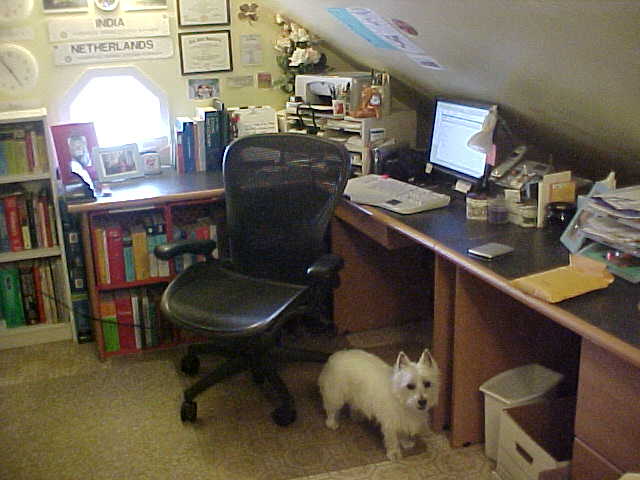 Your computer monitor should be at eye level and there should be no glare from light sources behind or in front of the monitor. Ideally, the light should come from the side. Your desk chair should be adjusted so that your feet are flat on the floor (or resting on a foot rest – a telephone book can also be substituted for a foot rest) and the lumbar support presses comfortably against your back and follows the curves of your back. When the armrest on my last desk chair broke, I moved it to the living room computer and bought a used Herman Miller Aeron chair. The Aeron chair is considered the BMW of desk chairs and is priced accordingly ($700 to >$1,000). You can frequently find them at used office furniture stores or from offices that are going out of business.
I also find an ergonomic keyboard to be invaluable in preventing repetitive stress injury and carpal tunnel syndrome (I also use a little software tool called ‘WorkPace‘ to monitor my work level and force me take regular breaks, but more on that another day). I have two German Cherry keyboards with a built-in  touchpad right under the arrow keys. They are so well-used that the letters have worn off some of the keys. There are numerous ergonomic keyboards and click-less mice out there to choose from. I find having a built-in touchpad prevents my arm from getting sore from constantly reaching for a mouse. The hot pink button is a ‘Panic’ button I bought from a local gag store.
You should also place the items you use most frequently within easy reach from where you sit. For translators, this means the phone and the dictionaries you use most often should be closest to you so you do not need to stretch to reach them. Dictionaries and reference materials I use less frequently are in bookcases scattered around my office (the sloping ceiling does not allow tall bookcases).
It is much better to prevent the injury from occurring in the first place than recuperating from a debilitating injury. The health consequences associated with desk work, such as a stiff neck, strained eyes, sore forearms or tingling and numbness that would indicate carpal tunnel, are easily preventable if you take the time to set your workspace up correctly. I also go the extra mile and try to get regular, monthly massages to loosen the rock-hard muscles in my neck and shoulders.
Bulk discounts – yea or nay? May 30, 2008
Posted by Jill (@bonnjill) in Business practices, Marketing ideas, Translation Sites.5 comments
There’s an interesting discussion on the ATA German Language Division listserv at the moment about bulk discounts (a.k.a. volume discounts). The general consensus is not to offer them. I wanted to summarize the main points why translators should not consider offering bulk discounts.
-
It is not beneficial to work more at a lower rate – in fact, it’s worse, because you would have to decline assignments from your regular clients who pay your standard rates.
- These regular clients will then go elsewhere when you are not available, and you would lose a good client.
- Most professionals – and even most non-skilled workers – who work over 8 hours a day get paid time and a half overtime – and double time on weekends. Freelance translators unfortunately do not have this luxury. And offering volume discounts ensures that the opposite is true – you are paid LESS for working MORE.
- Many jobs that require volume discounts also have extremely tight deadlines, which would make it a rush job for which you should be paid more – not less.
-
You don’t know if the client will really come through with the kind of volume he is promising (one savvy member suggested drafting up a contract to “contractually commit to a legally enforceable minimum (annual) volume” and if the client doesn’t hold up its end of the bargain you can consider the contract null and void).
- If such a contract were signed, you might be legally considered an employee.
- Why spend time working for a client who doesn’t respect you enough to pay a competitive rate?
- Prices keep rising (gas, food, housing, etc.) and agencies keep trying to depress prices. Volume discounts are just another way to lower the price. Globalization may be rampant, but the fact remains that U.S.-based translators cannot afford to work at extremely low rates and still make a living. If you continue to offer quality translations the clients who choose to outsource will eventually come back. If they don’t, there is still plenty of work to go around. With globalization the need for translation is increasing exponentially and there aren’t enough skilled translators to handle the load as it is.
- Agencies that ask for volume discounts are most likely trying to get a bargain and negotiate the best price. Most agencies will be willing to pay your rate once you tell them you do not offer volume discounts.
- The supply and demand in the industry means you can safely turn down volume discounts and still have plenty of work from other clients. I get contacted by one to two new clients a week who found my profile on the Internet or ATA database or heard about me from colleagues or clients.
If anyone else wants to add something to the list I would love to hear it.
BTW, if you work in German you should definitely join the ATA and subscribe to the GLD listserv. The GLD list has 297 members despite the division itself having over five times as many members (currently close to 1200 members). Those members don’t know what they are missing. I find the listserv to be one of the most valuable tools out there. It is a virtual water cooler for home-based workers (and even some in-house translators). We help each other with terminology and discuss business practices and anything else you can possibly think of (even German stores and food). Most of the things I will bring up here I have learned from the GLD list or PT, which is a Germany-based listserv for translators with 1331 members as of 3/30/08 (the lingua franca is of course German).
Spelling Bee fever May 30, 2008
Posted by Jill (@bonnjill) in Random musings.2 comments
Reading the paper this morning (yes, despite having a blog and working on the computer 24/7 I prefer to start my morning with a cup of fresh-brewed German coffee, turning the pages with newsprint-stained fingers), I was reminded it is time for the annual Scripps’ National Spelling Bee. As you all know, most translators have mad spelling skills and an interest in words. When my friend Corinne was in town to present at a NOTA event for local teachers and visit me two weeks ago, we went to see The 25th Annual Putnam County Spelling Bee, a Broadway musical about the spelling bee that is currently touring the country. I hadn’t laughed that hard in a long time. Almost every line was LOL funny. If you get a chance to see it, you should take advantage of it! You might even consider applying to be one of the four audience members who gets to spell words on-stage with the others. The night we were there one woman with excellent spelling skills flummoxed the actor playing the vice principal when she spelled a particularly difficult word, designed to eliminate her, correctly.
For those of you who won’t be able to go see the musical, ESPN will be broadcasting the semifinals live today from 11 a.m. to 2 p.m. and ABC will carry the finals live this evening from 8 to 10 p.m.
A well-deserved night out May 30, 2008
Posted by Jill (@bonnjill) in Marketing ideas.2 comments
As easy as it is to chain yourself to the computer, it is very important for home-based freelancers to get out and socialize. Someone recently described translators as “gentle people working in attics.” In some respects this can be quite true. Before I got my dog it wasn’t unusual for me to go several days without leaving my apartment. However, I find it very important to get out and, as the local newspaper misquoted me in an interview as saying, “work on my social skills.”
I organize a local German language Meetup.com group and decided it would be nice to go see “Die Fälscher” (English: The Counterfeiters), which won the Oscar for Best Foreign Language Film of the Year in 2008. Afterwards the group went to dinner at a Turkish restaurant to discuss the movie and get to know each other. It felt great to turn the computer off at 5:30 after translating several thousand words and meeting some like-minded folks to enjoy an excellent movie. If you don’t have a Meetup.com group for your language in your area, you should definitely start one. I have met some nice people and am getting away from my desk more often. Plus, it is a business expense (advertising and keeping up my language skills – at least that’s what I’ll argue if I’m ever audited). My group is only three months old and I’ve already gotten an interesting proofreading job from it.
As for the movie, which was the original idea behind this musing but I digressed as I typed, if you haven’t seen it and are looking for a powerful and thought-provoking film be sure to check it out. “The Counterfeiters” is the true story of the largest counterfeiting operation in history, set up by the Nazis in 1936. The main character, Saloman Sorowitsch, is an expert forger. He is arrested for forgery and eventually finds himself in a concentration camp. He uses his artistic skills and cunning to survive and is soon transferred to the upgraded camp of Sachsenhausen, where he and a group of professionals/prisoners are forced to produce fake foreign currency. The acting is top-notch, and the attention to detail is amazing. In fact, the acting and costumes were so good that I didn’t even recognize that the star of the film played one of my favorite Austrian TV series characters, Bezirksinspektor Ernst Stockinger, from Kommissar Rex and Stockinger. “Stocki” was very much an Austrian Columbo – seemingly bumbling and at times absurd and laughable. This role in “The Counterfeiters” was a complete departure.
And I’m relaxed and refreshed for another day of translating tomorrow. After all, all work and no play makes Jill a dull gal.
The ebb and flow of the translation industry May 29, 2008
Posted by Jill (@bonnjill) in Random musings.3 comments
Thanks to the encouragement of my friend, Corinne, I have decided to share my inane thoughts and helpful tips with the world. You are probably wondering who I am and why I need a blog. I am a German to English translator and have been in the translation industry since 1995, when I graduated with an M.A. in translation from Kent State University. I lived and worked in Bonn, Germany for six years and have been back in the U.S. since 2001. I am a freelancer and work from home, which affords me the freedom to pick and choose jobs and take breaks whenever I want. I use a lot of tools in my job and have amassed a ton of helpful hints, and I plan on sharing them for posterity through this blog.
You’re probably wondering about the title of this post. It never ceases to amaze me how the field of translation can be so feast or famine. A few weeks ago I was eking by on a couple hundred words a day, and today I have assignments totally approximately 15,000 words – all due by June 4th. I also have a test translation I have been trying to finish, but it isn’t going to happen until I get the paid work off my desk. Most translators I know have periods in which they doubt their career choice – and it is generally in periods of feast and famine. The trick is knowing that this too shall pass. It’s important to remind yourself that your nightmare translation job will be over eventually and the next plum job is sure to come in any day now. I love my job – and plan to use this blog to explain why. I hope you enjoy it.


 Musings from an overworked translator