Posted by Jill (@bonnjill) in Business practices, Random musings.
As I have mentioned before, I have reached the point where I can be more selective about my clients. I have already raised my rates and still find myself regularly turning down two to three (or more) jobs a day from new and existing clients. I am finding the process difficult on several different levels.
I severed ties with a particularly difficult client (a European PR agency) several months ago after a nasty e-mail exchange with one of its employees. I had been working with them since 2006. They would frequently send me texts that were due within a few hours and had asked me to translate a difficult batch of software strings and other technical website features for their client’s new portal. They also expected me to use a specialized, proprietary tool without being able to answer any of my questions about it (in all fairness the client had sent them the tool and they had no idea how to use it. Luckily I am adept enough with software to be able to figure it out on my own). When I would turn the jobs down they would literally beg me (“bitte, bitte“) to accept the job. The whole month of the site launch had rankled my enjoyment of working with them.
I had been getting more and more frustrated with their demands and complete cluelessness about the field of translation. All my attempts at client education were met with complete disregard. After the employee demanded I send her the character count of the multiple-file job I had delivered a few days before and had already archived, I told her my final line count, which was how I billed them, and said if she needed the character count she could do it by opening the files and using the Word count feature in Word (the files had no text boxes or anything that wouldn’t be counted). She replied that she wasn’t my employee, which set me off, so I replied that I wasn’t her employee either and suggested she find someone else to translate her texts in the future. It left bad feelings on both sides, which is a shame because I really enjoyed working with the agency owner.
I recently found myself in a similar, yet slightly different situation at the end of last week. I have been working with a European translation agency for about a year now and was never really happy with the remuneration because they insisted on using five different Trados rate classifications. They approached me about translating a large job that would take up the entire month, which I considered accepting provided I still had time for my other clients’ jobs. However, when I asked about an outstanding invoice that was three weeks overdue I was told that their payment terms were 60 days, which was news to me. Payment up to now had always been made within 45 days, which had been acceptable. At that point I decided I needed to let them go. It was a tough decision, because they agreed to make an exception and honor my payment terms of 30 days. However, they asked that I start billing them in U.S. dollars, which would cost me bank transfer fees, instead of paying me in euros to my German account. And then there was still the problem with the Trados rate scale. But that is another post in and of itself…
I realize I made a good decision in the first case, but I am questioning the second. We ended our e-mail discussion on very good terms. She thanked me for my “frank response” and said she would take my arguments about Trados into consideration and discuss it with her colleagues. She also wished me all the best and said “If in the future your circumstances change please don’t hesitate to get back into contact with us.” Such an understanding response and willingness to compromise makes it very difficult to have the resolve to stick to a decision.
I would love to hear your opinions on the matter. Where do you draw the line in the sand with a client? How have you handled having too many clients and not enough time in the day to translate all the jobs offered to you? I am opposed to the idea of outsourcing extra work or expanding to become an agency, because I am proud of my work and love what I do.
Posted by Jill (@bonnjill) in Business practices, Random musings.
Inspired by the Masked Translator’s post, When your client goes bankrupt, I want to stress the importance of “spreading the love.” By that I mean the importance of not relying on one or two customers for all of your work. I know I’ve said this before, but it bears repeating. If one of those customers goes bankrupt or the project manager you work with leaves to strike out on their own or go work for another company, you might find yourself in dire straits.
When I was first establishing myself on the U.S. market after relocating to the U.S. in 2001, one of my colleagues gave me the best advice when she told me you need 7 clients to be successful. I realize the wisdom of those words and strive to cultivate a large client base. I didn’t realize how many clients I actually had until I entered them all into my Translation Office 3000 database. It has reached the point where I am trying to cull some of my clients who are difficult to work with or have unacceptable payment terms, but more on that another day.
Not every client is going to contact you as their first point of contact, but that isn’t necessary to build a thriving translation business. I can confidently say that I am the “A translator” for two of my clients. When they contact me (at least once a week, if not some weeks every day) I do everything I can to make sure I have capacity for their work. One of them tends to send a small job every day or every couple days, but those small jobs add up when I issue my invoice to them at the end of the month (I only issue monthly bills for three clients – everyone else gets billed when the job is delivered). I also have numerous clients for whom I am their B or C translator, but that is okay too. Having several clients who contact you with job requests (perhaps not every day, but at least several times a month) ensures that you will be kept busy throughout the month.
This also translates into a steady inflow of payments, so there is no major ebb and flow in the bank account (except for maybe right after my quarterly tax payment when the clients have also had to pay their quarterly taxes and are a little slow in issuing payments). I must be extremely lucky, because I have never had a client go bankrupt while owing me money. However, I also don’t tie myself up with one client’s job for an entire month, ensuring no other money will be coming in. If you spread the love, you’ll find things go relatively smoothly most of the time (but be sure to tuck aside some money as a cushion to cover the dry spells – and never, never tap into your quarterly tax payment fund).
Posted by Jill (@bonnjill) in Business practices, Random musings.
My iGoogle page has once again provided an interesting tidbit. Today’s “How To of The Day” is “How to Get Clients to Pay Invoices Promptly.” As someone who has $1000 in overdue invoices and almost $2000 due within the next week, I was very curious to see what they had to say.
Their tips include:
- Make your payment policies clear at the time your services
are retained.
- Accept all forms of payment and encourage credit card
payment.
- Get a deposit in advance.
- Always let the customer pay when they offer.
- Make arrangements for payment before you deliver the final
product.
- Follow up every day until you receive your money.
- Apply your payment policies to every single customer.
- Contact the credit agencies.
I have only quoted the highlights. I highly suggest clicking on the above link and reading the whole article.
I agree with most of the points, but unfortunately in our business some of the points don’t apply. First of all, I don’t know many translators who are willing to accept credit cards (I know there are a few who rely on PayPal and/or Moneybookers, but I personally can’t justify the fee). Getting a deposit in advance or payment before delivery is all well and good if the client is a direct client, but I don’t know many (if any) translation agencies that are willing to accept either of those practices. I also disagree with following up every day until you get paid. I generally wait a week or two before I send out a reminder. Once the invoice is over 30 days late I will write an e-mail every week or every couple days. If it were ever to get more than 45 days late I think I would then start writing them every day and being a total pain.
Luckily I haven’t had to worry about this much. I do my due diligence before accepting work from a new client (I subscribe to Payment Practices and Zahlungspraxis [a German-language payment practices list] and ask for referrals from several of their translators if the agency isn’t listed on one of those lists) and generally only work with clients with whom I have a good relationship. In the rare cases that an invoice has been almost 30 days overdue it is usually because the project manager or accounting has misplaced or lost the invoice – or at least claims they have and assure me that it will be processed as soon as possible.
The bullet item I would probably add would be: “9. Submit invoices either with the job or immediately after you have submitted the job.” I’ve found most agencies take 30 to 45 days to pay an invoice (and I refuse to work with agencies that have payment terms of 60 days or even 60 days EOM [end of month]). Why wait an additional 15, 20 or 30 days because it took you that long to send them the invoice in the first place?
Do you have any tips you have found to be helpful for being paid promptly by your clients? I definitely want to hear them!
Posted by Jill (@bonnjill) in Business practices, Tools.
Disclaimer: For all those of you who already aware of this issue, bear with me, because this is for those who are not as familiar with word counts. Also, since I am a German translator, I am not at all familiar with how to count languages such as Japanese, Hebrew, etc. If you work in one of these languages, I suggest you ask some of your colleagues what they use.
Counting words, characters, and/or lines is a crucial subject for all freelance translators, because it is the foundation for pricing our translations, issuing invoices to clients, and getting paid. However, if you have been relying exclusively on the Word Count feature in Microsoft Word to invoice your clients, you may have been invoicing for a much lower word count than you actually translated. Different word processing programs and translation tools often produce different word count values for the same document. Sometimes those differences can be quite drastic. They are due to the use of different rules for counting as well as deficiencies in the applications themselves.
If you have been using the Word Count feature in Microsoft Word to invoice your clients, you have been short-changing yourself. The reason for this is that Microsoft Word does not count comments, headers, footers, embedded objects and files, and—most importantly—text boxes. If a file has been run through an Optical Character Recognition program, these programs tend to create a lot of text boxes. Word does not count the words in text boxes, and yet you definitely have to translate them.
The same problem exists with Excel and PowerPoint. One of my clients once sent me a PowerPoint presentation to translate and quoted me a word count of 2,000 words. By the end of the day I was nowhere close to being finished. After a quick count using PractiCount I discovered that the actual word count was more like 6,000 words because the client had not counted the embedded Excel spreadsheets. I wrote the client and explained why I would not be meeting the one-day deadline, and the client agreed to give me two extra days to work on it.
PowerPoint also does not offer character counts, which means translators in languages that rely on character counts should consider using a third party counting tool for this reason.
There is also a problem with version consistency. Every version of Word, PowerPoint, etc. has different rules regarding words and word count. PowerPoint 97 and 2000 are not consistent with the Word counting rules. For example, they count hyphenated words as two words. Fortunately (or perhaps unfortunately for us?) PowerPoint XP corrects this difference. In plain text, this means that two different users with different PowerPoint versions may disagree about the word count on the same document. So if your client contests your word count, the reason may be because the client is using a different version of Word, PowerPoint, etc. I for one am still using Word 2002 and see no reason to upgrade to Word 2007, because I am happy (and, most importantly, intimately familiar) with the 2002 version. I know I am not alone.
In our comparison of counting tools (see What’s in a Word?, ATA Chronicle, August 2006), PractiCount and Total Assistant came out the clear winners. PractiCount ($59.95 for the standard edition) is easy to use due to its tabbed interface and adjustable settings, and it can also generate invoices. PractiCount can count footers, headers, text boxes, inserted Excel and PowerPoint documents, comments, WordArt and more. Total Assistant ($24.95 for the standard version, $44.95 for the professional version) can produce a word count of multiple files in just two steps and counts unfriendly formats such as PowerPoint and Adobe Acrobat. Total Assistant is a more basic but also cheaper program than PractiCount. Total Assistant Pro also adds invoice generation and other reports.
Some of the available word count tools are AnyCount (which comes with Translation Office 3000 or can be purchased as a stand-alone tool), TextCount, and FreeBudget. Marita and I recommend downloading the various free trial versions and deciding which one you prefer and best suits your needs.
I’m sure there are many more tools out there, and if you work with a different tool, feel free to tell us about it in the comments. As I’ve said, I can only talk about the ones I have worked with in the past.
Posted by Jill (@bonnjill) in Business practices, Tools, Translation Sites.
I’m amazed to learn that one of my translation agency clients, which specializes in financial translations (note: I do not translate the heavy financial stuff. They have me translate magazine articles and the like), relies on the Trados analysis feature to perform its word counts, because Trados does not count stand-alone numbers. Numbers often have to be localized (commas changed to decimal points and vice versa), so if you have a document with a lot of numeric information with decimals or tables of pure numbers, Trados short-changes you. I feel that if I have to look at the number and/or physically alter it, then I should of course be compensated for that work.
Trados is a translation environment (CAT) tool and not a word count tool. Marita Marcano and I wrote an article about word count tools in the ATA Chronicle (“What’s in a Word?, p. 32 of the August 2006 issue) and presented a session at last year’s ATA conference on word count tools with Clove Lynch, who was representing the Localization Industry Standards Association (LISA). LISA is working on coming up with a word counting standard, so hopefully this will change things soon. However, as it stands now, each tool has its own counting algorithm it uses to perform its count. There is no standardization between tools. We found PractiCount and Total Assistant to be the most accurate tools in our comparison. Word was a disaster (for reasons I will go into tomorrow for those of you who are not aware of the problem).
It seems to be a well-known fact among my colleagues that Trados does not count numbers. I don’t understand why some agencies insist on using Trados to do their word counts. They are not only shorting the translators, who are typing in the numbers, but are shorting themselves because they bill their clients based on these incorrect word counts.
Update: Client education does indeed work. I just received my client’s response: “I will definitely forward your feedback on the Trados Tool. It is the only tool we have to make a wordcount!!” I referred them to my article as well.
Posted by Jill (@bonnjill) in Business practices, Random musings, Translation Sites.
If you are just getting started (or are striving to be better), here are my top 10 tips to be efficient and successful.
1. Be organized. Develop a system that works for you. Use some kind of job tracking system. Make lists of tasks you need to do that day, week, month. Keep all open jobs in a folder and move the files somewhere else once you have delivered the job. Set up an archiving system to archive your past work using a system that allows you to quickly and easily locate a file if the client asks for it. I zip up the source file, Trados backup file, target file, and any reference materials and/or any purchase orders from the client and name it with the client name and some descriptive words about the file (title, keywords, etc.). I then save the zip file in a folder called “Archive” in My Documents that has subfolders for each month, which are then moved inside folders for each year at the end of the year. Also, keep a handle on your e-mail in box using folders and e-mail filters. Read your e-mail program’s Help to find out more.
2. Manage your time wisely. Check your e-mail and plan your day accordingly as soon as you turn the computer on. Work when you need to work. Set your e-mail program to check e-mail every half hour – not as soon as it comes in. Avoid being sucked into watching television when you should be working. One of my colleagues always recounts to new translators how she would watch soap operas for several hours a day when she first started translating. If you do take a break, set a deadline and then go back to work when that time is up.
3. Take regular breaks. Try to get up and walk away from your desk every hour for at least five minutes. Make a cup of tea or coffee or drink a glass of water. Take a lunch break. Sitting at a desk in one position can be very taxing on your shoulders and strains the eyes. Getting up and walking away allows your eyes to focus on something else for a while. Your health and your sanity will thank you.
4. Be easy to work with. Be the translator that project managers contact for assignments. If you cannot accept a job, try to recommend another translator who can. Always be pleasant and try to be as accommodating as possible. I always include a few sentences of personal greeting to my project managers or the accountant who receives my invoice. Build up a personal rapport with your clients.
5. Strive to be the best. Respond promptly to e-mails – even if it is just to say “Thank you for your inquiry; however, I’m afraid I am booked through next Thursday.” Turn in your translations on time or even early. If you are running behind, notify your clients in advance – not an hour before the deadline. Do everything you can to track down that last elusive term or abbreviation. Ask your colleagues on a listserv, call an expert, or research it on Google. One time I was translating bank statements and records and called someone at the bank in Germany to find out exactly what the abbreviations meant instead of just guessing.
6. Don’t be a generalist – specialize. By that I mean don’t accept every job that comes across your desk just because you might need the work. If you don’t know how to translate patents or have no idea what the steel pressing text is about, turn it down! You’ll be doing yourself and your client a favor. If you accept a job that is over your head you will only be stressing yourself out and may ruin your relationship with your client by turning in a sub-par translation despite all your hard work.
7. Put in the extra effort to format your documents properly. Clients really appreciate it when you format the documents to correspond to the source text. That said, they may have different margin settings or may not have your font, so your perfectly formatted document could look terrible if you don’t format in a manner that transcends margins and fonts. Learn as much as you can about formatting. Learn how to set tabs instead of hitting the tab key eight times and/or the space bar. Try to use common fonts such as Arial or Times New Roman instead of obscure fonts such as Shruti or Ravie. Learn how to use the Hanging Indent tab on the ruler instead of using the space bar to line up your text.
8. Run spell-check. This should be obvious, but you’d be surprised how many translators do not run spell-check before delivering their translations. Make sure your translation is perfect – or at least has no obvious typos. Someone once told me to proof your translation backwards so you really notice the words.
9. Try to take tech-free days. When I am really busy my apartment looks like a tornado went through it by the end of the week :-). It’s important to schedule days or afternoons off so you can run errands, do laundry, vacuum, wash dishes, and just plain relax. My biggest pet peeve is that agencies don’t seem to respect weekends. It is up to us to defend our right to have a day or two off. Everyone needs days off in order to recharge. In our case, we also need to loosen up our shoulders and give our brains a break. Translation can be stressful and requires a lot of concentration and thought.
10. Keep marketing yourself whenever you can. Even though I have plenty of work and several clients who regularly contact me at least several times a week, you never know if that client will develop liquidity problems, your favorite project manager may leave and no one else there will know you, or their client base may change and they will suddenly no longer be getting work in your field of specialization. Become active in local groups (either translation-related or in your fields of specialization) and post regularly on listservs where your fellow translators are active. Join the ATA and attend their smaller, specialized conferences (you’re more likely to make lucrative contacts). Keep your resume up to date, post your profile/resume on translator portals such as Aquarius, TranslatorsCafe, or ProZ (however, I don’t pay to use them.), and carry business cards with you wherever you go. You never know where your next job will come from.
Does anyone else have a fabulous tip they would like to share? I’d love to hear it!
Posted by Jill (@bonnjill) in Business practices, Marketing ideas, Random musings.
After a good night’s sleep I feel well-rested and ready to the tackle the day.
I’m going to treat myself to a nice breakfast out in a few minutes, but I just wanted to talk about the importance of having a foreign bank account. Having an account in your foreign country of choice will not only save your foreign-based clients money and hassle when paying you, it will also save you money on wire transfer fees and/or foreign check charges.
A service like Paypal and Moneybookers may be convenient, but it is a lot more expensive than setting up a foreign bank account when you consider the fees involved (1% or 5% doesn’t sound like much, but when you have a EUR 5,000.00 payment it can be downright painful!)
You may also obtain more work from agencies in foreign countries. For instance, with the dollar tanking, agencies in Europe are in search of good translators here in the U.S. because they can hire translators for a lower euro word or line rate yet still keep the translators happy because the rate is higher in the long run due to the exchange rate. But the key to being able to earn euros is having a euro-based bank account.
I opened my bank account in Germany while I was living there and simply changed my address when I moved. My bank (Dresdner Bank, which bought out the Internet-based Advance Bank) has no problems mailing my bank statements to the U.S., and I am able to track my accounts, make transfers, and use my Dresdner Bank credit card here in the U.S. As far as I am concerned, online banking is one of the best inventions since sliced bread and the Internet!
One of my French translator friends was in Paris a few weeks ago and managed to open a savings account there with the help of one of her friends/colleagues, who went with her and dropped a lot of names of the people he knows at the bank, which really helped get things moving.
That is all well and good, but there are also ways that U.S.-based translators can open a foreign bank account without having to physically be in the foreign country. It’s a little extra work, but it’s really worth it. Now, I can only speak for German banks, since I have experience with them.
A good place to start is http://answers.google.com/answers/threadview?id=784503. You would open a personal account because your business is not registered with the German authorities. It’s legal to have a personal account in this case.
Several translators I know have opened an account with Postbank, Deutsche Bank, or Bank of America. The procedure is probably similar for any bank.
Get the form for opening an account online, print it out and complete it. It has to be “legitimiert” (notarized/legitimized) by a German embassy, consulate or mission and then returned by post. No initial deposit is usually required. The only hassle is having to go to the nearest German consulate to have it legitimiert.
One translator I know has had very bad customer service experiences with Postbank and found Deutsche Bank to be relatively easy to use. Their account forms can be downloaded from the Web. Also, you will need to complete forms validating that you are a foreign tax subject and provide a W-9 – the bank may be able to provide these to you in advance.
Most of us do our banking online (very secure with a TAN system) and also use a debit card here or abroad. There are several ways you can access your money:
Having a foreign bank account gives potential clients the (accurate) impression that the translator has regular dealings with that country and gives them one less administrative task to worry about. And that is truly money in the bank!
P.S. One important note: you should always declare your foreign income on your tax returns! My tax consultant tells me as long as you do not have $10,000 in a foreign bank account you do not need to declare that you have a foreign bank account (I’m not a tax consultant – I’m merely repeating what my consultant told me!). But you do need to report your foreign income. It simply isn’t worth the aggravation, and one should never try to cheat Uncle Sam. I track all my income on an Excel spread sheet (four worksheets – one for each quarter). Column A is for payment in euros, Column B the exchange rate that day, Column C the total or converted total in dollars, Column D the invoice number, Column D the client name, and Column E the date paid. I total up the dollar amount and set aside 20% for my estimated quarterly tax payment. Preparing my taxes is a breeze because I simply print out the Excel spread sheet and hand it to my tax consultant. But I digress…
[July 16, 2008: If you are looking for a German bank, Expatica has a very good article that compares the different German banks and the various services they offer.]
Posted by Jill (@bonnjill) in Business practices, Random musings.
I’m having one of those days where you wish you could just crawl back into bed and pull the covers over your head. I delivered my second batch of files for one of my clients today, but unfortunately due to her poor writing/communication skills apparently that batch of files had been canceled but she hadn’t made that clear. I assumed the second batch of files she had sent out had precedence over the first batch and that the due date for the first group of files I received was June 11th. So I translated 1,600 words for nothing – well, not quite nothing. They’ve offered to pay 50%, which I obviously have no choice but to accept. AAARGH!!! I’d rather have the full amount since I had turned down several jobs in order to translate that batch. Don’t bother telling me I should have asked for a PO. With this client usually an e-mail confirming the job (which I have) is sufficient. I have an e-mail stating “You still can do the other documents, I sent you yesterday, but this batch is more important for the client.” Oh well, I’m not giving up yet.
To add insult to injury, I have almost $1000 in overdue invoices at the moment (6 invoices ranging from 6 to 17 days overdue) and when I wrote the PM for the largest outstanding invoice to remind him (because they have been prompt payers in the past) he told me they cannot locate my invoice. I went into my out box and forwarded the e-mail from April 28th in which I sent the invoice to him (with the invoice attached). He promised they would process it right away. I hope it arrives by June 15th when my quarterly tax payment is due, but I highly doubt it. Luckily I have a tiny cushion tucked away.
I don’t know about you, but I really want to call it a day and avoid e-mail and the phone for the rest of the day! Unfortunately I can’t, because I still have to translate 3000 words of a medical report (for Friday) and 3000 words of quality management text (due whenever but I’d like to get it off my desk by Friday).
Ah, the joys of being a freelancer…
Posted by Jill (@bonnjill) in Business practices, Translation Sites.
I just received one of those e-mails we all love from an agency I haven’t worked for in at least a year and a half. Part of me wanted to refer them to Corinne McKay’s post on the care and feeding of translators, but in the end I decided it just wasn’t worth it and simply deleted both e-mails from my in box without answering them.
Since most of you probably received this as well (judging from the anonymous, generic greeting) I don’t have qualms about posting the text of the e-mail here. If this violates some kind of code please let me know. After all, I am new to the blogosphere. I have, of course, left out all identifying information.
Hello,
I am contacting you because you are listed as one of our valued translators.
We need to identify those translators who use Trados and rate breakdowns.
Please respond if you do or do not use Trados.
If you do currently use Trados, please fill out the table below:
| Trados version: |
|
| Rate breakdown |
|
rate percentage (for example: 33%) |
Rate (USD)
|
| Repetitions |
|
|
|
| 100% matches |
|
|
|
| 95-99% matches |
|
|
|
| 85-94% matches |
|
|
|
| 75-84% matches |
|
|
|
| 50-74% matches |
|
|
|
| No Match |
|
|
|
Please contact me if you have any questions.
Yeah, right. I’ll be getting right on that…
First of all, I don’t know what happened to the Trados suggested rate of 30/60/100, because a lot of agencies that have recently contacted me are asking for all kinds of crazy graduated rates (see above). Anything less than a 85% match pretty much needs your full attention – not to mention those close matches that maybe have a number or word that is different. I know several translators who do not pay close enough attention to close matches as it is, which drives me crazy when I proofread their work.
Secondly, why should I essentially VOLUNTARILY offer an agency a discount – for a piece of software that I purchased out of my own pocket? Every job has its own particulars and should be negotiated accordingly. If the agency provides a good TM and I have a good relationship with them, I am usually happy to negotiate a Trados discount with them. However, that should not be considered a given just because I own a translation environment tool.
Posted by Jill (@bonnjill) in Business practices, Translation Sites.
Au contraire! I, like you, thought I didn’t need a job tracking system. When you are first starting out it is easy to keep track of the jobs because you may only have one or two. You may not think you need a job tracking system right now, but once things get busy and you completely forget about a job you agreed to take when you were stressed out with another job and/or forgot to write it down somewhere, you will definitely implement one! I’ve been there and I know of what I speak. I have forgotten two jobs in the thirteen years I have been doing this, and both times I was absolutely mortified. Luckily I had good relationships with the clients and was able to save our relationships. The first time I offered a substantial discount and busted my rear end to get the file done as soon as possible. The second time they decided to do it in-house, and the situation involved a lot of groveling and apologizing on my part… I’m still working with both clients – and the last job I forgot was back in November 2006.

There are numerous systems translators use to track their jobs. As you can see, I use the old-fashioned, yet oh so handy, dry erase board. It’s a tried and true method to track jobs and note deadlines and estimated word counts, and it gives you the added satisfaction of crossing a job off once you have finished the job and sent the invoice (the same day you deliver the job – or at most the next day. Don’t put it off or you’ll forget!!!).
As I mentioned before, one of my German-English colleagues uses Post-It notes on her monitor to track her jobs. Here are some other options you may not have thought of…
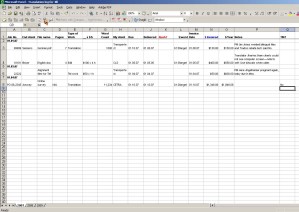 An Excel spreadsheet is an excellent tool to track your jobs and keep a running tally of how many words you have translated in a year. The graphic to the right may be difficult to read, but basically it contains the job number, end client, file name, pages, type of work (editing or translation), _x$h, word count, actual client, due, delivered, rush?, $/word, invoice date, $invoiced, notes, and TM. You can adapt this to fit your needs. You may want to include a column for date paid, late? (or days late), etc. I particularly love that it tracks the words you have translated for that year. You can also use all kinds of formulas to automatically add it up for you if you like that kind of thing. The sky’s the limit!
Another tool that is especially designed for translators is Translation Office 3000. This project management, accounting, marketing, word count, dictionary, etc. tool quickens, simplifies and optimizes a translator’s day-to-day work. You can keep track of your jobs, track your outstanding invoices, note your quotes and easily convert them into a job, handle your client contact information, and count your files based on lines, words, characters, etc. – all with the help of this tool. I particularly like the ability to track contact information and the visual schedule so you can see when a job is overdue. I don’t like the fact that you have to first create a project and then enter a job, but others may find it very helpful. You can download a free 30-day version here.
Some other options that were suggested to me when I forgot the job were:
3) a web calendar with automatic reminders (e.g., Freemail Kalender at
http://web.de)
I use a web calendar as well (more on that another day when I talk about iGoogle), but I haven’t gone the extra step and entered due dates in it. My job board is perfectly sufficient for my needs – provided I am diligent about writing a job down as soon as I accept it. It’s become habit now, which is quite comforting.
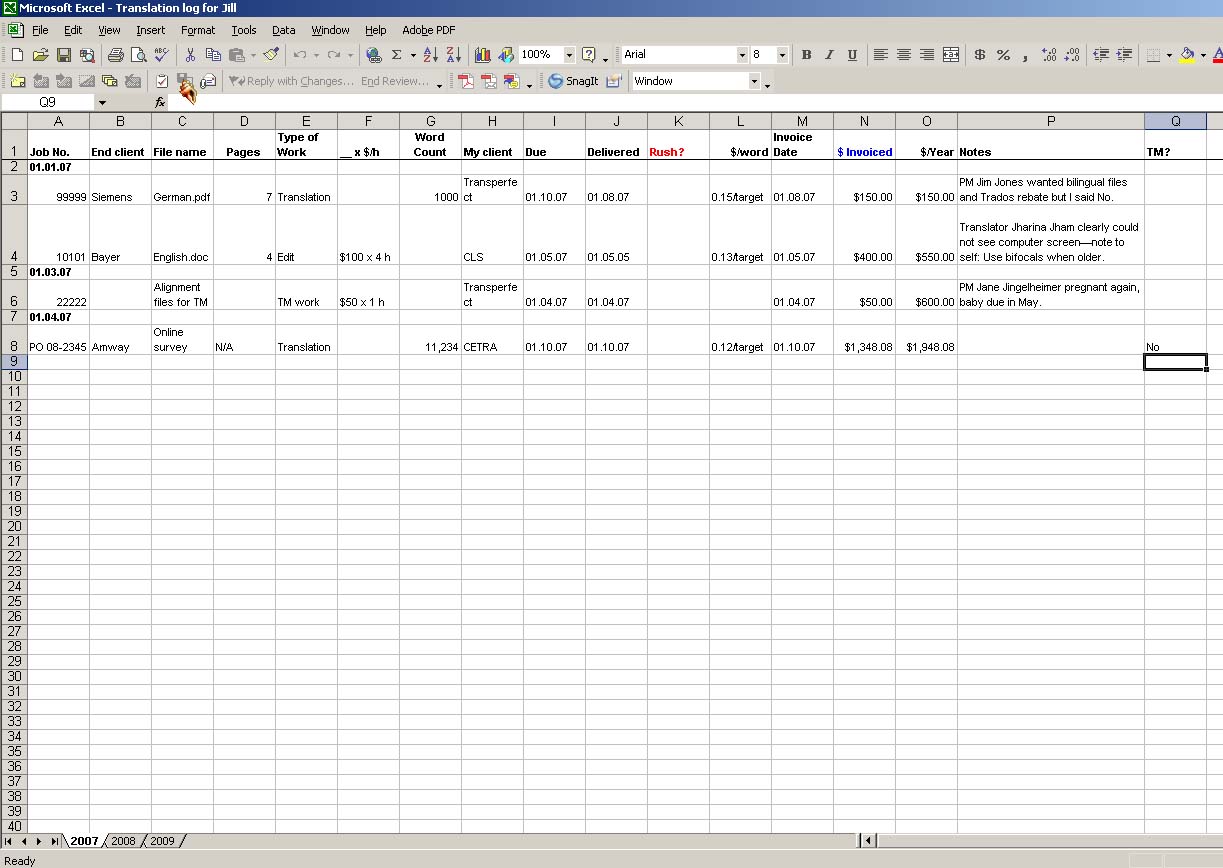 An Excel spreadsheet is an excellent tool to track your jobs and keep a running tally of how many words you have translated in a year. The graphic to the right may be difficult to read, but basically it contains the job number, end client, file name, pages, type of work (editing or translation), _x$h, word count, actual client, due, delivered, rush?, $/word, invoice date, $invoiced, notes, and TM. You can adapt this to fit your needs. You may want to include a column for date paid, late? (or days late), etc. I particularly love that it tracks the words you have translated for that year. You can also use all kinds of formulas to automatically add it up for you if you like that kind of thing. The sky’s the limit!

 Musings from an overworked translator