jump to navigation

There is no universal sign language February 11, 2016

Posted by Jill (@bonnjill) in Random musings.
2 comments

Note: I find this fascinating. Sign language is as much a language as anything we speak.

sign

Gallaudette professor Carolyn McCaskill demonstrates differences in sign language between black and white users. Pictured left, McCaskill signs “stuck,” while Jason Begue signs “pregnant” (Bill O’Leary/Washington Post)

There Is No Universal Sign Language

(By Frances Stead Sellers)

Carolyn McCaskill remembers exactly when she discovered that she couldn’t understand white people. It was 1968, she was 15 years old, and she and nine other deaf black students had just enrolled in an integrated school for the deaf in Talledega, Ala.

When the teacher got up to address the class, McCaskill was lost.

“I was dumbfounded,” McCaskill recalls through an interpreter. “I was like, ‘What in the world is going on?’ ”

The teacher’s quicksilver hand movements looked little like the sign language McCaskill had grown up using at home with her two deaf siblings and had practiced at the Alabama School for the Negro Deaf and Blind, just a few miles away. It wasn’t a simple matter of people at the new school using unfamiliar vocabularly; they made hand movements for everyday words that looked foreign to McCaskill and her fellow black students.

So, McCaskill says, “I put my signs aside.” She learned entirely new signs for such common nouns as “shoe” and “school.” She began to communicate words such as “why” and “don’t know” with one hand instead of two as she and her black friends had always done. She copied the white students who lowered their hands to make the signs for “what for” and “know” closer to their chins than to their foreheads. And she imitated the way white students mouthed words at the same time as they made manual signs for them.

Whenever she went home, McCaskill carefully switched back to her old way of communicating.

What intrigues McCaskill and other experts in deaf culture today is the degree to which distinct signing systems — one for whites and another for blacks — evolved and continue to coexist, even at Gallaudet University, where black and white students study and socialize together and where McCaskill is now a professor of deaf studies.

Several years ago, with grants from the National Science Foundation and the Spencer Foundation, McCaskill and three fellow researchers began to investigate the distinctive structure and grammar of Black American Sign Language, or Black ASL, in much the way that linguists have studied spoken African American English (known by linguists as AAE or, more popularly, as Ebonics). Their study, which assembled and analyzed data from filmed conversations and interviews with 96 subjects in six states, is the first formal attempt to describe Black ASL and resulted in the publication last year of “The Hidden Treasure of Black ASL.” What the researchers have found is a rich signing system that reflects both a history of segregation and the ongoing influence of spoken black English.

The book and its accompanying DVD emphasize that Black ASL is not just a slang form of signing. Instead, think of the two signing systems as comparable to American and British English: similar but with differences that follow regular patterns and a lot of variation in individual usage. In fact, says Ceil Lucas, one of McCaskill’s co-authors and a professor of linguistics at Gallaudet, Black ASL could be considered the purer of the two forms, closer in some ways to the system that Thomas Hopkins Gallaudet promulgated when he founded the first U.S. school for the deaf — known at the time as the American Asylum for Deaf Mutes — in Hartford, Conn., in 1817.

Mercedes Hunter, a hearing African American student in the department of interpretation at Gallaudet, describes the signing she and her fellow students use as a form of self-expression. “We include our culture in our signing,” says Hunter, who was a reseach assistant for the project, “our own unique flavor.”

“We make our signs bigger, with more body language” she adds, alluding to what the researchers refer to as Black ASL’s larger “signing space.”

When she tries to explain how Black ASL fits into the world of deaf communication, Lucas sets out by dispelling a common misconception about signing.

Many people think sign language is a single, universal language, which would mean that deaf people anywhere in the world could communicate freely with one another.

Another widely held but erroneous belief is that sign languages are direct visual translations of spoken languages, which would mean that American signers could communicate fairly freely with British or Australian ones but would have a hard time understanding an Argentinian or Armenian’s signs.

Neither is true, explains J. Archer Miller, a Baltimore-based lawyer who specializes in disability rights and has many deaf clients. There are numerous signing systems, and American Sign Language is based on the French system that Gallaudet and his teacher, Laurent Clerc, imported to America in the early 19th century.

“I find it easier to understand a French signer” than a British or Australian one, Miller says, “because of the shared history of the American and French systems.”

In fact, experts say, ASL is about 60 percent the same as French, and unintelligible to users of British sign language.

Within signing systems, just as within spoken languages, there are cultural and regional variants, and Miller explains that he can sometimes be stumped by a user’s idiosyncracies. He remembers in Philadelphia coming across an unfamiliar sign for “hospital” (usually depicted by making a cross on the shoulder, but in this case with a sign in front of the signer’s forehead).

What’s more, Miller says, signing changes over time: The sign for “telephone,” for example, is commonly made by spreading your thumb and pinkie and holding them up to your ear and mouth. An older sign was to put one fist to your ear and the other in front of your mouth to look like an old-fashioned candlestick phone.

So it’s hardly surprising, Miller says, that Americans’ segregated pasts led to the development of different signing traditions — and that contemporary cultural differences continue to influence the signing that black and white Americans use.

(read the full Washington Post article »here)
How NOT to use your hard-earned government security clearance April 1, 2015

Posted by Jill (@bonnjill) in Business practices, Random musings.
1 comment so far

According to this news article, a Japanese translation company under contract with the Nuclear Regulation Authority has apparently leaked an internal, classified document online from the nuclear watchdog. The document does not contain confidential information but is marked “Classified 2,” one of three levels of classification by the government. The company sent the document, without password protection, to a job applicant and solicited translators who would double-check its translations via a private-sector online bulletin board.

News flash: anything marked Classified should not be put online. The agency I work with uses a password-protected FTP site for downloading and uploading files. I had to get my security clearance verified before I could even look at the files to see if I would be a good fit for the job.

Companies don’t seem to realize that if you are doing any kind of government work you really can’t use cloud-based translation tools, cloud storage or any other number of new innovations. Microsoft 365 will never be used by this translator for that very reason! It’s just too risky. My security clearance is too valuable to even risk it. My laptop is encrypted. I do not use cloud-based tools. My government-related files are kept on my hard drive and deleted within the prescribed 90 days. And I’m just a lowly translator!

I know we joke about translation agencies sending files to numerous potential translators, but there is a foundation for these jokes. Why would agencies risk their valuable government contracts? Let this be a wake-up call to the industry. Shaking my head this morning.

P.S. Unfortunately this is NOT an April Fools joke. Thanks to Rina Ne’eman of Hebrew Translations for sharing this on Facebook.

RE: (Almost) Wordless Wednesday March 26, 2015

Posted by Jill (@bonnjill) in Random musings.
add a comment

I thought I had scheduled these through April. I was in Iceland last week and didn’t realize they weren’t in the queue until today. Sorry for the oversight. I’ll be back again next Wednesday.

Interesting blog post on Machine Translation and what sites store December 9, 2014

Posted by Jill (@bonnjill) in Random musings, Tools, Translation.
1 comment so far

My ATA not-so-newbie, Joe, wrote an interesting blog post in response to Jost’s article in the recent ATA Chronicle. He discusses an important issue involving machine translation and the data collection methods of various cloud and MT services and how this affects the translation industry. If you choose to use these services you should also be aware of what liberties you are giving them.

John Oliver on military translators and interpreters October 20, 2014

Posted by Jill (@bonnjill) in Random musings, Translation.
2 comments

From last night’s Last Week Tonight with John Oliver:

Translators who have aided the U.S. Military in Afghanistan and Iraq are in great danger in their home countries, but red tape is making it impossible for many of them to leave. John Oliver interviews Mohammad, one translator who made it out.

In the process he made millions of Americans aware of a problem many of us in the industry have known about for years. Thanks, Mr. Oliver! And thanks for sharing this, Rose!

Also, Afghan interpreter Mohammed started a petition on Change.org to help save his family’s lives http://t.co/l7Gc1UoXW7 Please sign and share.

Even Microsoft gets it wrong (“Skype Translator”) September 29, 2014

Posted by Jill (@bonnjill) in Random musings, Uncategorized.
5 comments

From the latest ATA News Briefs:

New Translation Technology No Threat to Professional Translators

After 15 years of research, Microsoft has unveiled Skype Translator, a voice translator that will convert speech from one language to another in almost real time. The service—dubbed by the media as the “Star Trek Translator”—will be available for Windows 8 by the end of this year. Microsoft chief executive Satya Nadella describes the system as a neural network that “learns” from data, much like the human brain. “It’s not,” Nadella says, “just about daisy-chaining speech recognition, machine translation, and speech synthesis.” But according to Andy Way, associate professor of computing at Dublin City University, the hype promises more than can be delivered. Way says, “You’re more likely to have everything else in Star Trek before you ever get a universal translator.” Philipp Koehn, chair of the Machine Translation School of Informatics at the University of Edinburgh, agrees with Way. “Automatic spoken translation is a particular problem because you’re working with two imperfect technologies tied together—speech recognition and translation,” he says. Despite their imperfections, industry analysts say Skype Translator and other automated translation programs are here to stay. They believe globalization has driven the demand for translation beyond the availability of translators. European Commission Language Officer Angelique Petrits says that her organization translates two-million pages into 24 different languages every year. “The organization wouldn’t be able to fulfill its mission without up-to-date translation technology.” Petrits does not view machine translation as a replacement for human translators. “Technology is a tool that helps dealing with the scarce resources of translators by speeding up their work and allowing them to concentrate on the essentials. It also contributes to the consistency of terminology, crucial in EU texts,” Petrits says. Way, Koehn, and Petrits all insist that technology is not about to replace translators. As Way observes, “There is just so much translation to be done—people have estimated that only around five percent of what needs to be translated actually is—that good translators will never be out of a job.”

From “Tech Is Removing Language Barriers—but Will Jobs Be Lost in Translation?”
Guardian (United Kingdom) (09/19/14) Williams, Martin

Well, considering they keep talking about “spoken translation” I don’t think we have anything to worry about. Come on, engineers, if you are programming it you should AT LEAST know the difference between interpreting and translation. Wow.

Goodbye to you September 8, 2014

Posted by Jill (@bonnjill) in ATA, Random musings.
1 comment so far

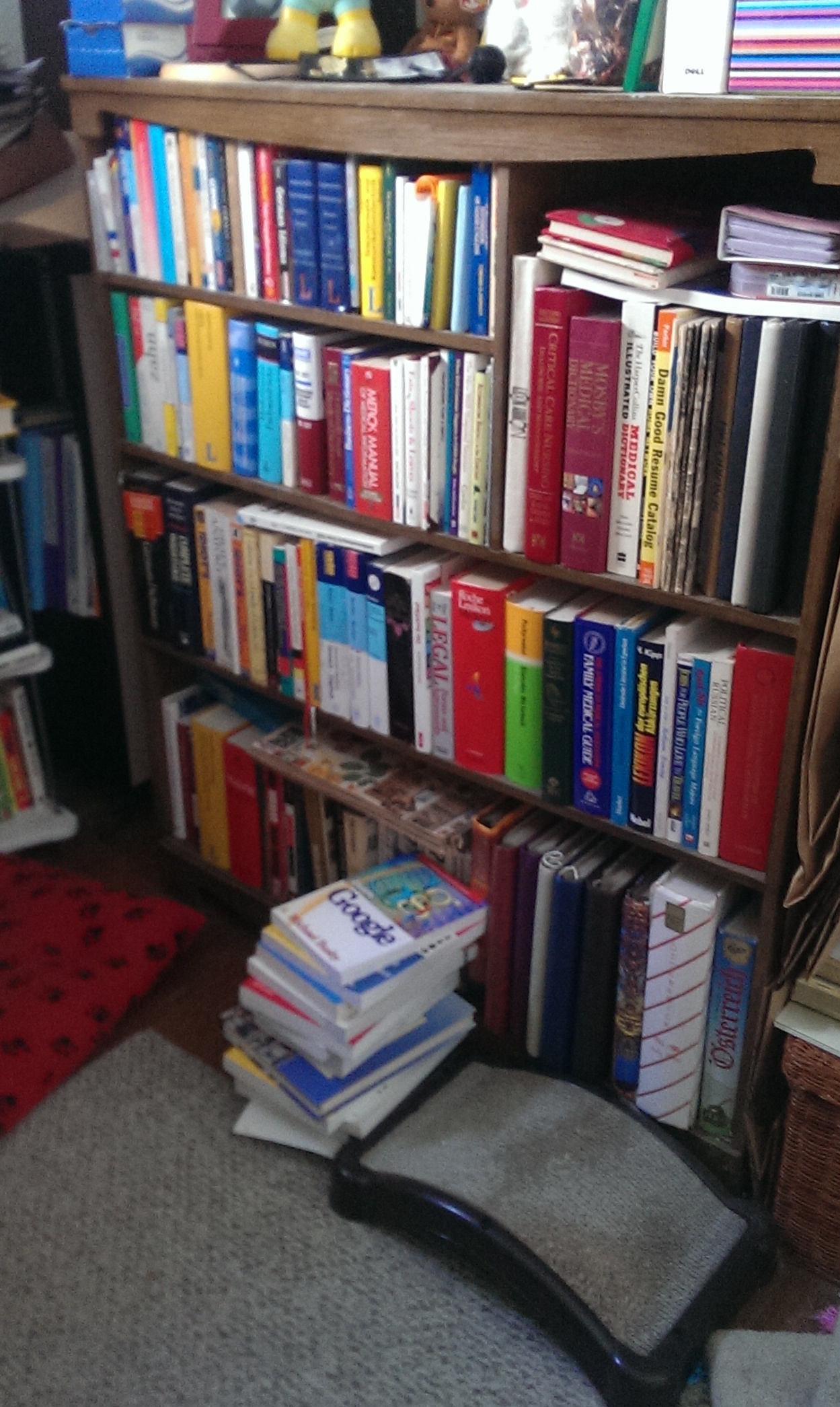
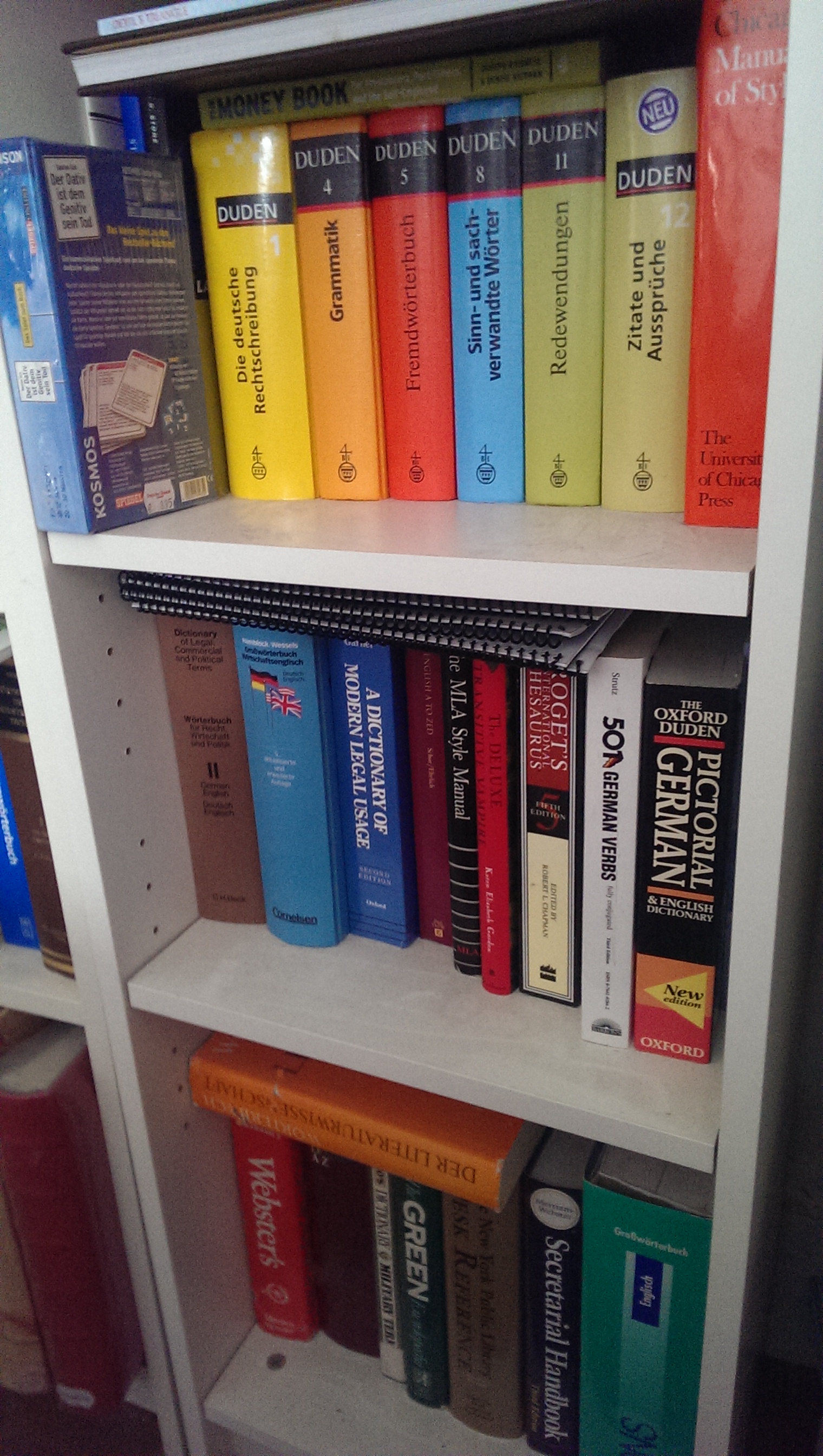
IMAG1155I just received an email from Freek at Intrans Book Service. After twenty five years of supplying translators with specialized dictionaries he has made the difficult decision to shut down his business as of December 31 2014. He has already stopped importing new books and will be selling off his stock at http://www.intransbooks.com.

IMAG1154I have bought many of my dictionaries from Freek over the years – both at the conference and through the website. He was also the only exhibitor willing to attend the Mid-Year Conference of the ATA Medical Division I organized. I made it a goal every year when I started doing business in the U.S. to buy at least one dictionary a year from Intrans. However, at some point I had bought all the important dictionaries and no longer needed them. I have been relying on electronic dictionaries and the Internet for a while now. I guess this is just a sign of the times. In light of the Internet both in terms of terminology research and the low-bid world of online suppliers it no longer made good business sense, and I completely understand his decision even though we will miss him. I take comfort in knowing I will have my library for years to come and will think of him every time I reach for my Dietl/Lorentz or Langenscheidt Medizin.

Thanks for all the wonderful years of service, Freek. We will miss your smiling face and your sister’s cookies at the Annual Conference this year. I wish you nothing but the best.

Guest post – Dear Translator: Please pay your taxes! June 2, 2014

Posted by Jill (@bonnjill) in Business practices, Random musings.
4 comments

Hello, all:

I started as a translator and interpreter and now run an agency based in Arlington that serves nonprofits and mission-driven organizations exclusively.

Today I received a rather thick envelope from the IRS. Apparently, a translator who I used fairly frequently between 2005 and 2010 and for whom I submitted 1099-MISCs, had not paid some (or all) of his taxes and the IRS was approaching all those companies who had sent him work in order to levy his earnings.

This translator owed around $40,000 in taxes, but the IRS is not to be messed with: penalties added another $60,000 onto the total and he now needed to pay back over $100,000.

The IRS wanted to know if I had any pending payments for him, and if so, I had to send that money their way, and not to him.

However, here is the most alarming thing: THIS TRANSLATOR PASSED AWAY A YEAR AGO.

His estate probably has no money, and the IRS wants theirs, so they’re probably hoping that there are some monies still owed him that they could take. I don’t know, and I’m certainly not a tax professional, but that’s what I assume is happening.

Moral of the story?

Please, translators, PAY YOUR TAXES. Pay ALL of them. Pay them PROMPTLY. Don’t try any funny stuff. The IRS *will* get you (or your heirs), even after you’re deceased.

Thanks for listening!
Sandra Alboum

Sandra Alboum runs an agency that serves nonprofits and mission driven organizations exclusively, is a two-time jeopardy champion, and an amateur gourmet chef and professional mother of two. She sent this post to the ATA Business Practices listserv, and I felt it was worth reposting to a wider audience.

Nothing in life is certain but death and taxes. And as you can see your taxes may live on even after death. Be sure to pay yours and to report all of your income!!

Quote of the day May 1, 2014

Posted by Jill (@bonnjill) in Random musings.
add a comment

“I’m amazed at how much my writing is improved when I step away from the computer, even in small amounts. If I’m stuck, I vacuum the living room or walk the dog. I’m amazed at what comes out of that… We have to realize that part of the writing life where we’re sitting down at the computer is harvesting the crops, but you have to have planted them and watered them and created fertile soil – and that’s a life.”
— Donald Miller

Hope you enjoyed the holidays January 2, 2014

Posted by Jill (@bonnjill) in Random musings.
1 comment so far

I want to apologize for missing (Almost) Wordless Wednesday yesterday. I forgot to feed the queue. A Christmas Story was filmed in Cleveland, and the leg lamp is its timeless symbol. So in honor of the holidays I wish you a wonderful and prosperous new year from downtown Cleveland, Ohio. Hopefully you had a gentle slide into the New Year and are ready to get back to work. Our clients wait for no man or woman. I am already slammed, but was also snowed in today and will most likely be snowed in tomorrow as well. The plows are having a tough time keeping up with the snow and wind. Arctic cold is predicted for early next week. Ah, the joys of Cleveland in January.

clev2