Savoring the slow days March 24, 2009
Posted by Jill (@bonnjill) in Random musings.1 comment so far
After work 12- to 14-hour days all last week and translating a total of around 34,000 words I woke up this morning with a dull headache, but was committed to enjoying the day. It’s chilly but sunny, and the birds are singing and building their nests. The perfect spring day. I had a nice lie-in with my dog, Lily, tucked in firmly by my side (I don’t know if she was afraid of the windows rattling from the spring gusts or was cold, but she usually sleeps at my feet – or rather ON my feet). She almost pushed me out of bed this morning, and that’s unusual. After letting her out to run around the backyard, I fired up the computer and checked my e-mail. I translated the two remaining responses in the survey (final word count: 35,789 – 5,000 of which were translated by a colleague so I could enjoy the weekend) and put on a pot of coffee. I have a 4-cup Gevalia coffeemaker that makes the most delicious coffee… I have a medical report due later today, and one of my colleagues is checking several spots for me. I’ll be heading out to deliver Meals on Wheels in about half an hour, which brings me great joy. I then have an appointment scheduled at 2 with a colleague through LogMeIn to finally remove all vestiges of Office Live, which causes Word to crash every few minutes and drive me batty. Once my computer is fixed and the translation is delivered the day yawns ahead of me, and I plan to embrace it. I’ll definitely go on a walk with Lily in the local park – or maybe even head down to her favorite dog park. I’ll read several chapters of The Private Patient by P.D. James and maybe catch up on some TV shows. The evening will be probably spent watching several movies (Hancock and The Dark Knight) that I borrowed from the public library and have to return soon. Sounds like heaven, doesn’t it? Now if you’ll excuse me, I need a refill on my coffee…
Bonus TGIF: Spielberg interview (TV Total) – oops! Lucas March 20, 2009
Posted by Jill (@bonnjill) in Fun stuff, TGIF.3 comments
Fidusinterpres, a German and English to Portuguese translator who lives about a half hour outside of Bonn, just shared the best video clip on his blog, and I had to share it with you all. N24 needs to hire an interpreter who has actually seen Star Wars. Unbelievable! The interpreter translated the famous phrase “May the force be with you” (Möge die Macht mit dir sein) as “Am vierten Mai sind wir bei Ihnen” (May the 4th be with you – or more precisely We’ll be with you on the 4th). Unbelievable! This may only be funny for German speakers, but give it a try.
I love Stefan Raab. His hit show TV Total premiered while I still lived in Germany, and I always enjoyed watching it. I think he’s just hilarious. He plays with the German language really well. I have a copy of his hit single “Maschendrahtzaun” in my CD case. It was based on a reality TV court show in which the plaintiff had a very strong East German accent. The poor woman was completely overwhelmed with the PR and fans outside her house at the time, but the song was a huge hit.
TGIF: My Internet’s Gone Down March 19, 2009
Posted by Jill (@bonnjill) in Fun stuff, TGIF.add a comment
I have a friend coming to visit tomorrow, so I’ll be busy cleaning when I’m not frantically translating my massive survey. I thought I’d post the Friday video a little early tonight so I don’t forget.
This is a cute video about the horror we all fear: losing our Internet connection. I know I for one go into serious withdrawal when my Internet has gone down. Enjoy!
Stuck between cultures March 19, 2009
Posted by Jill (@bonnjill) in German culture, Random musings.5 comments
When I lived in Germany I frequently referred to myself as a Stranger in a Strange Land. I never quite fit in. The people (particularly those in positions dealing with customer service or more likely the lack thereof) would frequently frustrate me. I wasted time on German men who were impossible to read. My neighbors never quite understood me (although I did get a complement from one older woman on the Christmas lights in my window 🙂 ). I became a little bastion of America in Germany. And yet I loved living there. I made a lot of friends and embraced the cultural traditions like sitting in a beer garden or sitting in the sun at a café with a Milchkaffee, a nice piece of cake and a good book.
I am currently reading several books set in Europe, Spotted Dick, S’il Vous Plait by Tom Higgins and The Private Patient by P.D. James. Spotted Dick is about a translator who opened an English restaurant in Lyon, France. It’s enjoyable. I just wish he would translate his French phrases for those of us who don’t speak French… Anyway, I started The Private Patient last night and was seized by a wave of “homesickness” (or Fernweh – whatever you want to call it…) while reading a paragraph explaining how she walked through the center of town listening to the church bells. It’s amazing how just a simple sentence or description can transport me back to Europe and make me wish I lived there again.
But things wouldn’t be the same if I did. My friends have scattered to the wind, gotten married or had children. Living in Europe in my forties wouldn’t be the same as it was in my late twenties. I am sure I would be able to meet new people and make new friends, but there are lots of benefits to being home as well. I love having all my things around me, for one. I lived a temporary life for six years, with minimal property and lots of used furniture. I now own new furniture and have both new and old things from my childhood/college years/etc. surrounding me. It’s great to have all my CDs in a shelfing unit and just pick out the one I want to hear. I love being a dog owner and doubt I could bring her with me without a lot of hassle and paperwork.
But there’s also a lot to be said for wandering along cobblestone streets and listening to church bells peal – or sitting in a beer garden on the Rhine River watching the barges go by. I decided the way to deal with this is to make sure I actually get to Europe this year, come hell or high water. It’s been a while since I’ve been back, and I do really miss it.
It’s amazing how our adopted countries can quickly become home – and how home never quite feels the same when we return. We translators are a rare breed of people who learn to live stuck between cultures. In the end we adopt the practices that we enjoy the most. I have several German, Spanish and Czech cookbooks that I can use when I get a craving for a bit of the old country. I celebrate Karneval instead of Mardi Gras. I give friends who move into a new home a basket with salt and a loaf of bread. We become the best of both worlds. How about you? What do you miss about your home and adopted countries?
Everyone’s talking about rates these days March 18, 2009
Posted by Jill (@bonnjill) in Business practices, Random musings.7 comments
Corinne’s post Lowering your translation rates: why/why not has taken the translation industry by storm (or maybe just the people I follow on Twitter 🙂 ). I’ve been talking to a lot of fellow translators about this, and everyone has an agency that has tried to get them to lower their rates. It seems the Big Two are particularly guilty of this. One agency in Massachusetts allegedly refuses to pay more than 10 cents for into English translation, while a perfect agency in New York has been trying scare tactics and a big hammer to get their translators to lower their rates. Now, mind you, this particular agency is known for sending job requests after 6 PM that are due the next day or contacting translators on Sunday – both practices that should require weekend or rush rates. The translators I have spoken with who have been asked to do this have stuck to their guns and not agreed to lower their rates – and received job requests the next day at their usual rates!
I have to admit that I was probably Corinne’s inspiration for this post. I mused on Facebook that I was thinking of lowering my rates when I was in the midst of a fairly long dry spell a week or so ago. I was then asked by my favorite client to offer a 10% discount on a very large job (20,000 words) with a tight deadline. I’m glad I didn’t give in to either temptation. Instead of offering a volume discount (which makes no sense from an economic standpoint – working harder for less money???) I am working with the client to keep the word count low (only translating multiple responses once, using contractions whenever I can, allowing them to pretranslate some of the more simple responses, etc.). They are hopefully happy with the compromise. I also have a new client who is willing to pay me my highest rate ever and has sent me four jobs in as many days.
So stick to your guns. We have bills to pay too! For $22 an hour I can work as a secretary or clean houses (both jobs with markedly lower stress levels). There are not that many qualified translators out there as it is. If the agencies keep trying to depress rates more and more they will soon find there will be even fewer qualified translators. The economy is sure to improve any day now. Just remember, this too shall pass!
TGIF: Beauty is nothing without brains March 13, 2009
Posted by Jill (@bonnjill) in Fun stuff, TGIF.1 comment so far
Here’s a bonus TGIF video to brighten your day. It isn’t language-related, but since most translators I know love books I figure this is related enough. It made me giggle, and that’s really all that matters, right? Enjoy!
TGIF: Emma Thompson to the rescue March 13, 2009
Posted by Jill (@bonnjill) in Fun stuff, TGIF.4 comments
This clip from Césars 2009 (France’s version of The Oscars) is one of those edge-of-your-seat clips, but not for the reason you would think. You don’t need to understand French to appreciate it, although I’m sure the French speakers will enjoy it more for the humor of the presenter. You only need to watch about the first 1:45 or so to see why I named this post what I did.
Favorite tools: Firefox March 12, 2009
Posted by Jill (@bonnjill) in Tech tips, Tools.6 comments
Next to Trados and WinAlign, my favorite tool is without a doubt Firefox. I have Firefox running from the moment I wake up to the minute I go to sleep. Firefox is a free open source browser that offers a “faster, more secure, and fully customizable way to to surf the Web.” As you can see from my screenshot I have put a lot of time and effort into customizing my browser to make it work for me. My homepage is my iGoogle page, which I have talked about in detail on this blog several times. I have TwitterFox running in the bottom right-hand corner (I expanded it for the screenshot), and I can access it whenever I want to check out the Twitter tweets from the folks who I am following. I follow a variety of people, but they are primarily translators located all over the world who often offer really good information. I also have numerous tabs open at all times and toggle quickly between them as needed.
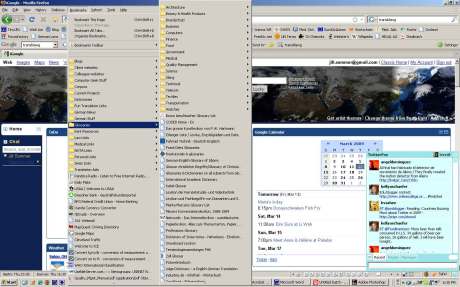
As far as organization is concerned, I now have two toolbars of my most frequently visited sites (thanks to a tip from one of my blog readers – thanks, Maxim!) such as my blog, online dictionaries, the Translator’s Home Companion portal, the Accurapid Translation Journal, Frank Dietz’ and Marita Marcano’s collection of glossaries, etc. as well as a very organized Bookmarks drop-down menu. I have the drop-down menu organized into folders and subfolders, which allow me to quickly and easily access subject-specific glossaries, dictionaries, traffic watches, Pandora Radio, Oanda (a really great currency exchange site), my bank accounts, my public library, conversion tools, etc. I have folders for blogs (from before I started using a feed reader – come to think of it I can probably delete the folder now…), client websites (for logging onto workspaces and managing translation jobs), colleague websites, translation aids (such as style guides, translation portals, payment practices sites, etc.), etc. One of my friends commented that they would love to get their hands on my Bookmarks, but this represents over 10 years of collecting and maintaining URLs. I consider it to be proprietary information just like my TMs are. 🙂
Do you have any Firefox tips you would like to share with us? Tell us about them in the Comments!
Yeah, good luck with that… March 9, 2009
Posted by Jill (@bonnjill) in Business practices, Translation Sites.4 comments
I just wanted to share two translation requests I received tonight. Enjoy!
Dear Sir or Madam;
Medical Translation from German into English
We are in a need of German to English Medical translators.
We might need at times to translate an average of 380 pages of medical transcriptions. The work will be performed for at least a year. We prefer that these service we deliver to us already proofread, edited and reviewed for final delivery. We expect zero errors and omissions. We might have penalties for any return document(s) by client with more then 1% of error and or omissions.
You also need to agree to sign a confidentiality agreement, take training as needed and get certified about HIPPA rules.
Translators must vast experience (at least 3 years) on medical transcription is a plus, medical education or combination of both.If interested please provide an update resume and rates per word and page s well as the extended of the work (only translation vs translation, editing etc. no later then 3/11/09 12:00 PST USA
If questions please send them by email.
Gee, zero errors and penalties? Sounds like a dream job – not. No one is that perfect. They can’t even write an e-mail with zero errors. They also didn’t mention if the translators would be reimbursed for the training and certification. I’m guessing no. Sorry, but I’d rather clean houses or be a secretary somewhere than be on tenterhooks for the next year working for this agency and wondering if the client was going to complain.
And this next one was just unbelievably ridiculous. Not surprisingly, it came through ProZ:
We are looking for German to US English freelance translators for a potential big project in the medical field.
The details are as follows:
Source format: .PDF and .doc files
Target format: .doc files
CAT tool: Trados
Proposed rate: 0.03 EUR/target word (I know it is a bit low, but the project is about 2000 pages and the client cannot offer higher rates)If you are interested in this project and accept the proposed rate, could you please send me an updated copy of your CV in Word format? Your CV will be sent to the client (hiding your contact details) and, after the client’s approval, Silvia will contact you sending a short unpaid translation test, which will be reviewed by the client.
Should you have any question, please don’t hesitate to contact me.
I look forward to hearing from you.
A bit low? That’s downright insulting. Just a little under $0.04 a word for MEDICAL!!!! My delete button got quite a workout tonight!
Call me crazy, but I have a feeling both these agencies are bidding on the same job since the requests came in within an hour of each other. What do you think?
E-mail marketing tips March 9, 2009
Posted by Jill (@bonnjill) in Business practices, Marketing ideas.9 comments
As a follow up to my guest post at Naked Translations, here are some dos and don’ts for an e-mail marketing campaign. I got inspired by reading Tips for applying to a job from Craigslist this morning (another tweet from someone I follow on Twitter). As the author says, it doesn’t take much to distinguish yourself from the rest of the pack. This is also true for the translation field. There are certain dos and don’ts when applying as a freelance translator with a translation agency. Take them to heart to ensure your e-mail doesn’t end up in the Trash folder.
1. Don’t have any spelling errors or typos in your e-mail. Seriously, just don’t!!! You are applying for a job as a translator, which requires good grammar and spelling. You need to make sure your e-mail is flawless. Read the e-mail through a couple times before sending it to make sure you catch every spelling error or typo. You might even want to start at the bottom and work your way up so you don’t miss anything.
2. Indicate your language pair in the subject line or the first sentence. The person reading your e-mail shouldn’t have to dig through your letter to find out what language(s) you translate.
3. Use the body of the e-mail as your cover letter. Don’t attach a cover letter and a resume. No one is going to take the time to look at two files. One – maybe, two – no way.
4. Try to write a unique but catchy cover letter. Let your personality shine through. In this day and age, no one wants to read a stuffy letter that has obviously been sent to 300 other agencies or could have been written by 300 other translators.
5. Focus on what makes you special and what makes you stand out. What makes you the best choice compared to the other prospective translators sending their resumes to the agency? Do you have an M.A. in translation, are a Diplom-Übersetzer, used to work as a medical doctor or researcher, or have a law degree? Have you lived in the target country for several years? Did you grow up in a bilingual household and are equally comfortable in both languages? Be sure to mention it in one of your first sentences.
6. Make sure the agency works in your language pair. If the agency specializes exclusively in Japanese and English translations, don’t send them an e-mail unless they specifically say on their website that they are looking to branch out to include other languages.
7. Check their website out before applying and follow their directions to the letter. If they say they only accept submissions through their website, don’t bother sending them an e-mail. It will only be deleted, because it shows you can’t follow directions.
8. Tailor your e-mail to the agency. Show them you did some research and looked at the website to find out if your fields of specialization mesh with theirs. Find out who you should address the e-mail to and try to avoid sending an e-mail to “To whom it may concern:” if the website specifies a contact.
9. Make sure the person you are sending the e-mail to is in fact a translation agency and not another freelance translator. I can’t tell you how many times I have received unwanted resumes from prospective translators. All you have to do is look at my website to see that I am a one-woman show. That said, if you have a website that talks about “we” instead of “I” you are making yourself a target for unwanted resumes.
10. Localize your resume for your target audience. If you are applying to a German agency, it helps to send them a resume that is in German and conforms with other German resumes. Also, make sure your resume is proofread by a native speaker.
11. Think carefully about how you write your name. Choose one name and spelling and stick with it. This will generate name recognition. For example, I use the name “Jill R. Sommer” on my resume, on my business cards, on my website, in the ATA directory, for presentations at conferences, and anywhere else I have a presence (the exception to this being my blog). Also, if your name is somewhat exotic for your target audience be sure to clarify your gender. For example, sign the e-mail as (Ms.) Jill R. Sommer or (Mr.) Chiang Kai-shek. That takes the pressure off the person who might want to respond to you, but doesn’t know how to address you.
12. Use a professional e-mail address. It simply makes a good impression. If you have your own domain name, you give the impression that you have invested in your profession. Free e-mail services like yahoo.com don’t make a good impression. The only exception to this is Gmail, because it is a more serious provider and has outstanding online file storage capacity. There is some debate on the professionalism of aol.com addresses. Some of those who profess to be against aol.com accounts believe that since AOL started off as an entertainment site it is not as serious as other e-mail providers. Just a little food for thought… E-mail with your own domain name ensures no one has any prejudices when they see your e-mail address. And it should go without saying that e-mail addresses like “ cutiecat23@juno.net” or “BigBigGirl@yahoo.com” simply don’t convey the professionalism you need to convey.
13. Consider naming your resume “Last name first name_resume.” If your resume is called “resume,” it is simply going to get amended with resume1.doc, resume2.doc, etc. by the client’s e-mail program. Make sure the client knows what the file is at a glance and can allocate it to your application.
14. Include a Summary of Qualifications instead of an Objective. You don’t need an Objective on resumes to a translation agency. It should be apparent from your e-mail cover letter that your objective is to start working with them.
15. Keep your resume brief. Try to keep it to 1-2 pages. I send a brief resume and refer potential clients to my website, where my resume is a lot more extensive (I also include a list of all the dictionaries and reference materials I own to show I have invested heavily in my profession). If the client is interested in working with me, the information is available, but they don’t have to wade through it if they aren’t.
So, those are my top tips. Does anyone have any other deal-breaking tips? Insights from agency owners or project managers are especially welcome.


 Musings from an overworked translator