TGIF: Happy Halloween! October 31, 2008
Posted by Jill (@bonnjill) in Fun stuff.add a comment
I am flying to Orlando today for a much needed mini-vacation and the ATA conference. I’ll be back in the office on the 11th. I’m not sure if I will be posting for the next 10 days, so please be patient if I don’t. I promise I will have all kinds of things to talk about after the conference.
I wanted to leave you with a non-translation-related video in honor of Halloween. This has some blue language (a.k.a. naughty words), but it is hilarious – and very true. The local news reported that a guy in England was told to take down some of his decorations because they were “too scary.” Give me a break! When I was little, the guy down the street (who had worked for Disney at one point) decorated his house to the hilt with scary decorations – I’m talking shutters askew, witch flying down on a broomstick, coffin opening, etc. – all to really spooky music and sounds. As a kid I was terrified to walk through there, but now I think back on that “haunted house” with fondness every year at Halloween! It totally rocked!
Folks, I hope you enjoy Foamy the Squirrel. Happy Halloween!
TGIF: Stay one step ahead October 31, 2008
Posted by Jill (@bonnjill) in Fun stuff.add a comment
It’s Friday! Time for another language-related video. All these Berlitz ads are starting to seem familiar, but they definitely get the point across in a unique way.
Lost the dongle October 29, 2008
Posted by Jill (@bonnjill) in Fun stuff.3 comments
Caveat emptor: My apologies if any of you are easily offended by nudity (although let’s face it, most translators have lived in other countries and don’t get offended by nudity and technically this isn’t nudity… 🙂 )
I am cleaning some files off my computer and discovered this little gem that someone sent me in 2005. Anyone who used to work with Trados back when it required the use of a dongle will really appreciate this. For those of you who don’t know what a dongle is/was, it was a small device that plugged into the serial port or parallel port of a computer in order for it to use protected software. When the dongle was not present (missing, not plugged in all the way, defective, etc.), the software would only run in a restricted mode or refuse to run at all. Ah, good times…

TGIF: How to never be unnatural or ridiculous October 24, 2008
Posted by Jill (@bonnjill) in Fun stuff.3 comments
Sorry for the blog silence this week. I am completely overwhelmed with work and am counting the hours to Friday afternoon, when all of my projects are due. Hopefully next week will be better. I only have about 40 pages of medical invoices and referrals to translate. Then I leave for FLORIDA! I can’t wait…
Anyway, it is Friday! Time for another video. Since I don’t speak French I can’t judge how good this gentleman’s French is, but I doubt he learned it in two weeks. Good thing he doesn’t look unnatural or ridiculous doing it. 🙂 Have a great weekend! I hope to stay as far away from the computer as I can.
TGIF: Another Berlitz commercial October 17, 2008
Posted by Jill (@bonnjill) in Fun stuff.1 comment so far
Whoever comes up with the ideas for the Berlitz commercials deserves a pat on the back. They are unique and funny. Here is another Berlitz commercial for your enjoyment. It can’t beat the ad with the German Coast Guard newbie, but it is still pretty enjoyable. Have a great weekend everyone!
TGIF: Bill The Language Guy from The Amazing Race October 17, 2008
Posted by Jill (@bonnjill) in Fun stuff.2 comments
I’ve been trying to stay away from the computer for the past couple of days to get my tendonitis flare-up under control, but I couldn’t leave you guys without the weekly video. For those non-US-based viewers, The Amazing Race is a reality show in which multiple teams race around the globe to ‘amazing’ locations for $1,000,000. It’s a big hit here in the U.S. and is now currently in Season 13. Being totally averse to anything reality-show-related, I have never seen the show, and based on this clip I know why. This guy has the audacity to think that the key to winning the race is being able to try to talk to people in their own language, even if he does it badly. The look on the cab driver’s face is worth watching the clip. Enjoy!
No idea why the link isn’t working, but click here to view it directly in YouTube.
TGIF: Maggi Buchstabensuppe October 9, 2008
Posted by Jill (@bonnjill) in Fun stuff.add a comment
And now for something a little lighter… this video seems to be making the rounds among German translators at the moment. Man, I just realized that I haven’t had alphabet soup in a long, long time. Do they even make it anymore?
I don’t think something like this would ever be allowed to air in the U.S., because all kinds of “concerned mothers” would come out of the woodwork to mount a protest (come on, you know they would!).
Even if you don’t speak German you can appreciate it with the help of the following key: Kuh=cow (as in “you stupid cow”), Depp=dork, dweeb or moron, Zicke=bitch, Idiot (should be self-explanatory). Then Hure=whore and Ruhe=Be Quiet! Enjoy.
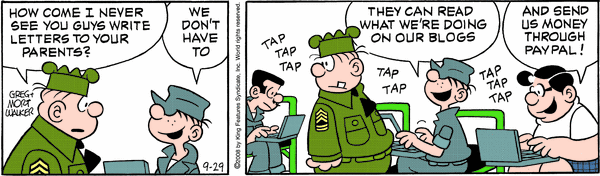
How technology has changed things October 5, 2008
Posted by Jill (@bonnjill) in Fun stuff.add a comment
Beetle Bailey appears to be super-hip. Hi Mom, there’s no need to send me money through PayPal though…
TGIF: Fun with languages on Frasier October 2, 2008
Posted by Jill (@bonnjill) in Fun stuff.2 comments
I was telling a friend about the I Love Lucy clip the other day. She told me about this scene in Frasier, which I had completely forgotten about. It’s from “An Affair To Forget.” Niles thinks Maris is having an affair with her fencing teacher. The trouble is, he only speaks German, so Niles needs Marta the maid to translate it into Spanish so Frasier can translate it into English for him.
It leads to a fencing duel.
Happy St. Jerome Day! September 30, 2008
Posted by Jill (@bonnjill) in Fun stuff, Translation Sites.2 comments
 Translators and interpreters celebrate September 30th as their day, since it is the Feast Day of the patron saint of librarians, scripture scholars, students, and of course, translators and interpreters. Eusebius Hieronymus Sophronius, better known today as Saint Jerome, was born sometime between 340 and 347 AD in Stridon, which is located on the Italian side of the modern Italian-Croatian border. He studied theology in Trier, which is one of my favorite German cities.
St. Jerome is one of the few people awarded sainthood in recognition of services rendered to the Church rather than for eminent sanctity or miracles. St. Jerome earned his place in history mainly for his translations and revisions of the Bible. He revised translations of the Gospels and the Psalms and translated the Old and New Testaments into Latin. This translation was recognized eleven centuries later by the Council of Trent as the official version of the Bible: the Vulgate.
Jerome’s humility regarding his own work set a good example for translators who followed him. He freely admitted ignorance, even embarrassment, when warranted, and revisited some of his translations, making corrections and additions. On the other hand, he also pointed out that a translation’s accuracy depended greatly on the reliability of the source text: copyists often inadvertently introduced errors, which would be compounded and passed down through the centuries.
Perhaps his most famous mistranslation put horns on Moses’s head. The original Hebrew scripture (Exodus 34) stated that when Moses descended from Mt. Sinai, he had “rays of light” coming from his head. The Hebrew word can also mean “horns,” and Jerome chose the latter meaning. This error has been perpetuated to the present in many ways. When Michelangelo sculpted a marble Moses in 1515, he relied on Jerome’s description in the Latin Vulgate translation. The resulting 235-cm-high horned statue can be seen in Rome (S. Pietro in Vincoli) today.
St. Jerome is usually depicted as a half-clad anchorite, with cross, skull and Bible for the only furniture of his cell, his red hat or some other indication of his rank somewhere in the picture. He is also often depicted with a lion, due to a medieval story in which he removed a thorn from a lion’s paw, and, less often, an owl, the symbol of wisdom and scholarship. Writing materials and the trumpet of final judgment are also part of his iconography.
St. Jerome died at Bethlehem from a long illness on September 30, 420. He is buried at St. Mary Major in Rome.
* This post was cobbled together from The Translator Interpreter Hall of Fame, Wikipedia, and here. For some fun with St. Jerome, see Sue Ellen Wright and Jost Zetzsche’s Jeromobot videos. We’ve also heard rumors that Jeromobot will be at this year’s ATA conference.


 Musings from an overworked translator