Twenty years ago today… November 9, 2009
Posted by Jill (@bonnjill) in German culture, Random musings.8 comments
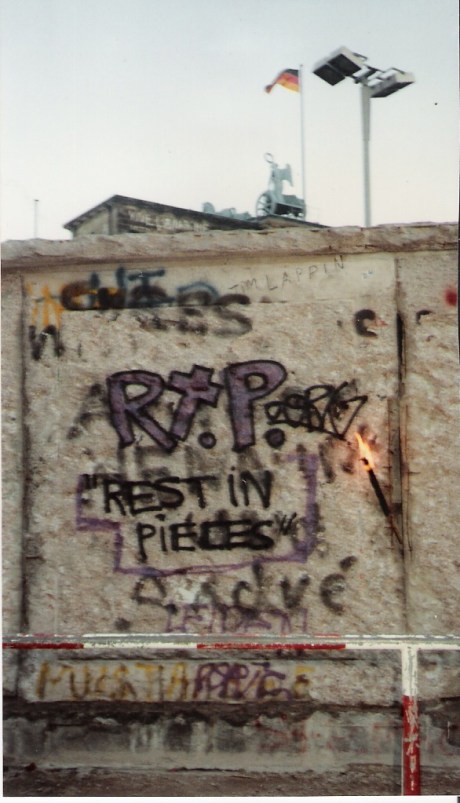 “The Berlin Wall (German: Berliner Mauer) was a concrete barrier erected by the German Democratic Republic (GDR) (East Germany) that completely encircled the city of West Berlin, separating it from East Germany, including East Berlin. The Wall included guard towers placed along large concrete walls, which circumscribed a wide area (later known as the “death strip”) that contained anti-vehicle trenches, “fakir beds” and other defenses.” – Wikipedia
The East German government built the Wall on August 13, 1961 to stop East German citizens from fleeing to West Germany. Once the Wall was up the vast majority of East Germans could no longer travel or emigrate to West Germany. Families were separated and East Germans who had worked in West Berlin could no longer go to their jobs. Around 5,000 people attempted to escape over the Wall after it was built, with death toll estimates between around 100 and 200. I had always been fascinated with German culture, and after I watched the movie “Gotcha” starring Anthony Edwards I decided I wanted to be a spy in East Berlin and studied German and Russian in college.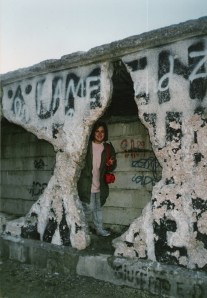
I was living in Salzburg during my academic year abroad. The previous year I had taken a German culture class, and my professor had stated we would never see the fall of the Berlin Wall in our lifetime. That professor was our Academic Year Abroad (AYA) adviser that year, and our group had just returned from a trip to Vienna, Austria. We were all amazed when the first dominoes started falling, when Hungary proclaimed itself a democratic republic and opened its border on October 23rd. The inflow of Hungarians into Austria was immediately apparent. East Germans were also fleeing to Austria through Hungary. Hungary tried to close the border again, but the damage was done. East Germans clogged the West German embassy in Budapest and refused to return to East Germany. This then triggered a similar incident in Czechoslovakia and mass protests within East Germany.

I remember November 9th being a very exciting day. The East German government announced that East Germans would be allowed to cross through the border checkpoints, and the people started flowing through. It was chaos. The border guards didn’t know what to do or how to react. East Germans walked through the West Berlin streets, unsure what to do with themselves. Lots of people climbed onto the Wall once they realized the border guards weren’t going to retaliate. Strangers were hugging and kissing each other. I remember sitting around the TV in my Austrian dorm watching the happenings in Berlin, crying. My parents told me later they were looking for me at the Wall, but I had an art history exam that Monday so I stayed home to study (what an egghead, right? That is one of my biggest regrets in my life…).
 I got my chance to hammer away at the Wall in February when I traveled through Berlin during our month off. We still needed transit visas to enter East Germany and to cross the border into East Berlin, but we were free to visit the museums (the Pergamon Museum was and is amazing!), shop in the East Berlin stores, and chop away at the Wall. It was bizarre. The photos you see above were taken there of me – in the Wall and in front of a hole in the Wall with a guard house behind it – and I didn’t realize a guard stopped and posed behind me.
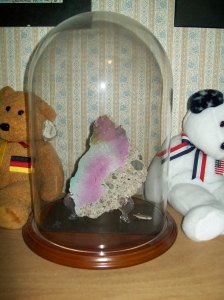
When I visited Haus der Geschichte while living in Bonn as you got closer to the late 1980s in the exhibit they had a recording of the “chink-chink” sound of chisels and hammers chopping at the concrete that you could hear along the Wall back then. It brought tears to my eyes and transported me back to February 1990. My pieces of the Wall are among my most prized possessions.
My dream of being a spy was crushed that day, but I stuck with the languages, graduating with a double major in German and Russian and a minor in Political Science. I went on to get a Master’s in translation and the rest is history. All’s well that ends well.
Congratulations Germany on a peaceful transition of power 20 years ago and a successful reunification.
Walpurgisnacht and May Day April 29, 2009
Posted by Jill (@bonnjill) in German culture.5 comments
I miss Germany, but I really miss Germany during the holidays that I celebrated when I lived there. Two of those holidays occur within 24 hours of each other: Walpurgisnacht and May Day.
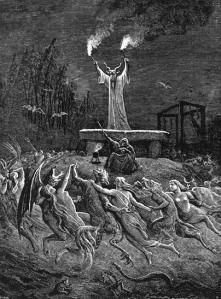 Walpurgisnacht (Walpurgis Night) is a traditional religious holiday celebrated by pagans and Satanists, as well as Roman Catholics, on April 30 or May 1 in large parts of Central and Northern Europe. Walpurgisnacht gets its name from Saint Walburga (or Walpurga), a woman born in what is now England in 710. Saint Walpurga traveled to Germany and became a nun at the convent of Heidenheim in Württemberg. She was made a saint following her death in 778 (or 779), and May 1 is her saint day.
In Germany the Brocken, the highest peak in the Harz Mountains, is considered the focal point of Walpurgisnacht. Witches (Hexen) and devils (Teufel) allegedly gather on the mountain (also called the Blocksberg), which is often shrouded in mist and clouds, lending it a mysterious atmosphere that has contributed to its legendary status. The tradition of the witches gathering on the Brocken was immortalized in Goethe’s Faust: “To the Brocken the witches ride…” (“Die Hexen zu dem Brocken ziehn…“)
In its Christian version, the former pagan festival in May became Walpurgis, a time to drive out evil spirits—usually with loud noises. Bonfires were built to keep away the dead and chaotic spirits that were said to walk among the living then. The bonfires reflect the holiday’s pagan origins and the human desire to drive away the winter cold and welcome spring. This is followed by the return of light and the sun as celebrated during May Day. I experienced Walpurgisnacht for the first time when I lived in Austria. We went to a bonfire and jumped over the bonfire to welcome spring. When I was in grad school at Kent we did a translation about the Brocken, so my interest has always been piqued by this holiday.
May Day is observed on May 1st in many countries around the globe as the International Workers’ Day, but I never saw too many labor protests in Germany. Even though the day was inspired by labor protests in the U.S., the holiday has historically had special importance in socialist and communist countries, which is one reason it is not observed in May in America. In Germany, May Day is a national holiday and an important day, partly because of Blutmai (“bloody May”), a labor protest in which 32 people died and 80 people were injured, in 1929. The holiday also tends to be a day of demonstrations that often turn into clashes between the demonstrators (hooligans) and the police in Berlin and other large cities. If the weather is nice, law-abiding people use the day for picnicking or relaxing with the family.
 In addition to being an international day of labor and protests, May 1 is also celebrated in the Rhineland by the delivery of a Maibaum (May tree) covered in streamers to the house of a girl the night before. The unmarried men of the villages gather together to chop down trees and help each other deliver them to a love interest’s house. A tree wrapped only in white streamers is a sign of dislike. I never saw many of those. Anyone who would go to the trouble of gathering trees probably wouldn’t put forth the effort for someone they disliked. On leap years, it is the responsibility of the females to place the Maibäume, though the males are still allowed and encouraged to do so. They also placed a tall Maibaum or Maypole in the town square. In small towns virtually the entire population
  turns out for the ceremonial raising of the Maypole and the festivities that follow, with Bier und Wurst of course. I never saw any Morris or Maypole dancing in Bonn. I know how to do it though, having learned it here in the U.S. in grade school. I loved watching the trucks filled with trees drive through the village as I biked home late at night and then waking up in the morning and seeing trees propped up against the houses and the town square decorated. It always seemed so magical.
Felix Mendelssohn wrote Die erste Walpurgisnacht (The First Walpurgis Night) and based the words on a poem by Johann Wolfgang von Goethe. Mendelssohn completed an initial version in 1831. It was extensively revised and published as his Opus 60 in 1843. The text describes pagan rituals of the Druids in the Harz mountains in the early days of Christianity. If you have a bit of time, you might enjoy listening to this in the background while you work.
Thanks to Wikipedia and About.com for the background to this post.
illy’s tax stimulus package April 14, 2009
Posted by Jill (@bonnjill) in Fun stuff, German culture.2 comments
Have you ever looked at the “possibly related posts” at the bottom of the blog posts here in WordPress? If not, you may be missing out. Some of the possibly related posts are pretty lame, but the latest one for my last post, T minus one and counting… Tax Day is almost here, was really interesting. Apparently illy, the maker of that delicious Italian coffee, is offering a special deal. According to the Slashfood post, illy is apparently “offering a deal on their brand new espresso machine. After June 30th, it will cost approximately $695. If you purchase this new machine before June 30th, you’ll just pay $150.” So if you were looking for a way to spend your tax refund check (oh, who am I kidding? none of my readers get tax refunds… I mean, if you want to buy a new coffeemaker…) you should check out the new espresso machine. The only hitch is that by buying the machine you “can enroll in their automatic coffee delivery program.”
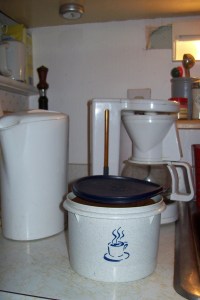
My beverage center in my kitchen
Now, I don’t drink enough coffee to make an automatic coffee delivery program worth it. I don’t want to become addicted and get a headache if I have to go without coffee one day. I do appreciate a really good cup of coffee every other day or so. Most translators I know are huge coffee fans. We have lived in Europe, hung out in Viennese/Parisienne/(insert city here) cafes and appreciate a good cup of joe. If you are anything like me you buy imported coffee. I just finished up my illy and have cracked open my big pack of Jakobs Krönung, which should last me a while. I have a German Tupperware coffee container (see photo) that fits a 500 g pack of Jakobs Krönung perfectly. Another factor in translators’ love of coffee (and tea) is that we sometimes have to pull all-nighters to meet a deadline. This coffeemaker might be just the ticket…
Stuck between cultures March 19, 2009
Posted by Jill (@bonnjill) in German culture, Random musings.5 comments
When I lived in Germany I frequently referred to myself as a Stranger in a Strange Land. I never quite fit in. The people (particularly those in positions dealing with customer service or more likely the lack thereof) would frequently frustrate me. I wasted time on German men who were impossible to read. My neighbors never quite understood me (although I did get a complement from one older woman on the Christmas lights in my window 🙂 ). I became a little bastion of America in Germany. And yet I loved living there. I made a lot of friends and embraced the cultural traditions like sitting in a beer garden or sitting in the sun at a café with a Milchkaffee, a nice piece of cake and a good book.
I am currently reading several books set in Europe, Spotted Dick, S’il Vous Plait by Tom Higgins and The Private Patient by P.D. James. Spotted Dick is about a translator who opened an English restaurant in Lyon, France. It’s enjoyable. I just wish he would translate his French phrases for those of us who don’t speak French… Anyway, I started The Private Patient last night and was seized by a wave of “homesickness” (or Fernweh – whatever you want to call it…) while reading a paragraph explaining how she walked through the center of town listening to the church bells. It’s amazing how just a simple sentence or description can transport me back to Europe and make me wish I lived there again.
But things wouldn’t be the same if I did. My friends have scattered to the wind, gotten married or had children. Living in Europe in my forties wouldn’t be the same as it was in my late twenties. I am sure I would be able to meet new people and make new friends, but there are lots of benefits to being home as well. I love having all my things around me, for one. I lived a temporary life for six years, with minimal property and lots of used furniture. I now own new furniture and have both new and old things from my childhood/college years/etc. surrounding me. It’s great to have all my CDs in a shelfing unit and just pick out the one I want to hear. I love being a dog owner and doubt I could bring her with me without a lot of hassle and paperwork.
But there’s also a lot to be said for wandering along cobblestone streets and listening to church bells peal – or sitting in a beer garden on the Rhine River watching the barges go by. I decided the way to deal with this is to make sure I actually get to Europe this year, come hell or high water. It’s been a while since I’ve been back, and I do really miss it.
It’s amazing how our adopted countries can quickly become home – and how home never quite feels the same when we return. We translators are a rare breed of people who learn to live stuck between cultures. In the end we adopt the practices that we enjoy the most. I have several German, Spanish and Czech cookbooks that I can use when I get a craving for a bit of the old country. I celebrate Karneval instead of Mardi Gras. I give friends who move into a new home a basket with salt and a loaf of bread. We become the best of both worlds. How about you? What do you miss about your home and adopted countries?
No sex please: We’re Germans (Reuters) February 28, 2009
Posted by Jill (@bonnjill) in German culture, Random musings.5 comments
One of my friends sent me the oddest article from Reuters.com Friday about how Germans just don’t talk about sex. I don’t understand this, because sex is everywhere in Germany: the daily newspapers like Bild features a photo of a buxom (usually topless) woman on the front page every day, parents are more lax with their children when it comes to opposite sex friends staying over, “Oben Ohne” (topless) sunbathing is normal on European beaches (I’ve done it – it was no big deal), they show soft porn on TV on Sunday nights, etc. I suppose this ties in with my previous post on not understanding German men. Yet one more piece to the puzzle that is the German mindset… 🙂 We Americans may be more prude, but sex seems to be a more common topic here. I’ll be curious to see what some of you folks have to say about this one.
No sex please: We’re Germans
BERLIN (Reuters) – Germans would rather talk about death, sickness or money problems than sex.
A new poll of nearly 2,000 Germans showed sex to be the subject they least liked to talk about, with 64 percent saying it was something they would rather avoid.
Just below sex on the list of least-liked topics were cash and relationships, according to the Allensbach polling institute. One in three of the Germans preferred not to talk about death, and one in five said sickness was a no-go area.
The favorite conversation topic was gossip about friends, followed by the latest prices of consumer goods. Coming a close third was “everyday stuff” and how they felt about themselves.
(Writing by Franziska Scheven)
Alltag bei Sprachmittlers: Übersetzer und die lieben Kunden February 9, 2009
Posted by Jill (@bonnjill) in Fun stuff, German culture.add a comment
Someone on one of my German-speaking listservs shared this link with us a while ago, and I found it too priceless not to share with you. It’s in German, but I might get around to translating it for the non-German speaking folks – providing the humor translates. It depends on how tomorrow goes.
Krampus outside Salzburg December 5, 2008
Posted by Jill (@bonnjill) in German culture.1 comment so far
In honor of December 5th, here is a video of some Krampus. This kind of Krampus I didn’t mind. It was the ones who skulked in the dark and attacked folks that scared the bejeebus out of me.
‘Twas the night before Saint Nicholas Day December 5, 2008
Posted by Jill (@bonnjill) in German culture.2 comments
Christmas in Austria and Germany was always my favorite time of year. Nothing beats the Christkindlmärkte (Christmas markets) and a nice steaming glass of Glühwein (mulled wine) while standing under white twinkle lights and straw ornaments. The Christmas season is officially starting today for me, with Saint Nicholas Day, which was the inspiration for the American Santa Clause. In Germany, Nikolaus is usually celebrated on a pretty small scale. Many children put a boot, called Nikolaus-Stiefel, or shoe outside the front door on the night of December 5 to December 6. St. Nicholas fills the boot with gifts, and at the same time checks up on the children to see if they were good. If they were not, they will have a tree branch (rute) in their boots instead. Sometimes, a disguised Nikolaus also visits the children at school or in their homes and asks them if they “have been good” (sometimes ostensibly checking a book for their record), handing out presents on a per-behavior basis.

Krampus in Austria, Photo courtesy of Wikipedia
But for many children, Nikolaus also elicited fear, as he was often accompanied by Knecht Ruprecht, who would threaten to beat, or sometimes actually eat, the children for misbehaving. Knecht Ruprecht is a scary looking incubus with goat legs. In Switzerland, where he is called Schmutzli, he would threaten to put bad children in a sack and take them back to the dark forest. In other accounts he would throw the sack into the river, drowning the naughty children. These traditions were implemented more rigidly in Catholic countries and regions such as Austria or Bavaria. In parts of Austria, Krampusse, who local tradition says are Nikolaus’ helpers (in reality, typically children of poor families), roamed the streets during the festival. They wore masks and dragged chains behind them, even occasionally hurling them towards children in their way. These Krampusläufe (Krampus runs) still exist, although perhaps less violent than in the past. The word Krampus originates from the Old High German word for claw (Krampen).
Traditionally in Austria young men dress up as Krampus in the first two weeks of December, particularly in the evening of December 5, and roam the streets frightening children (and adults) with rusty chains and bells. In some rural areas the tradition also includes slight birching by the Krampus, especially of young females. I for one hated walking on the streets of Salzburg during this time, because it was an excuse for delinquents to beat people. Some of us wore long coats to ward off the hits. Basically you heard the bells and ran like hell.
So Happy Nikolaus, folks!
No GEZ fees for Internet PCs November 26, 2008
Posted by Jill (@bonnjill) in German culture, Random musings.2 comments
I never thought it would happen. The German courts have ruled that there is no legal basis for charging the GEZ fee (German TV and radio license fee allowing you to be in possession of equipment capable of receiving radio or television broadcasts) for PCs with Internet access. As an American, where we don’t have to pay a license fee, I never liked the idea of charging a fee to listen to the radio or watch TV. Technically it is a fee to support public broadcasting, but I prefer to donate to the stations I watch directly, which wasn’t ARD and ZDF. Nope, I was a fan of Pro7, Sat1 and RTL – all the channels that showed all the American and British shows. Not to mention the Dutch channel. But I digress… Once I bought my car I paid for a radio, but not a TV, just to keep them off my back. I stumbled on a fun discussion in English about the fee while researching this post. It’s worth reading for a giggle.
When I was still living in Germany I heard rumblings that the authorities were going to start charging a fee for PCs that access the Internet. Apparently because they claimed that people would be able to watch TV and listen to the radio over the computer, which back then was a pipe dream and now is reality. Well, no more. Several people filed lawsuits against the fee for the professional use of a PC with Internet access and the court decisions keep coming – all against the fees. The courts agreed, saying there was “no justifiable legal basis” to charge a fee for a PC that is used solely for business. And apparently people who use their PC at home for their job will also not have to pay additional fees as long as they have registered other radios or TVs. That’s one less useless fee Germans have to pay. Maybe they’ll revolt and get rid of it altogether – a girl can dream…
For more articles and blog posts on this subject (in German), visit:
- Gericht beschließt: keine GEZ-Gebühren für Internet-PCs
- Gericht kippt PC Gebühr – keine GEZ-Gebühren für PCs?
- GEZ-Gebühren für berufliche PC-Nutzung rechtswidrig
- Keine GEZ Gebühren für PC!
- Keine GEZ-Gebühren für den PC
And don’t bother posting comments telling me I should pay. I don’t live in Germany any more and don’t have any plans to move there for an extended period of time any time soon.
Alaaf! November 11, 2008
Posted by Jill (@bonnjill) in German culture.2 comments
Oh, how could I have forgotten that today is also the start of Karneval in the Rhineland! Thanks to my friend Heike, who reminded me. “The fifth season” begins at 11:11 a.m. on November 11th every year when women storm the City Hall and officially begin Karneval (Carnival). Karneval is a festive season which occurs immediately before Lent; the main events are usually during February and March. The Karneval spirit is then temporarily suspended during the Advent and Christmas period, and picks up again in earnest in the New Year, culminating on Rosenmontag (Rose Monday). Weiberfastnacht is the Thursday before Rosenmontag and is marked by lots of drinking and costumes – and men’s ties are not safe, because the women cut them off. Most businessmen wear old or ugly ties today for this very reason.
Carnival is mostly associated with Roman Catholic and, to a lesser extent, Eastern Orthodox Christians; Protestant areas usually do not have carnival celebrations or have modified traditions, like the Danish Carnival. The world’s longest carnival celebration is held in Brazil but many countries worldwide have large, popular celebrations, such as Carnaval of Venice, or the world famous German celebrations. Karneval festivities are especially strong in the Rhineland region (Cologne, Bonn and Düsseldorf), since it was a way to express subversive anti-Prussian and anti-French thoughts in times of occupation, through parody and mockery.
So Kölle Alaaf! I’ll be cracking out my Karneval CD this morning and celebrating virtually with all my friends in the Rhineland.


 Musings from an overworked translator