Déjà Vu drops its prices January 20, 2010
Posted by Jill (@bonnjill) in Tools, Translation.add a comment
One of my colleagues sent the following e-mail to the GLD list this morning. I thought it interesting enough to share it with you all. Since so many people have been unhappy with the latest version of SDL Trados I think it is smart that other translation environment tool manufacturers are reaching out to attract new customers. I myself am thinking about WordFast, but this is definitely a tempting offer…
Atril has announced a significant decrease in price for two versions of DVX:
Déjà Vu Standard: EUR 250 (down ca. 50%)
Déjà Vu Professional EUR 660 (down ca. 30%)Fully functional evaluation version available for 30 day test period @ http://www.atril.com
Interesting Chinese menu January 4, 2010
Posted by Jill (@bonnjill) in Translation.add a comment
One of my friends on Facebook (a non-linguist, I might add…) shared a very amusing menu filled with mistranslations that they discovered at Flumesday.com entitled “The Rabbit Fucks the Pot.” This is a photo of a menu from a Chinese restaurant at Chongqing’s Jiangbei Airport. This may be old news, since the post is from February 2007, but I wanted to share it with you all just in case you (like me) hadn’t seen it yet. The blogger’s commentary is almost as entertaining as the actual (mis)translations, with my favorite being:
What’s interesting is that the price to “fuck a fish head” is 10 yuan more expensive then to “fuck a spring chicken.” One would think fucking a spring chicken would cost more.
Advice for a budding translator December 3, 2009
Posted by Jill (@bonnjill) in Business practices, Translation.3 comments
Hi Ms. Sommer!
My name is [Nicole Kidman], and I just found your website! I’m a freshman at the University of Mary Washington, and I’m planning on majoring in German and…something else. I always thought translating and interpreting were one and the same, but now I realize there is a difference. The reason I wanted to double major is because I had NO idea what career options interested me, and my parents are pressuring me to have a back-up plan because I need to earn money somehow. After reading your website, however, I’ve realized that being a translator doesn’t mean standing behind a diplomat, translating what a speaker is talking about. I have a few questions that I hope you could entertain because I’ve never had the chance to talk to an actual translator before. I studied abroad in Germany last year (took a gap year between high school and college), so I’m pretty steady in my German learning. In high school, I took four years of Spanish (though I’m not passionate about the language), and this year I started Chinese. I definitely plan on continuing with German and Chinese, but I was wondering if you could offer some advice as to which third language I should learn. My parents want me to continue with Spanish. I realize this is the most reasonable choice since 22 countries speak Spanish, but I plan to either work in Europe or with a European country in America. As a translator who has expertise in the German language, which language would be the best accompaniment to German? My options are Spanish, French, Italian, Latin, Greek, and Arabic. Also, since I do want to have a steady career and income, would you say that translation is a steady and growing field?
Sorry, this email has become much more long-winded than I meant it to be! 🙂
Hi Nicole,
I suggest concentrating on learning one language you are passionate about and learning it really well. Live overseas for as long as you can. Being a translator means you need to understand every nuance of the source text (including cultural references and subtleties). Being immersed in the language ensures you understand that the text is talking about a Tornado fighter plane and not an actual tornado. If I were to do it all over again my second major would have been something helpful, like business classes or some technical field that I enjoyed. That would allow you to specialize right out of the gate. It is very rare to find someone who speaks seven languages and knows them well enough to translate them effectively. There are a few people out there that do, but they are very rare indeed. Most agencies prefer to work with someone who translates from one or perhaps two languages into their native language. My friend Jane translates from German and French into English, for example. Dr. Geoff Koby translates from Dutch and German into English, etc. Both work in languages that are somewhat similar. Even though I don’t translate from Russian, I find my knowledge of Russian sometimes comes in handy in WWII documents, for example, when it comes to the transliteration of names or cultural background information.
As for translation being a steady and growing field, absolutely. With globalization the need for translation continues to grow by leaps and bounds. As the current ATA President Nick Hartmann mentioned in the closing ceremony of the ATA conference this year, the industry grew 15% last year and looks like it will grow another 15% this year. There aren’t enough trained translators out there to cover the demand, so I would suggest continuing your undergraduate studies and study abroad one of those years. Then consider studying translation at the graduate level at either Monterey (if you want to interpret, this would be the best choice) or Kent State University.
I hope that answers your questions.
Hey fellow translators, do you have any wisdom to add? If so, please feel free to add some more advice in the comments!
Report from the 50th ATA conference November 17, 2009
Posted by Jill (@bonnjill) in ATA, Random musings, Translation.10 comments
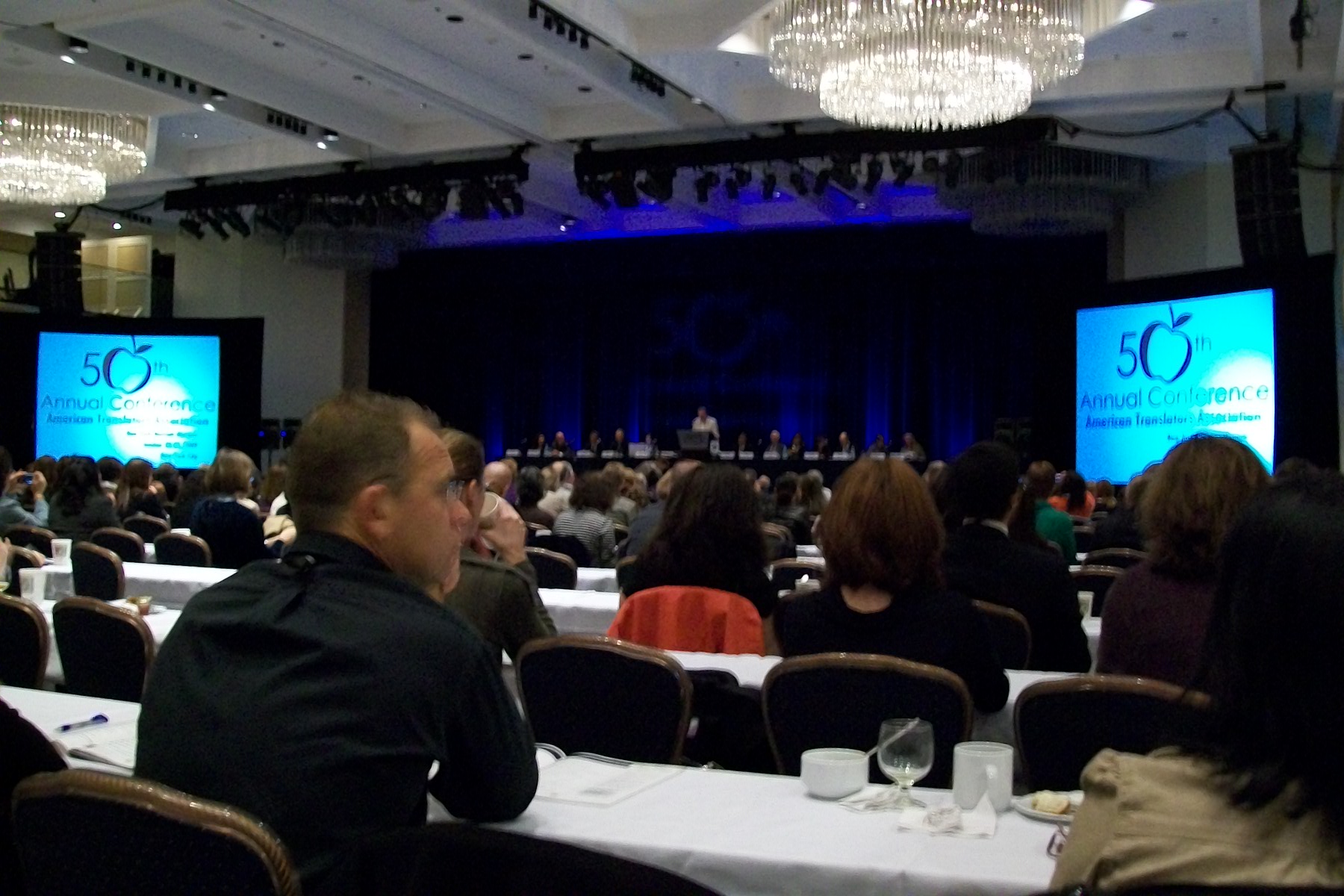
Opening Ceremony of the 50th ATA Conference
I have finally worked my way through all the mail, bills, errands, etc. that piled up while I was traveling to Myrtle Beach and NYC. It didn’t help that I immediately got slammed with work (not that I am complaining about that!!!) when I got back from the conference. I’ve had some time to mull things over, and I would like to share my impressions of the conference with you all.

The view of Times Square from my hotel room

The hotel bar
As I’m sure you have read everywhere else, this year’s conference had a record 2,300+ attendees. The hotel was located in the heart of Times Square, which was exciting, but also really expensive. In past years my fellow translators and I would hang around the hotel bar and network after hours, but with a beer costing $12 and a mixed drink at $16 there wasn’t a whole lot of hanging around being done. Also, the hotel didn’t have a lot of seating that encouraged you to hang around and catch up with friends and make new ones. The conference was spread out over four floors, so unless you already made plans and specified where to meet it was rather difficult to find people. There were quite a few attendees who I wanted to see but never did. Plus, I specified my cell phone number as my on site contact information, which never made it into the attendees list due to the sheer number of attendees that needed to be listed. I got home from the conference and had two calls on my answering machine from people looking for me at the conference.
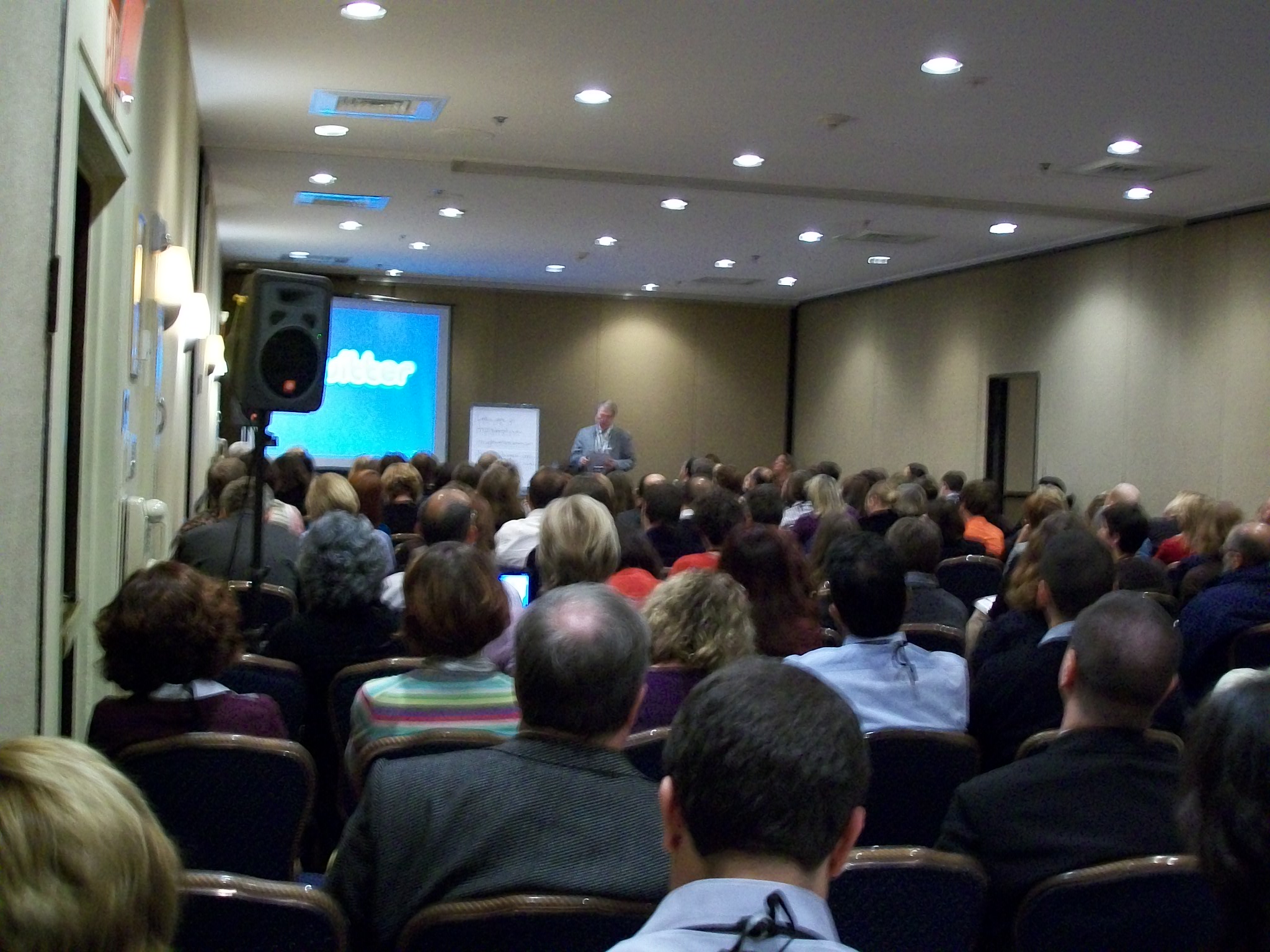
Michael Wahlster presents the ins and outs of Twitter to a packed room
The presentations were without a doubt top-notch this year. With all the proposals submitted only 1 out of 4 proposals were accepted, so the presenters really were the cream of the crop. I did not venture much out of the hotel this year and only attended one clunker, which was held by an invited speaker who was clearly out of her depth. The highlights for me were Karen Leube’s presentation on German-English medical translation and Chris Durban and Lillian Clementi’s Up the Down Economy! Growing Your Practice with ATA’s Client Outreach Kit. Karen’s presentation opened my eyes to several translation methods I have immediately started implementing, and I had heard good things about Chris Durban’s presentations for years. I hope to use some of their ideas to branch into marketing to some direct clients this year.
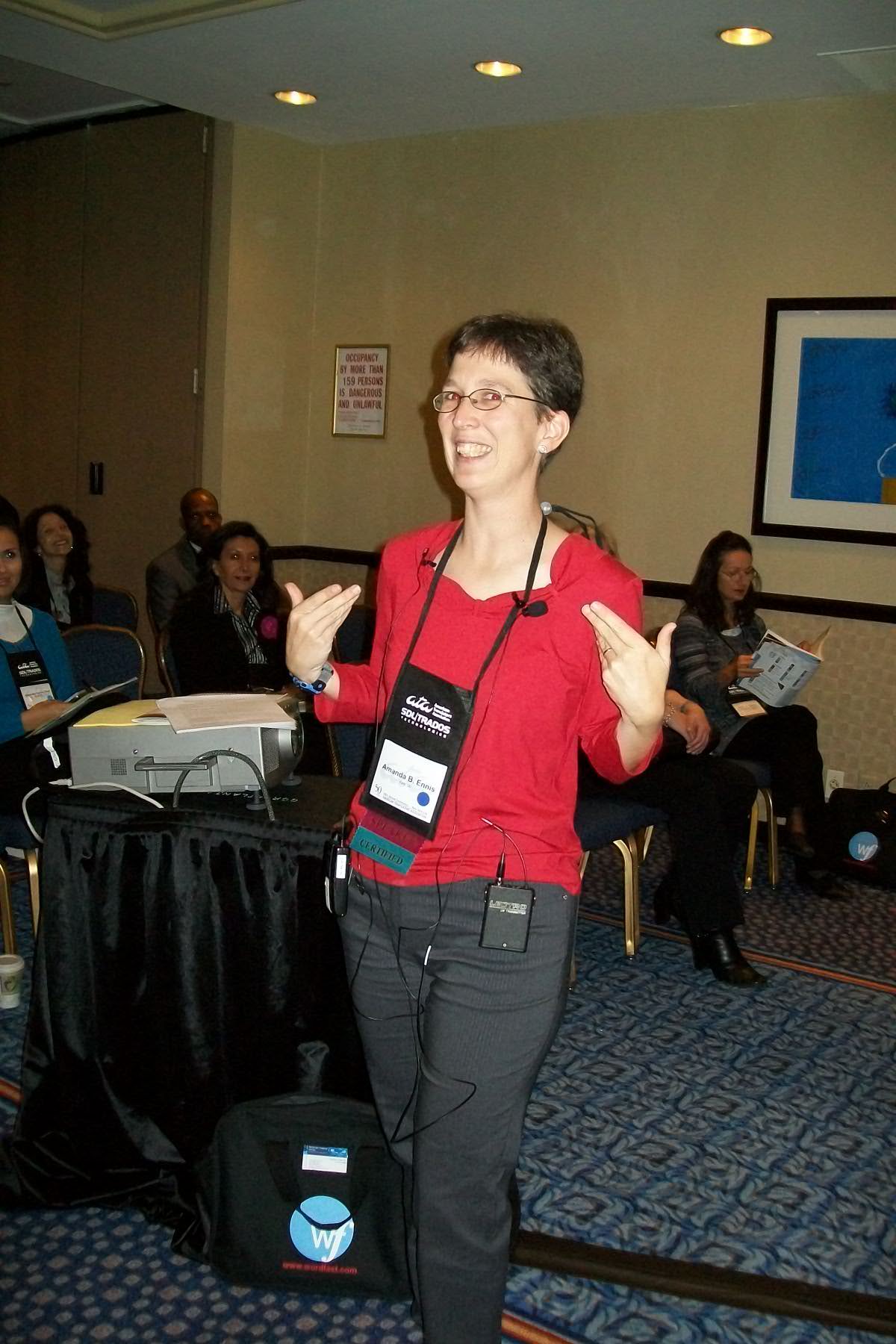
Amanda showing off her double microphones and conference badge
My presentations were very well-received. As usual, they were held at the same time as presentations I really wanted to attend, like Renato Beninatto’s and Nina Sattler-Hovdar’s presentations. Maybe next year. Amanda Ennis and I presented the first session for new attendees for something like the fifth year in a row. We’ve got our schtick down and still hopefully manage to make it quite fresh and entertaining. We’re the Abbott and Costello of translation :-). We have props and everything. This year they filmed us, which was a little intimidating.
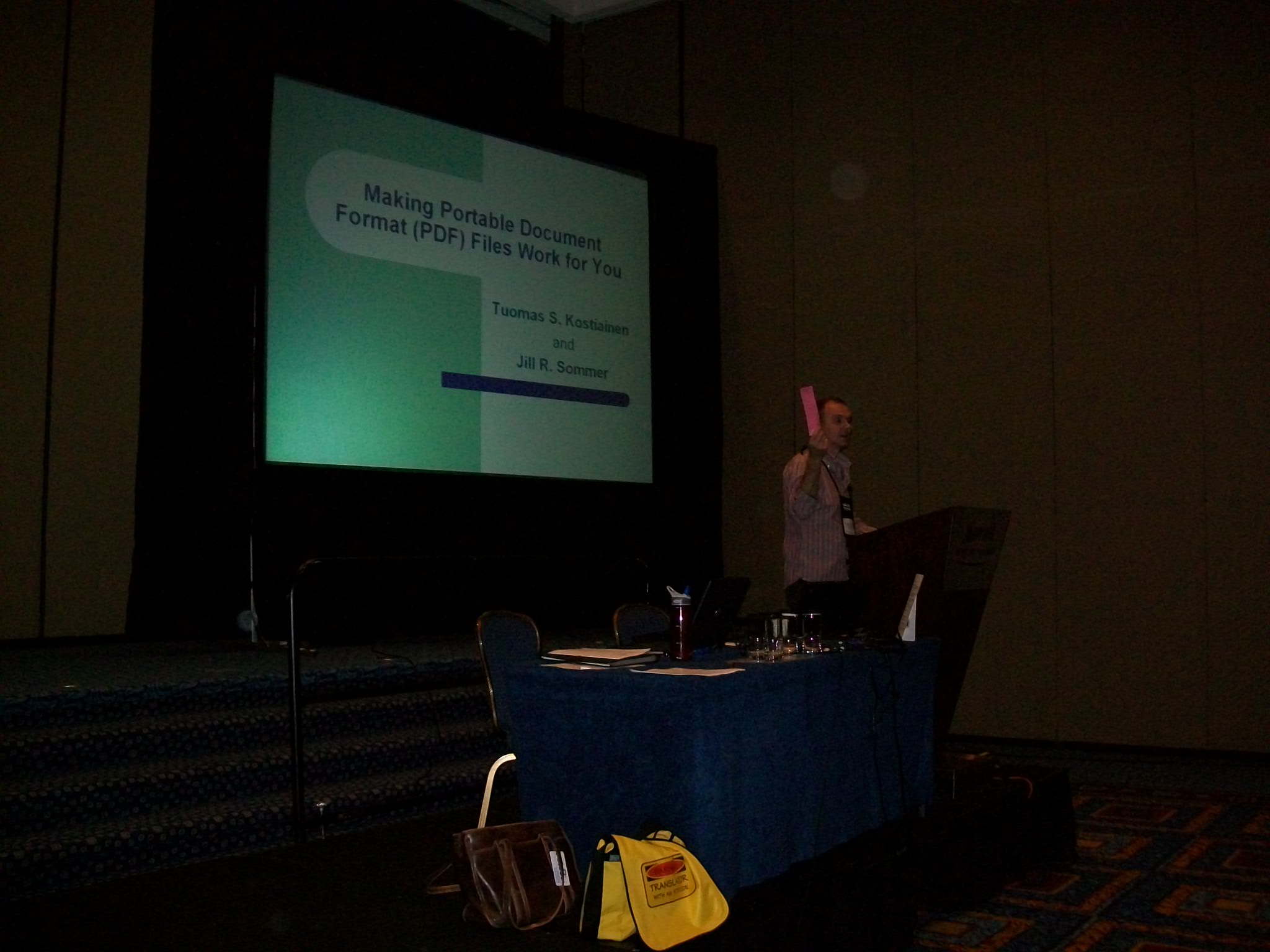
Tuomas at the start of our presentation
I was most excited about my second presentation of the conference, Making Portable Document Format Files Work For You, with Tuomas Kostiainen. Tuomas showed the attendees the ins and outs of Adobe Acrobat, such as editing PDFs, filling out PDF forms, and creating electronic signatures, and creating translation memories from PDFs using LogiTerm AlignFactory. I filled the second half of the presentation showing everyone how to create PDFs in Word and Excel and how to use optical character recognition tools to create MS Word files for translation in translation environment tools. I also briefly touched on formatting in Word. We received lots of enthusiastic feedback, which is always appreciated.
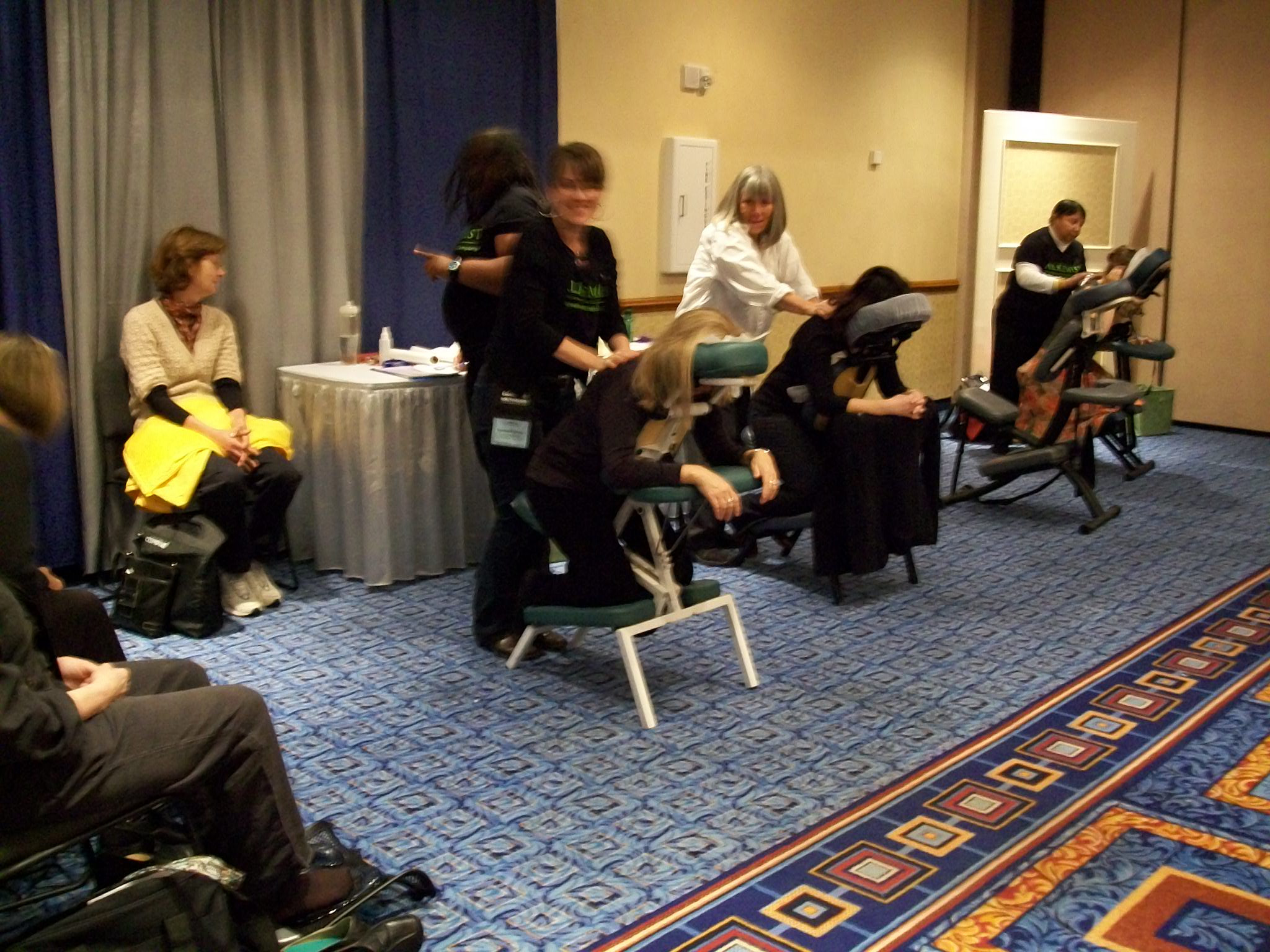
Chair massages complements of Bodyworks and ATA
The highlight of the conferences for me are the free chair massages that are available to attendees in the back of the Exhibit Hall. There is usually a bit of a wait, but I find if you wait until during sessions the wait isn’t as long. While you are waiting you can sit and massage your feet on an electronic foot massager. The massage therapists are always top-notch, and I enjoy slipping them a little tip as a thank you for giving me a little relaxation in the midst of all the craziness.
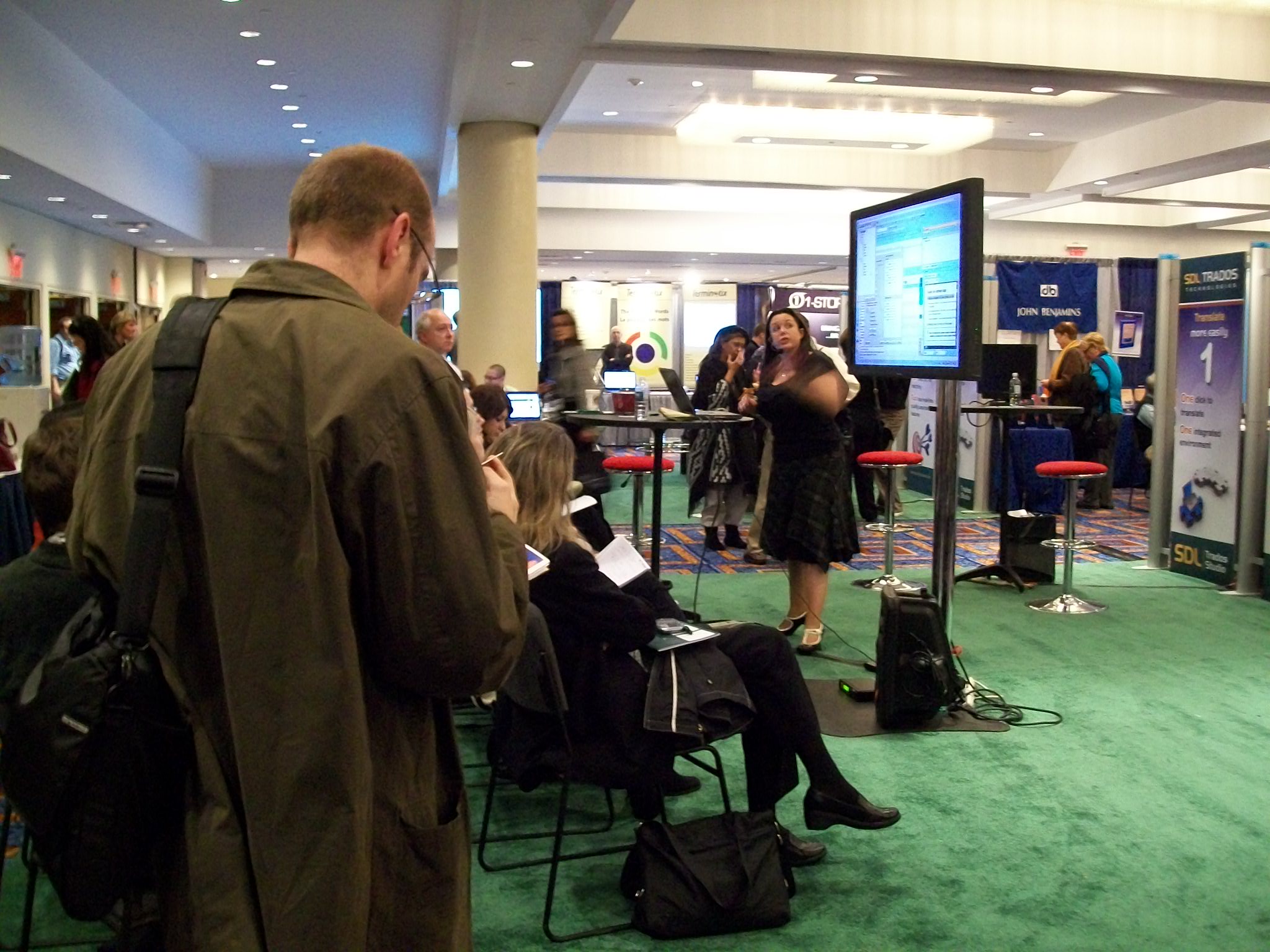
Presentation at the SDL Trados booth
The Exhibit Hall is also a central draw of the conference. Vendors such as tool vendors, universities, dictionary companies and translation agencies staff their booths to show us the latest and greatest in translation and interpreting. I usually buy a dictionary at the conference every year, but I never managed to get to the Intrans Books stand this year. I did stop at a couple translation agency booths to say hi to project managers with whom I have worked in the past and to reconnect with agencies who I have lost touch with when my project manager(s) left the company. I also walked through the Job Exchange at least once a day to make sure my resumes and business cards were replenished and prominently visible.
CETRA Reception
Last but not least, the networking. In addition to the blogger lunch I organized on Day 1 and the Kent State lunch on Day 2, I was invited to several private receptions for various translation agencies with whom I work. I enjoyed finally meeting one of my favorite project managers after talking with her on the phone for several years now. Plus, it is a nice opportunity to sit down and really talk with colleagues in a smaller, quieter setting.

View of the Chrysler Building from The View
I had planned to leave on Saturday afternoon, but decided to stay an extra night when a friend offered me her free bed for the night. Since I had driven to Baltimore and took the bus to NYC it wasn’t a problem to stay. I went out for a wonderful dinner at The View, which was the revolving restaurant on the top floor of the hotel. We sat in the lounge, enjoyed the buffet and even got to watch the fireworks from the World Series over the skyscrapers. Afterward we headed down to the conference dance and danced a bit before calling it a night. It was a great way to end the conference.
 All in all I am very glad I went to this year’s conference. The presentations were interesting, and despite a couple minor complaints the venue was fabulous. I wasn’t feeling well, and some people noticed it enough to call me after the conference because they were concerned. I ended up being really sick the whole next week and am still not 100%. However, I still managed to meet what promises to be two new agencies, reconnected with some agencies and colleagues, met some really great new people, and got to hang out with my friends. And I got to see the Naked Cowboy 🙂

Stumbling for words on the tip of your tongue October 19, 2009
Posted by Jill (@bonnjill) in Translation.4 comments
I thought it was just me, always stumbling to remember a word that is just beyond the reach of my memory. Well, it turns out it afflicts bilinguals more than monolingual speakers.
USA Today has an article entitled In search of that word on the tip of your tongue that discusses how “deaf sign-language speakers may hold the keys to finding where those words are hiding.” It turns out that sign language speakers have the same problem, but they call it “tip of the finger.” As Jennie Pyers and colleagues at Wellesley College in Massachusetts recently conducted a study of bilingual sign-language speakers that offers insights for all bilinguals.
As Ms. Pyers explains in the article, “”Bilingual folks have the problem even worse… In the study, English-only speakers, shown pictures of 52 rarely recalled things (such as a metronome), averaged about seven tip-of-the tongue glitches. But English-Spanish bilinguals did worse, averaging 12 glitches.” Pyers goes on to explain that “[m]ost likely… bilingual folks only get to exercise the vocabulary of each language half as much as single language speakers, with correspondingly fewer chances to regularly use a word.”
But it’s not all bad news. The study found that “people who speak more than one language possess advantages that make a difference, beyond just fluency in another tongue.” Multiple language speakers apparently outperform monolinguals because we “possess a better attention span for hard tasks. And they seem to be better at switching their focus from one task to the next, a real advantage in our era of multi-tasking emails, cellphones and occupations. The explanation is that they practice controlling their languages, repressing one at the expense of the other, constantly,” Pyers says. “So they are just better at controlling their focus.”
How about that? Yet another benefit of being bilingual. Who knew that those momentary lapses while struggling to come up for the right word make me better suited to being a translator, because it helps us focus our attention and multi-task.
The trouble with translation memory programs October 1, 2009
Posted by Jill (@bonnjill) in Business practices, Tools, Translation.8 comments
Here we go again…
There is a very interesting article in Ezine, Translation Memory Programs Causing Problems For the Translation Industry and Also For End-Users by John Hadfield, that is arguing that the use of translation memories is in fact slowing down translators and driving the price of translation up as a result. He starts off by claiming, “Under this system, the translator often has more work to do as a result of using a TM, but gets paid much less for a particular translation than he or she would have been paid before the introduction of TM’s.” I don’t know about that, but I do know that I have to really pay attention to every segment (because not all matches are true matches) and spend a lot of time figuring out how best to make the translation units flow together and not sound translated (a final run-through after cleaning up the document usually helps tremendously). He also states that many translators dictate their translations. I don’t know if many translators do this, but I do know a couple translators who dictate their work. He makes some very interesting points including:
…The most glaring result of this problem is that all translators have been forced to increase their standard price per word over the last few years in order to survive, so for documents which are almost totally non-repetitive (and where a TM is therefore useless), the translation agency or end-user ends up paying much more for its translations than it would have paid before the introduction of TM’s. However, that same customer still requires the translator to use a TM for its translation, even though it is obvious to all that the document concerned is not likely to show any repetition in any but a few random single or two-word phrases.
I don’t know if my raising my rates has anything to do with the use of translation memory. I have raised my prices to keep up with inflation. Also, as with any profession more experience should always be compensated with a higher salary, bonuses, etc. As freelancers we don’t have that luxury. I charge what the market will bear. I certainly don’t do it to survive because I am faced with discounts for repetitions and matches.
…Apart from the translation of manuals which use a great deal of repetition (such as workshop manuals, job code manuals, etc.) and certain standardized contracts and legal texts, statistical analysis of any large company’s or large translation agency’s translation work over a period of one year would very probably show that the compulsory use of TM’s, combined with the resulting increased prices per word from freelance translators (who perform by far the major portion of translations throughout the world), has finally resulted in the entire operation costing more to the end-user than it would have cost before the use of TM’s became general.
…There is also increasing evidence of a curious attitude prevalent amongst certain end customers and agencies in which the method of translation (i.e. the use of the TM system) seems almost to have become more important than the translation itself.
I’ll give him that. A common complaint I hear on all my translation forums is that many TMs contains mistranslations, sloppy work and out-and-out errors, which are then perpetuated in the company’s documentation for all eternity. Since we are not paid to correct the TMs and agencies are told by their end clients to not touch the 100% matches, these mistakes are usually not pointed out and the end client is usually blissfully unaware of the problem.
The author is proposing to require the agency’s translators to offer a reduced price per word for translations which do not require the use of a TM, and perhaps abandoning the use of TMs altogether. That is a very interesting suggestion, but I think I’ll stick with my word rates and my TEnT for now. It does save me time in texts that are repetitious, and I generally work with agencies that do not demand discounts for repetitions. I bought my TEnT to save me time and ensure greater consistency. And every once in a while I do get a plum job that is already in my TM, which saves me time and frees me up to take another job.
Translation memory is not a burden to be vilified, but I do think translation agencies and some TEnT developers should think long and hard about their practices. We pay for our tools – not the agency. Why should we be paid less to use them? That just doesn’t make sense. And don’t even get me started on selling certification classes to use the tools. Those certified users are now out in the cold and out several hundred dollars because the latest version is totally different from the one they were trained on.
I’m curious to hear what you all think. Does using a TEnT take you more time or less?
Wishing translators and interpreters a Happy International Translation Day September 29, 2009
Posted by Jill (@bonnjill) in Translation.10 comments
Translators and interpreters celebrate September 30th as their day, since it is the Feast Day of the patron saint of librarians, scripture scholars, students, and of course, translators and interpreters. St. Jerome is one of the greatest biblical scholars of all time, having translated the Bible from Hebrew and Aramaic into Latin (the Vulgate) in the early 5th century. For more on St. Jerome, check out my September 30, 2008 post.
The Fédération Internationale des Traducteurs/International Federation of Translators (FIT-IFT) came up with the celebration back in 1991 to raise awareness of the profession. This year’s theme for International Translation Day is “Working Together.” As it says in the linked press release, FIT-IFT “invites translators around the world to take a fresh look at why and how it pays to join forces. The days of the fiercely solitary translator working in splendid isolation are numbered, say many industry observers.”
I plan to celebrate International Translation Day by grabbing my laptop, dressing up in my translator gear and heading to the local Starbucks to work for an hour – just to be visible. Would anyone local care to join me?
What are you planning on doing for International Translation Day?
I want to be a plumber September 25, 2009
Posted by Jill (@bonnjill) in Random musings, Translation.3 comments
Martin at False Friends, Good and Bad Translation, Denglisch, Tipps für Übersetzer just posted the best blog post I’ve read in a while. If you understand German, you should run right over there and check it out. In the meantime, I have written him to see if I can translate it and post it here for all you non-German speakers. He basically tells the story of a plumber who has to work over the weekend and then has a DIY client mess it up along the motto of “Ich kann’s besser/I can do it better.” It’s priceless!
Being bilingual has its advantages September 16, 2009
Posted by Jill (@bonnjill) in Translation.2 comments
Friend and fellow translator, Kimme, posted this news article on Facebook this morning. Apparently the pilots on a recent Aer Lingus flight broadcast the wrong announcement in French warning to prepare for an emergency landing, causing the French passengers on board to panic. The English version simply asked passengers to return to their seats because of turbulence. Oops! I would imagine those passengers who were bilingual were extremely confused.
Words every client should hear September 16, 2009
Posted by Jill (@bonnjill) in Random musings, Translation.3 comments
RT: @sarahdillon: A good translator isn’t expensive – just see how much a bad one really costs you & you’ll agree…
Thanks, Sarah, I could not agree more!


 Musings from an overworked translator