A worthwhile cause July 25, 2008
Posted by Jill (@bonnjill) in Random musings.1 comment so far
I just read about this homegrown charity on CNN.com, Pedals for Progress, and wanted to share it with all of you. I think I’ve found a charity I can finally get behind. Sure, I regularly donate to my usual charities, but this one just touched my heart for some reason. Pedals for Progress has collected and shipped more than 115,000 used bicycles to 32 developing countries worldwide, where they are sold at a low cost to local residents. Used bicycles offer access to jobs and health care that they might not be able to reach while walking. I have an unused bike languishing in my garage right now because I prefer the mountain bike that actually fits me and is therefore easier to ride. How about you?
TGIF: Catherine Tate’s 7 Language Interpreter July 24, 2008
Posted by Jill (@bonnjill) in Fun stuff.4 comments
I’ve been enjoying my time off and already have next week booked solid. How did that happen? Anyway, I wanted to take a few minutes to share this video with you all. I’m going to warn you that it is quite painful, yet hilarious to watch.
UK comedian Catherine Tate plays numerous characters in her variety show, The Catherine Tate Show , which debuted in February 2004. This particular clip aired on October 27, 2006. The try-hard wannabe “I can do that” character Helen Marsh didn’t really take off in the tennis and curling sketches, but was truly brilliant when she volunteered to act as an interpreter and reduced the languages of the world to a string of silly noises. Enjoy!
A Wicked Deception July 22, 2008
Posted by Jill (@bonnjill) in Fun stuff, Translation Sites.7 comments
One of my former students sent this to me today. I don’t know how I’d missed it until now.
This fine little film by Matt Sloan capitalizes on Babelfish for its dialog. It translates to and from English, French and German. It was filmed on location in Trouville, France. Enjoy!
I want to neglect the remainder of my life with you!
Just deserts July 21, 2008
Posted by Jill (@bonnjill) in Random musings, Translation Sites.add a comment
Snopes.com has an interesting posting about the phrase “just deserts” (as in someone who gets what they deserve). I found it interesting enough to share with all of you – especially since I have used it incorrectly all these years. I would equate this as one step above “whetting your appetite,” which is a common English spelling error as well.
Claim: A person who gets what he deserves is said to have received his “just desserts.”
Status: False.
Origins: Sometimes it doesn’t matter if you use the language correctly, because people will think you’re wrong even when you’re not.
For example, when we established the “Crime and Punishment” section of this site, we created a category for tales about criminals whose punishments were meted out in unusual ways. Like so many others before us (particularly operators of bakeries and pastry shops), we played on the “desert”-“dessert” pun and called the section “Just Desserts”; before long we started receiving mail from readers chiding us for misspelling the phrase “just deserts.” Eventually we gave up, removed the punning references, and renamed the section “Just Deserts”; then we began to receive even more mail from readers informing us that we had misspelled the phrase “just desserts” and providing us with mnemonics to help us remember the difference between “desert” and “dessert”:
You spell “Dessert” wrong in this link.I think your intention is to refer to metaphor using the term for after dinner snack. The way you spell it, “Desert” means a region that receives little rainfall.
A rule of thumb – Dessert has 2 S’s because more people would select to have dessert than spend time in a desert. It’s lame but it helps you remember.
Just wanted to point out that under your “Criminal” section, you spelled “Just Desserts” wrong. A desert is a barren expanse of land. Desserts are yummy. Just remember “strawberry shortcake” has two s’ and that’s how many s’ desserts has!
The confusion is understandable, because it involves a little-known word whose correct spelling and pronunciation runs counter to that of two similar and much more commonly used words.
The noun “desert” (accent on the first syllable) is generally used to refer to an arid, barren expanse of land; the noun “dessert” (accent on the second syllable) is a sweet course or dish usually served at the end of a meal. However, the word “desert” — when spelled like the former but pronounced like the latter — also refers to a deserved reward or punishment. Therefore, someone who does wrong and is punished in a suitable manner has received his “just deserts.”
Many people, unfamiliar with the “reward or punishment” meaning of the word “desert,” mistakenly assume that the phrase “just deserts” is properly spelled “just desserts” because of its pronunciation. (The usual reasoning is that a dessert is a type of reward one is given at the end of a meal, so someone who receives suitable rewards or punishments for his actions has gotten his “just desserts.”)
When one gets what one deserves, good or bad, one is getting one’s “just deserts,” accent on the second syllable but spelled like the arid, barren lands.
Enjoying some tranquility July 21, 2008
Posted by Jill (@bonnjill) in Random musings.add a comment
 As soon as I finish a 2,700 word translation for one of my clients that I agreed to do for Tuesday I am taking the rest of the week off for a well-deserved mental health vacation. My head was throbbing on Saturday after such a busy week, and I recognized my need for some time off. I read somewhere that translators and particularly interpreters have a higher rate of strokes and cerebral events since we work under a lot of stress (it might have been a one-off mention in The Interpreter by Suzanne Glass; I can’t remember.). I don’t want that to be me.
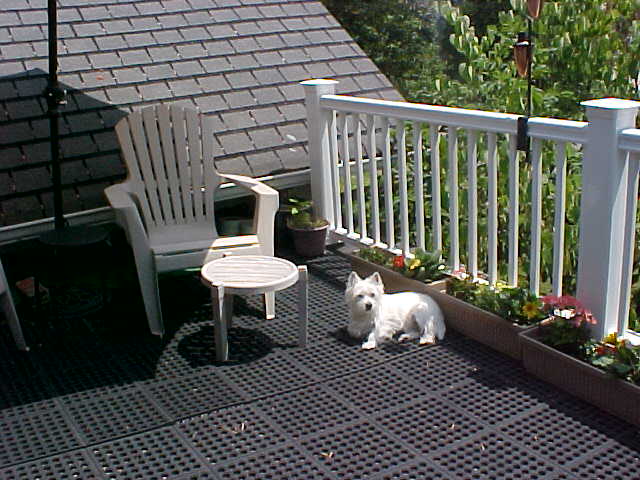
Anyway, after doing two weeks’ work in five days I definitely deserve it. I will be spending time on my balcony and reading a good book or two. Not to mention a trip or two to the dog park since I neglected my dog last week. And a couple trips to the city swimming pool. Basically just relaxing. I may even pop over to one of the islands on Lake Erie for a fun day exploring.
I may be posting this week if a thought pops into my head, but if I don’t I hope you have a great week and I’ll be back as usual next week.
Working under a deadline July 18, 2008
Posted by Jill (@bonnjill) in Random musings, Translation Sites.3 comments
As I mentioned yesterday, I am currently translating an 8,000 word computer game on horoscopes and love signs (the compatibility between the different signs of the Zodiac). I’m splitting the job with another unknown translator, who got “stuck” with the personalities of the various signs. I am translating the various pairings of the signs (Cancer-Capricorn, Leo-Leo, etc.). This is actually quite fun, because I used to be really into Linda Goodman’s Love Signs when I was in high school and college and still believe the concept does have some merit (In fact, I have the book sitting next to me, open to whatever pairing I am working on at the time so I can double-check the signs’ traits and mine it for terminology). Being a Virgo (actually, a double Virgo with my sun and moon both in Virgo) I definitely get along better with Earth and Water signs. And in the spirit of horoscopes and all things mystical, I just wanted to share today’s iGoogle Daily Horoscope for Virgo with you:
It’s hard to be creative when you are on a tight schedule, but having limited time now can actually work in your favor. Rather than being all dreamy and unfocused, your efficiency is heightened when you must produce under pressure. Paradoxically, you needn’t take it all so seriously; being able to enjoy yourself will help you be even more expressive.
Considering I translated 4,000 words yesterday and have about 2,500 to go before I’m done later today, I find today’s horoscope to be quite fitting. I find I work better under pressure. I recently finished a job on quality management (13 files, 7,500 words total) for a German hospital that took me a month and a half to finish because the client told me there was “no hurry” and his client was pretty relaxed. I kept putting the files off to accept jobs from other clients because I wasn’t under any time pressure, but they gnawed at my conscience. In the end, everyone was happy with the results and they didn’t mind that it took so long, but I did. I was just glad to finally cross the job off my job board.
Need a break? Watch this…, July 17, 2008
Posted by Jill (@bonnjill) in Fun stuff, Random musings.4 comments
I’ve been unbelievably busy this week. I translated a 6,800 word batch of medical reports on Monday and Tuesday and am now working on an 8,000 word computer game on horoscopes and love signs. I’m approaching burnout, so I took a break this afternoon to finally watch Act One of Dr. Horrible’s Sing-along Blog starring Neil Patrick Harris, Felicia Day and Nathan Fillion, which was released on Tuesday and almost immediately crashed the web site server and is now the No. 1 download on iTunes. Act Two is being released today and Act Three goes live on Saturday. They will only stay up until Sunday, July 20th. After that you can download it from iTunes and it will probably be released on DVD soon.
Dr. Horrible’s Sing-along Blog is the latest project by Joss Whedon (the creator of Buffy the Vampire Slayer, Angel and Firefly as well as the feature movie Serenity). It is the first-ever superhero musical, featuring shy, wannabe mad scientist Dr. Horrible (Neil Patrick Harris), his archnemesis Captain Hammer (Nathan Fillion) and the damsel in the middle (Felicia Day). Whedon wrote it during the writer’s strike in 2008 and filmed it in 6 days on a minimal budget. Joss’ work is known for its tight, witty dialog, and he can also write a catchy tune. And man, does Neil Patrick Harris have some fantastic pipes! I got chills listening to him.
I’ve been a huge fan of Buffy the Vampire Slayer and Angel for years now, since I first watched them in Germany (they translated surprisingly well, although they usually aired at 2 in the morning). If you haven’t seen his work, I highly recommend it. You’ll love the dialog and will stay for the gripping, enjoyable storylines.
“Coffee to go” July 16, 2008
Posted by Jill (@bonnjill) in German culture, Random musings.4 comments
There’s a very disturbing article about how European cafés are disappearing as Europeans are adapting to American trends in this week’s edition of the Expatica Germany newsletter. For those who are unfamiliar with it, Expatica is Europe’s leading lifestyle portal for internationals living abroad and they break the site down into the various countries with lots of country-specific tips about living abroad, numerous resources, information on expat life, etc.
“Coffee to go” the cry as Europe adapts to American trends reports that “the times when people would spend hours reading newspapers or indulge in deep conservation in Berlin while sipping endless coffees is somewhat seldom nowadays, partly due to faster-paced life trends, and soaring cafe rents.” It then goes on to discuss how Starbucks and coffee bars are replacing older, more relaxed coffee houses in many European capitals.
I find this trend sad, because I enjoyed many hours drinking coffee (ah, the simple pleasure of a Milchkaffee…) and enjoying homemade Kuchen or a nice brunch at cafés like Café Sacher in Vienna, Café Tomaselli in Salzburg, and my favorite café in Bonn – Bonngout. I’m sure cafés won’t totally disappear, but I find it very sad that Europeans are giving in to the American fast-paced life. That was one of the things I enjoyed most about living in Europe – things were more relaxed and slow-paced.
Choosing the right bank account for you July 14, 2008
Posted by Jill (@bonnjill) in Business practices, Random musings.add a comment
I recently sent a check to a fellow translator to whom I had subcontracted a legal contract. She hadn’t cashed the check yet, so I wrote her today to ensure she had received it. Since it was a very large check I wanted to make sure it hadn’t gotten lost in the mail. She replied that she had received it, but hadn’t had a chance to go to the bank to deposit it.
This made me all the more appreciative of my bank, which allows me to deposit my checks from home using my scanner. I find this service to be invaluable, because it allows me immediate access to the money and saves me gas and driving time. When I receive a check in the mail, I endorse the check and add my account number. I then turn on my scanner, log on to my bank’s web portal, click on Deposit@Home, and scan the front and back of the check in the deposit interface. Once the check has been accepted, I am given a confirmation number and can print out the confirmation page (but I generally just enter the confirmation number in the Memo: field in my accounting program). I am then instructed to write “Void” on the check and destroy it. I simply pop it in my cross-cut shredder and continue translating, answering e-mail, surfing the Net, reading blogs, etc. The whole process takes less than three minutes.
In case you are wondering, I bank with USAA Federal Savings Bank, which caters to the U.S. military (both active duty and retired military personnel, the National Guard and Reserve personnel, officer candidates in commissioning programs such as ROTC) and children of USAA members (which is how I can bank with them). I have insured my car with them since I was sixteen years old, and since there are U.S. military bases all over the world I was also able to insure my car through USAA when I was living in Germany.
When was the last time you analyzed the services your bank is offering? If you get a chance, you may discover it is time to switch banks. Does your bank charge you an annual or monthly fee? Does it offer you a free credit card or do you have to pay an annual fee for it? Does it charge you a fee for incoming electronic deposits or deposits from foreign accounts? Does your bank reimburse you for ATM fees at third party banks? Does your bank have an agreement with your overseas bank that allows you to withdraw money from your foreign bank account for free or a low fee? USAA isn’t the only bank that offers perks like ATM fee reimbursement, no-fee foreign deposits, and Deposit@home. National City Bank just started advertising ATM fee reimbursement. When you are negotiating with your bank it helps to know which banks offer which services. Maybe you can convince them to offer you similar services. Switching to a bank that doesn’t charge you fees or getting your bank to stop charging you fees can save you hundreds of dollars a year. It’s definitely worth looking into.
[July 16, 2008: In light of the IndyMac bank failure, you should also make sure your bank is FDIC-insured. Expatica also has a very good article comparing six of Germany’s largest banks on its portal]
Internet search tips July 13, 2008
Posted by Jill (@bonnjill) in Tools, Translation Sites.2 comments
Every translator should be adept at using the Internet. I consider the Internet to be one of my most valuable tools. I use it to search for parallel texts and elusive terms as well as keep up with the latest news and changes in my fields of interest. I also use it to verify facts, locate places of business, schedule my day, etc. In fact, I resigned from the FBI because my supervisor would not authorize access to the Internet. I never realized how reliant I am on the Internet until I was unable to use it to do my job.
There is no right or wrong way to search the Internet. If you find what you need and find it quickly, you can consider your method to be successful. However, you also need to make sure that what you have found is really the correct answer, is the best answer, and is the complete answer.
The following list provides a guideline for you to follow in formulating search requests, viewing search results, and modifying search results. These procedures can be followed for virtually any search request, from the simplest to the most complicated. For some search requests, you may not want or need to go through a formal search strategy; however, it’s a good idea to follow a strategy. Following the 10 steps will also ensure good results if your search is multifaceted and you want to get the most relevant results.
- Identify the important concepts of your search and rely on built-in relevance rankings provided by search engines.
- Choose the keywords that describe these concepts.
- Determine whether there are synonyms, related terms, or other variations of the keywords that should be included.
- Determine which search features may apply, including truncation, proximity operators, Boolean operators, and so forth.
- Choose a search engine.
- Read the search instructions on the search engine’s home page. Look for sections entitled “Help,” “Advanced Search,” “Frequently Asked Questions,” etc.
- Create a search expression using syntax that is appropriate for the search engine.
- Evaluate the results. How many hits were returned? Were the results relevant to your query?
- Modify your search if needed. Go back to Steps 2 through 4 and revise your query accordingly.
- Try the same search in a different search engine, following Steps 5 through 9 above. You may also want to try using a meta search engine that searches several search engines at once.
If you feel that your search has yielded too few Web pages, there are several things to consider:
- Perhaps the search expression was too specific. Go back and remove some terms that are connected by ANDs.
- Perhaps there are more terms to use. Think of more synonyms to “OR” together. Try truncating more words if possible.
- Check spelling and syntax (a forgotten quotation mark or a missing parentheses)
- Read the instructions on the help pages again.
If your search has given you too many results and many are unrelated to your topic, consider the following:
- Narrow your search to specific fields, if possible.
- Use more specific terms (for example, instead of cancer, use the specific type of cancer in which you’re interested).
- Use quotation marks to indicate phrases when a phrase more exactly defines your concepts (for example, “quality criteria” will be more specific than quality criteria, which could occur in different places on the page).
- Add additional terms with AND or NOT (or + and -).
- Remove some synonyms if possible.
One important final step that should never be brushed off is verifying the term by assessing the quality of the content.
- Consider the source (who is the organization behind the site? is it from an established news source, government, journal article, etc. or does the group have a bias that might influence the words they choose?)
- Look at the quality of the site (if there are spelling and grammatical errors you might assume that the same level of attention to detail probably went into the gathering of the content).
- Are the site and the contents current?
- Verify using multiple sources – is the term you have found used on other English language web sites?
Verifying is probably the most important step in the process. Some web sites are poorly translated, so your term may be a false friend or an incorrect translation that has been picked up by other sites. One example is the use of Imprint for Impressum on German web site translations. An imprint is used in the publishing world, but it is completely inappropriate for web sites. This has been the subject of numerous discussions on the various listservs I belong to. Some more suitable suggestions include Credits, Legal information, Corporate Information, Legal Disclaimer, Contact Details, Contact Details/Disclaimer, About This Site or even The Boring Stuff (depending on level of informality of the site). Anything but Imprint, but I digress…
Another technique that I find to be invaluable is to put portions of a sentence in quotations in the search field or using a term that is used in the same sentence with the German word. By searching for [German term] lasers 3:2, I was able to find a term that used the word “ratio” for another colleague who had spent several fruitless hours trying to find the term (I wish I could remember the specifics). And by searching for “sick days taken by employees” or “not work on Saturdays” you might stumble on a document that is similar (or identical) to the one you are translating. You can use the results to see how other people phrase things, which can be a terminological goldmine for the rest of your text.
By using these simple techniques and honing your search process you too can become a search champion. If you have an hour to kill, you might want to check out my streaming video presentation on Internet Research Skills, which was filmed in March 2006 at the University of Gainesville (disclaimer: I was talking to an empty room, so please ignore the awkwardness). If it doesn’t open in FireFox try opening it in Internet Explorer.


 Musings from an overworked translator