There’s more than one way to skin a cat… November 17, 2010
Posted by Jill (@bonnjill) in ATA, Random musings.25 comments
Every year at the ATA conference I get upset about how everyone talks about how ATA certification is the be all and end all of translation. It’s not. The exam is extremely difficult to pass. The folks at ATA quote a pass rate of 20%, which hasn’t changed even though ATA has now implemented a review of your credentials in order to be allowed to take the test. I would think the pass rate would go up if only qualified translators were allowed to take the exam and not just the bilingual hobbyists most translators are always complaining about. Also, some people just don’t test well.
The test itself is also flawed. I know, I know… “the graders and folks on the Certification Committee are working hard to improve the test…” blah blah blah, but the fact remains that it is still a very difficult exam to pass. I myself have failed it several times, failing by the skin of my teeth every time. One reviewer marked me off for translating “Schein” as “bill” (as in dollar bill) instead of the preferred “banknote.” Some of the “errors” were indeed true errors, but my translation style does not stick extremely closely to the source, which is what the graders prefer. I tend to translate freely when necessary. Not to mention the fact that I also use the Internet a lot to double-check terms and find synonyms. I also utilize a native German proofreader who ensures that I have not misunderstood the source text (it’s been a LONG time since that has happened, but better safe than sorry…). A handwritten test simply isn’t a good test of my skills (and my atrocious handwriting, which was flawless until computers came along, probably doesn’t help). There is also the fact that it isn’t available in all language pairs.
The fact that I have failed the test several times does not make me a bad translator. I happen to know that I am in very good company. I could name names, but I won’t (but those of you who have written me to tell me that you have joined my little club know who you are). In fact, I think the fact that I passed the FBI language battery of tests and the fact that I am frequently overworked attest to the fact that my clients do not think I am a bad translator. I have also heard from many PMs and agency owners that ATA-certified translators make just as many mistakes as non-certified translators and sometimes the quality simply isn’t there. I’m not on that end of the spectrum, so I can’t say that for a fact though. I’m merely repeating hearsay.
However, certified members are voting members in ATA. Were you aware that only 15-20% of ATA members are certified? Interesting, isn’t it? That means that 80% of ATA is NOT CERTIFIED. This also means that almost 80% of the members do not have the right to vote.
But there’s another way to ensure that you have a say in what goes on in the ATA. The ATA Board voted to simplify the process to obtain voting membership through Membership Review (also known as Peer Review) in 1999. As the ATA website states, “The new criteria… are in keeping with the ATA Bylaws that state voting members be ‘professionally engaged in translating, interpreting, or closely related work.'” I think more people who are professionally engaged in the industry should be making sure that they have a say in ATA business and who is on the ATA Board.
Membership Review involves submitting credentials and other information to the Membership Review Committee and paying a nominal fee of $50. Translators and interpreters can either submit a copy of your translation degree and one letter of recommendation from a client or evidence of three years of experience as a translator (three letters of recommendation and copies of your tax returns). See the ATA website for more details. It is a very painless process. Candidates who successfully go through the membership review process are considered Active Members but are not certified.
So what are you waiting for? Make sure your voice is heard! ATA shouldn’t be governed by just the certified members – it should be governed by ALL the members!
You win some, you lose some November 16, 2010
Posted by Jill (@bonnjill) in Business practices.9 comments
Putting projects “on hold” is a common occurrence in our industry. I just had another large project put “on hold” today. This is a great euphemism that can range from “sorry, we decided we just didn’t have the money for the project” to “we went with another provider but don’t want to hurt your feelings”. Hey, it happens and I no longer get upset by it. However, I also don’t sit around waiting for the project to pan out. After the first e-mail from the client saying their client was still making a decision I had a feeling it wouldn’t pan out, so I accepted a large OCR job for another client. The job was supposed to start last Wednesday, and I got the cancellation notice this afternoon (Monday). I am now happily plugging away at OCRing 670 pages of English legal texts.
It is important to not give up paid work for something that may or may not happen. Agencies understand this. If the project that you have expressed an interest in working on is delayed and somehow magically gets approved but you have since accepted other work, agencies will usually understand if you are no longer available. Hey, them’s the breaks and they know this.
What clues in your experience indicate a project just may not pan out? Are there any tips or tricks you would like to share with someone who may have just experienced this for the first time or is still trying to break into the industry?
Lionbridge does it again… November 1, 2010
Posted by Jill (@bonnjill) in Business practices, Scam alert.16 comments
They were probably hoping that everyone would be so busy at the ATA conference that no one would notice their little e-mail demanding a 5% discount from their vendors.
Luckily there were several bloggers who received the e-mail and commented on it. To learn more about the topic, you should read A Personal Response to Lionbridge VP Didier Helin’s Unilateral Demand of a 5% Discount (my favorite quote: “I was an infrequent and reluctant accomplice of your agency until some years ago, when I discontinued collaboration after coming to the conclusion that your project managers and I simply spoke different languages/lived on different planets/were not drinking the same Kool-Aid/were addicted to different hallucinogens.”) and Discounts Required.
Since Lionbridge refuses to pay more than US$0.10 a word for my language pair and implemented their pay to play system (see Would you pay to work for a translation agency?) I don’t work for them either.
Of course, it must also be said that this e-mail contradicts Lionbridge’s own press release, which I read a few days ago, that announced the “highest quarterly profits in its history”!!! Hey, Lionbridge, you suck!
Update: Here is another reasonable response.
Musings from the ATA Conference November 1, 2010
Posted by Jill (@bonnjill) in ATA, Random musings.6 comments
Yesterday was an exhausting day spent getting upset at Blue Sky Shuttle, whose driver was 25 minutes late for my scheduled 7 am pick-up and extremely rude to boot! No tip for him! My flight home was blissfully uneventful, apart from seeing Air Force One on the tarmac in Cleveland (President Obama was speaking about 4 miles from my home and the highway was lined with police officers awaiting the motorcade). I arrived home, unpacked and drove to my sister’s in time to trick or treat with my nieces. I slept 9 hours last night and feel ready to take on the world.

Photo by Jeff Sanfacon, ATA
I had a great time at the ATA Conference. I met a lot of you who told me you enjoyed reading the blog. Thanks ever so much! I love writing it. I also came up with the idea to market my services in alignment and optical character recognition conversion.
Speaking of OCR, my preconference seminar with Tuomas Kostiainen was well-received. We had 60 attendees, and I hope those of you who attended learned something. The best feedback I heard was from one of my older German colleagues, who is a known IT hater. She said “I didn’t enjoy the presentation, but I learned a lot.” LOL! That’s all we can ask.
Approximately 1500 people attended the 51st Annual ATA Conference in Denver, Colorado this year. The organizers really did a great job. The Welcome Reception and Division Open House was a fun time (although I don’t know how they expected us to use all the drink tokens in two hours. I know I didn’t…). The sessions were varied and ranged from practical (such as “Breaking into the Industry: How to Gain Experience When Employers Will Not Give You Experience Without Previous Experience” or “Ensuring Payment: Before, During, and After the Project”), serious (“Transcription and Translation of Evidence Recordings”) to whimsical (“What, Me Worry? Managing the Unmanageable Cycle of Feast or Famine”). I didn’t attend as many sessions as I wanted, because four of them were scheduled at the same time and several were scheduled when I was presenting. Luckily I ordered the eConference, so I will get a chance to check them out at my leisure.
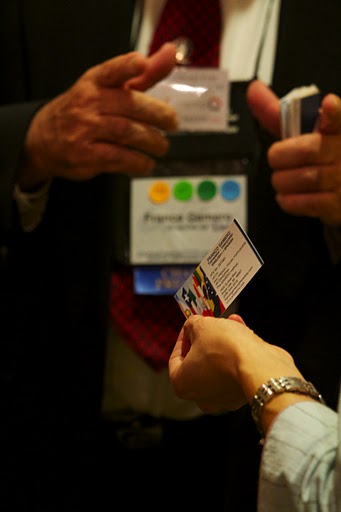
Photo by Jeff Sanfacon, ATA
I came equipped with business cards and resumes and made sure I picked up my plastic stand from the Job Marketplace on Saturday before the Exhibit Hall closed. The days seem to just fly by at the conference. I arrived on Tuesday and left Sunday morning. One older gentleman in the shuttle yesterday remarked that he thought the conference was too long. I disagreed and told him I never want the conference to end (tip: if you think it’s too much just attend for one day or two days). I enjoy seeing old familiar faces, catching up with my friends, and meeting lots of new people. I didn’t do as much socializing in the hotel bar as I have in the past. I blame the rough year I’ve had and the jet lag. However, I did get a chance to catch up with a lot of different people in the hallways, at special events and at breakfast, lunch or dinner. The GLD “Unofficial Official Get-Together” at the Peaks Lounge was extremely memorable and offered a fantastic view of the mountains and the Denver skyline.
I also have to give kudos to the hotel, the Hyatt Regency. My roommate and I were impressed with the service. The concierges were wonderful, and the staff was extremely responsive to our every need. The hotel was conveniently located near a lot of great restaurants that offered something for every budget, and Denver’s public transportation was very convenient. After enjoying Thai and Indian food during the week we were craving Italian on Saturday night, so the concierge made a reservation for us at Venice Ristorante. The free bus whisked us away down 16th Street, and we enjoyed an absolutely lovely meal with lots of laughs and socializing. My risotto with filet mignon, mushrooms and truffle oil was delicioso!
I plan on following up with the new clients and new colleagues I met as the day goes on. I hope you all enjoyed the conference as well – and those of you who did not attend hopefully enjoyed all the work that came your way!
Greetings from Denver October 28, 2010
Posted by Jill (@bonnjill) in ATA, Fun stuff.2 comments
 Greetings from the 51st ATA Conference in Denver, Colorado (the photo to the left is the view from my hotel room this morning). I am really enjoying meeting so many of you loyal readers face-to-face. I encourage you all to post comments, because sometimes it feels like I am writing into a vacuum. I am so gratified to hear that so many of you enjoy the blog. I know I enjoy writing it. I have started a list about upcoming topics I would like to write about and have also spoken with several people about possibly writing guest posts.
 We had our 3rd annual Blogger Lunch today. After an initial bit of confusion locating the restaurant, approximately 20 bloggers and readers ultimately enjoyed a nice meal at PF Chang’s and hopefully enjoyed chatting with those around them. I know I enjoyed chatting with everyone. Some of the bloggers who attended were Tess Whitty (@Tesstranslates) from Swedish Translation Services, Fabio Said (@fidusinterpres) from Fidus Interpres, Abigail Dahlberg (@thegreenerword) from The Greener Word , Michael Wahlster (@Translatethis) from Translate This!, Tom Ellett from The Wor(l)d Weary Translator, and Eve Bodeux (@ebodeux) from Bodeux International and the Speaking of Translation podcast. I hope I haven’t missed anyone. I would like to thank Eve Bodeux for choosing the restaurant and making the reservation.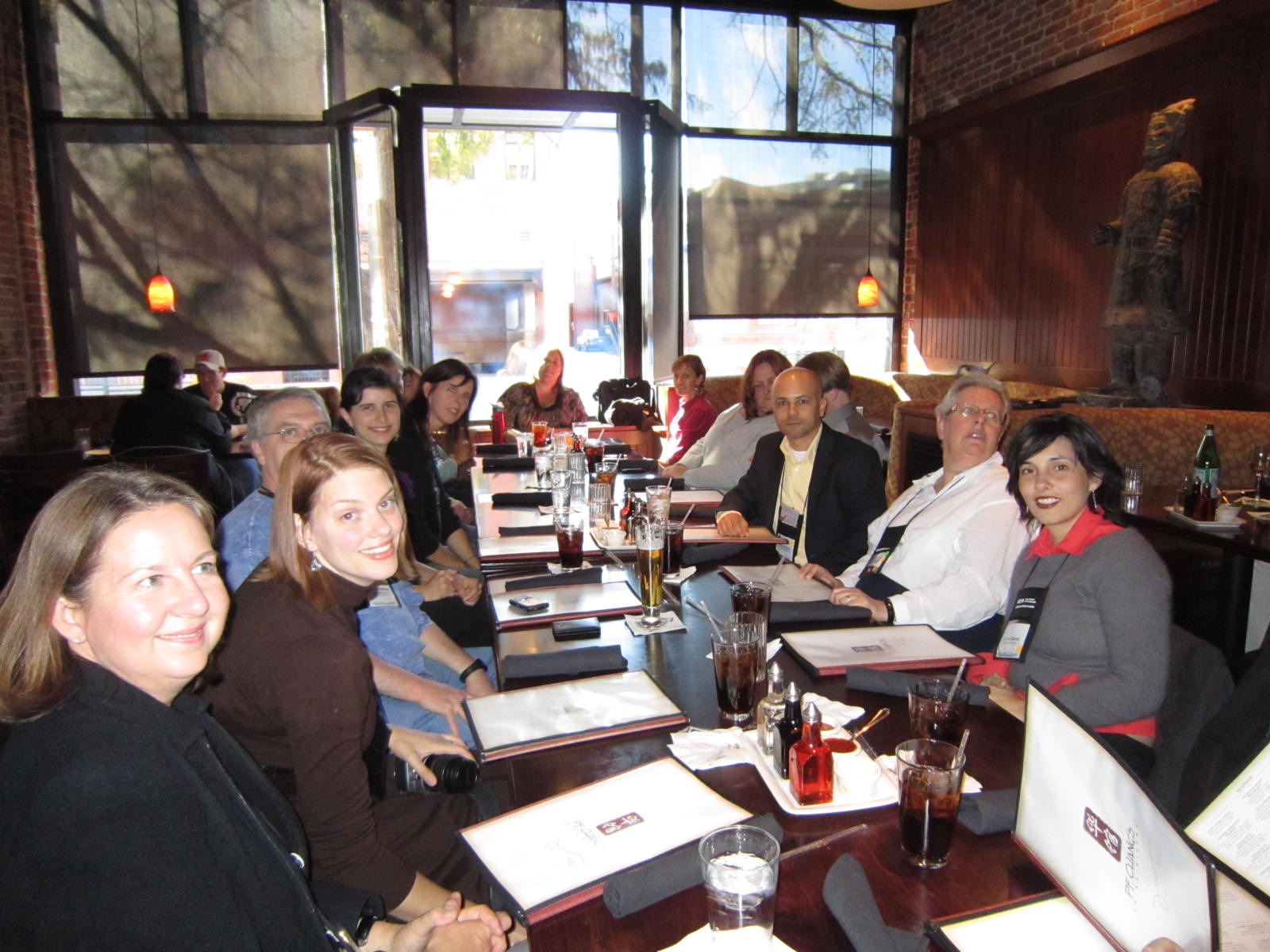
I would also like to thank all of you readers who joined us today. I hope you enjoyed talking with my fellow bloggers and perhaps were inspired to start your own blog or perhaps offer a guest post every once in a while. The most difficult part of blogging is coming up with new ideas for posts and keeping things fresh. By meeting you face to face I hope everyone walked away from this lunch with a deeper appreciation of the symbiotic partnership between blogger and readers.
Do you enjoy eating cabbages? October 21, 2010
Posted by Jill (@bonnjill) in Fun stuff, Translation.8 comments
One of the members of the ATA German Language Division shared an interesting blurb from the October 16-22, 2010 edition of the Feedback section in New Scientist with us, and I thought you might enjoy it as well. Thanks, Cantrell!
DO YOU enjoy eating cabbages? We’re not sure whether the teenager known online as binarypigeon does, but her mother tells us that when she wanted to test the limitations of online automatic translation systems, she typed the phrase “I enjoy eating cabbages” into one. She told it to translate this into Japanese – and then translate the resulting phrase back into English, and then translate that to another language, and then back to English, and so on.
After approximately 20 such translations, binarypigeon’s simple statement had turned into: “Therefore, that is eaten because of possibility of fact of thing of possible possibility, designated that and that of a certain specification regarding that reason being shown it becomes, is inferred or as been, because either one types, whether it has been shown the fact that possibility should do my cabbage to that of the reason of this type, either one should enjoy some dependence of the range hypothesis our appointments which are shown, whether, these of appointment of the appointment which is shown are done.”
In the light of this, Feedback hopes that international bodies like the United Nations will continue to rely on human translators rather than mechanical ones for a while.
Thanks Feedback and thanks binarypigeon! I think this example shows that machine translation still has a long way to go before it will ever be a viable option to replacing a human translator.
Blog lunch at the 51st ATA Conference October 14, 2010
Posted by Jill (@bonnjill) in ATA.14 comments
It’s that time of year again – the ATA Conference is upon us and with that the ever popular Blogger Lunch for fellow bloggers and those of you who read our blogs. Several people have been asking me about the lunch at the conference this year. Thanks for keeping me on track. I have become the Queen of Procrastination this year, and it is driving my sister crazy. Since Eve Lindemuth Bodeux and Corinne McKay are local I suggested they choose a spot. Eve suggested PF Changs on 15th and Market.
We have traditionally met for lunch on Thursday, the first day of the conference. We will meet in the lobby right at 12:40 or so. I will be presenting the First-Time Attendees presentation until 12:30. Feel free to meet me in the back of the room if you want to be sure to find me.
If you are interested in joining us, either add a comment or send us an e-mail so we can be sure to look for you.
You can’t get paid if you don’t invoice October 13, 2010
Posted by Jill (@bonnjill) in Business practices.14 comments
I know I touched on this subject back in August in my post entitled Operating as a business. It is so important to act like a business as a translator. As I said back then, “…we aren’t translating for the fun of it – or at least we shouldn’t be. I don’t know about you, but I have rent to pay, groceries to buy, a dog to feed, and bills that need to be paid. I am not in the business of working for free. I am absolutely aghast at some of my colleagues’ business practices.”
This morning I wrote one of my oldest and dearest clients to remind him that he hadn’t paid my last invoice. I usually have to remind him and then he pays it right away or responds that he transferred the money the day before (and is always telling the truth). It isn’t a big deal. I know he’s good for it. This time I waited a little longer to remind him (about 10 days), but it turns out that he didn’t have the invoice. I checked my out box, and it turns out I had failed to send it to him (not so surprising – it was a very chaotic time for me and I was “urlaubsreif” – in desperate need of a vacation).
When I wrote to apologize, I asked whether he had wondered where the invoice was since it was a big one for part two of a very big job. His response was:
Ach, ich hab mir abgewöhnt, mir um die Rechnungsfristen Gedanken zu machen. Eine Übersetzerin hat mal 14 Monate über 6000 Euro nicht abgerechnet, trotz mehrfacher Aufforderung. Ein anderer hat für ca. 2500 auch 9 Monate gebraucht … Irgendwann wundert einen nichts mehr. 🙂
A dirty translation of this is: “I’ve gotten out of the habit of thinking about invoice intervals. One [female] translator didn’t invoice over 6000 euros for 14 months, despite numerous requests. Another translator needed 9 months [to bill] approximately 2500. At some point nothing surprises you anymore.”
Wow, I guess some of our colleagues *are* translating for the fun of it…
I guess I shouldn’t be surprised, because I received an invoice from one of my subcontractors just the other day for work done in August. I’m going to say this again because it bears repeating – YOU CAN’T GET PAID IF YOU DON’T INVOICE. No wonder why some agencies have instituted policies saying they will not accept invoices for work not invoiced after a certain time (six months? a year?).
Business cards and resumes, oh my! October 1, 2010
Posted by Jill (@bonnjill) in Business practices, Marketing ideas.16 comments
I just ordered my business cards for the upcoming ATA Conference and am putting the finishing touches on my resume so that I can send it to Kinko’s. My friend Susanne is redesigning my website (hopefully in time to launch for the conference), and we have come up with a cool branding idea that builds off the template for my blog. My website will feature the sun and summer colors (get it? summer? Sommer? yeah, we’re clever like that 🙂 ), while the blog will feature the moon (since I’m overworked). I ordered business cards that tie in with the new website and will be ordering cards for the blog as well. I have always paired my resumes with the color of my website. Our field isn’t as stuffy, so I have always printed my resumes on a light blue paper to make them stand out from the typical off-white and cream resumes. This year I will be printing them on a light yellow paper that matches my new business cards. Resumes can be placed on the table in the Job Exchange of the Exhibit Hall. I use a plastic stand with built-in slots for matching clear business card holders so that my resumes do not get covered up by other resumes or separated from my business cards. You can find them at Office Max, Staples and most office supply stores.
All this conference preparation has reminded me that many of you new translators and those of you who have never attended an ATA conference may not be familiar with how we in the industry write our resumes. A resume is a one to two-page summary of our relevant skills, experience, and education. It must be brief  because the reader typically spends less than a minute reviewing its contents. You need to make sure your resume is concise, well written, and that the most important information that translation companies look for is immediately visible (such as your language pair(s) in bold or a larger font at the top under your name). You should also ensure that it does not contain anything that is irrelevant or unnecessary, such as the fact you worked at Borders (to use me as an example) or any other job that isn’t relevant to your chosen fields of specialization. If the jobs can prove your competence in a field (such as a stock broker, insurance agent or quality assurance rep at a company) then by all means include it.
The following suggestions are from “Resume Writing for Freelancers” by Beth Podrovitz and Jiri Stejskal, which was published in the February 2006 edition of the ATA Chronicle. I am not using the block quote tag, because it made the text look cluttered.
Here are some suggestions on how to make your resume stand out.
* Keep the document to one or two pages. Remember, this is a resume, not a CV. As such, it is important to summarize the most significant highlights of your professional skills that are relevant to the position you are applying for. A project or vendor manager’s time is limited. They spend only a few seconds looking at your resume to see if it is worthwhile to keep reading.
* Indicate your source and target languages. This information is important and having it clearly visible at the top makes it easier for project or vendor managers to find when they go looking for a specific language pair among the many resumes they have on file. If you translate more than one language, include it, but differentiate your strongest language pair from the others.
* Indicate your specialization. It is likely to be the second thing a project or vendor manager looks for on your resume. When looking for a particular area of expertise for a project, many translation companies use indexing and key word search tools to help them sift through the resumes on file. Having your specializations listed will help ensure that a word search leads to your resume. For example, if you are a German medical translator, make sure you list the words “German” and “medical.” If you are just starting out, you may not have substantial experience in a particular field, but it is still a good idea to indicate something you would like to specialize in and that you are actively pursuing.
* Submit your resume online, preferably in PDF format as an email attachment. A PDF file looks professional and can be viewed on different platforms without altering the fonts you use. It also indicates that you know how to create a PDF file, which many translation companies see as a valuable skill.
* List complete contact information. Make sure you include your mailing address, phone number, fax number, and an accurate email address that you check regularly.
* When saving your resume on the computer, use your last name for the filename. Don’t name your resume something generic like “U.S. resume” or “translator 1 .” This just makes good sense, especially when submitting your resume online, since translation companies will typically file an applicant’s material under their last name.
* Indicate your educational background in the proper place. If you graduated recently and do not have much work experience, make sure you emphasize your education. If you are an experienced translator or interpreter, you can move the education information to the end of your resume and emphasize your work experience instead.
* Provide relevant information only. For a freelance position, it is not necessary to show that there are no gaps in your employment history. You don’t need to write down that summer you spent pouring concrete or waiting tables, unless perhaps you were waiting tables at a cafe in Paris or Madrid.
* Indicate your experience with computer-aided translation (CAT) tools and whether you use such tools on a regular basis. Do you own and are you proficient in the use of a particular tool, such as TRADOS 7 Freelance? If the answer is yes, make sure it is reflected on your resume. Make sure you list specific CAT tools, since this is another area where translation companies use indexing and key word searches.
* Provide information on your desktop publishing (DTP) capabilities. Skills in using DTP applications such as InDesign or QuarkXpress are good to have, as they might set you apart from other translators.
* Proofread your resume thoroughly and have others proofread it. This is particularly important if your native language is not English. Of course, even native English speakers are not immune to typos and poorly worded English. Remember, you have designed your resume as a tool for selling your linguistic skills. If a resume is not flawless, your capabilities will appear questionable.
* Include relevant association memberships and credentials, such as ATA certification.
* Update your resume frequently. Sending out an updated resume is a good excuse to make additional contacts with translation companies. This will also help to keep your name fresh in the minds of prospective clients.
Things to Avoid
* Don’t use colors, photos, word art, and graphic images unless you have a good reason to do so (such as using your logo).
* Don’t state your date of birth, number of children, marital status, or other similar personal information. This is a common practice in other countries, but is not advisable for U.S. resumes.
* Don’t include an objective that is too broad. It is not necessary to state your objective at all if it is clear from your cover letter (which will typically take the form of an email message that you send with your resume attached) that you are a freelance translator or interpreter who wants to work with a translation company as an independent contractor. If you choose to include an objective, be sure to be concise. Do not make sweeping statements such as “To gain experience as a translator” or “To use my foreign language skills.”
* Don’t provide a list of your dictionaries. You can provide this information if requested, together with other resources you are using.
* Don’t describe your hardware and don’t list standard software applications such as MS Office. It is assumed that you already know how to use these programs, and the reader will wonder why they are listed. However, you might want to mention which platform(s) you are using, especially if you are a Mac user.
* Don’t leave the Track Changes feature on in Word. This may seem obvious, but the number of resumes submitted with tracked changes visible is surprisingly high. Though it is a good source of office ridicule, it is not a good way to present yourself to a potential client. Check your view settings and make sure you see what you want everyone else to see. This blooper can be easily avoided if you submit your resume in PDF format as suggested earlier.
* Don’t leave unused generic fields when using a template. Resume templates are fine to use, though they are fairly obvious to a reader who has seen hundreds of resumes. There is nothing wrong with using a template, provided it is appropriate for your purpose and is correctly customized to suit your needs.
* Don’t submit your resume in nonstandard applications, such as MS Publisher.
* Don’t include your rates. Of course, it is important that the project manager knows what you charge, but your resume is not a good place to provide such information. It is a good idea to submit a separate document containing your rate information, or to include such information in an accompanying message (or cover letter).
* Don’t use silly or unusual fonts. Use a common font like Arial, Helvetica, Times, or Times New Roman.
* Don’t use acronyms. Most of us know what ATA stands for, but standard resume writing suggests you spell out all proper names. If the name occurs more than once on your resume, it is fine to use an acronym for subsequent occurrences.
* Don’t write “references available upon request.” You can provide references in a separate document or in your cover letter.
* Don’t submit hard copies. While a paper resume can be printed on fancy paper and look impressive, it is the content, not the form, that is important to the project or vendor manager. More importantly, a digital resume is searchable and does not take up physical space.
* Last, but certainly not least, don’t make things up—be truthful and accurate.
Most translation companies receive resumes on a daily basis and have thousands on file. Because your resume is one of many, you need to make sure you use other marketing tools, in addition to providing a resume, to establish a relationship with a translation company. Examples include follow-up communication and networking at events attended by translation companies, such as a social function at a professional seminar hosted by ATA or another industry association.
Having a professional resume is an absolute must for a freelancer who wants to do business with a translation company. Investing time and effort in getting it right will lead to new business and a successful career.
Tomorrow’s International Translation Day September 29, 2010
Posted by Jill (@bonnjill) in Translation.5 comments
International Translation Day is celebrated every year on September 30th – on the feast day of St. Jerome, the Bible translator who is considered as the patron saint of translators. This year there is apparently a big ProZ.com virtual conference going on. Has anyone attended and can vouch that it is a good thing? Since it’s a ProZ thing I’m not all that inclined to participate. But I do have an open mind and would love to hear others’ opinions on it.
Instead I will be translating and hopefully taking some time off to read a good book on the couch. With the weather cooling down it is starting to be my favorite time of year – Fall – when there is nothing I enjoy more than cuddling on the couch with a mug of chai and a good book. This year I have a cat to cuddle on me. She got spayed on Monday and is feeling extra-clingy. Should be a good day. Happy International Translation Day tomorrow, everyone!


 Musings from an overworked translator